

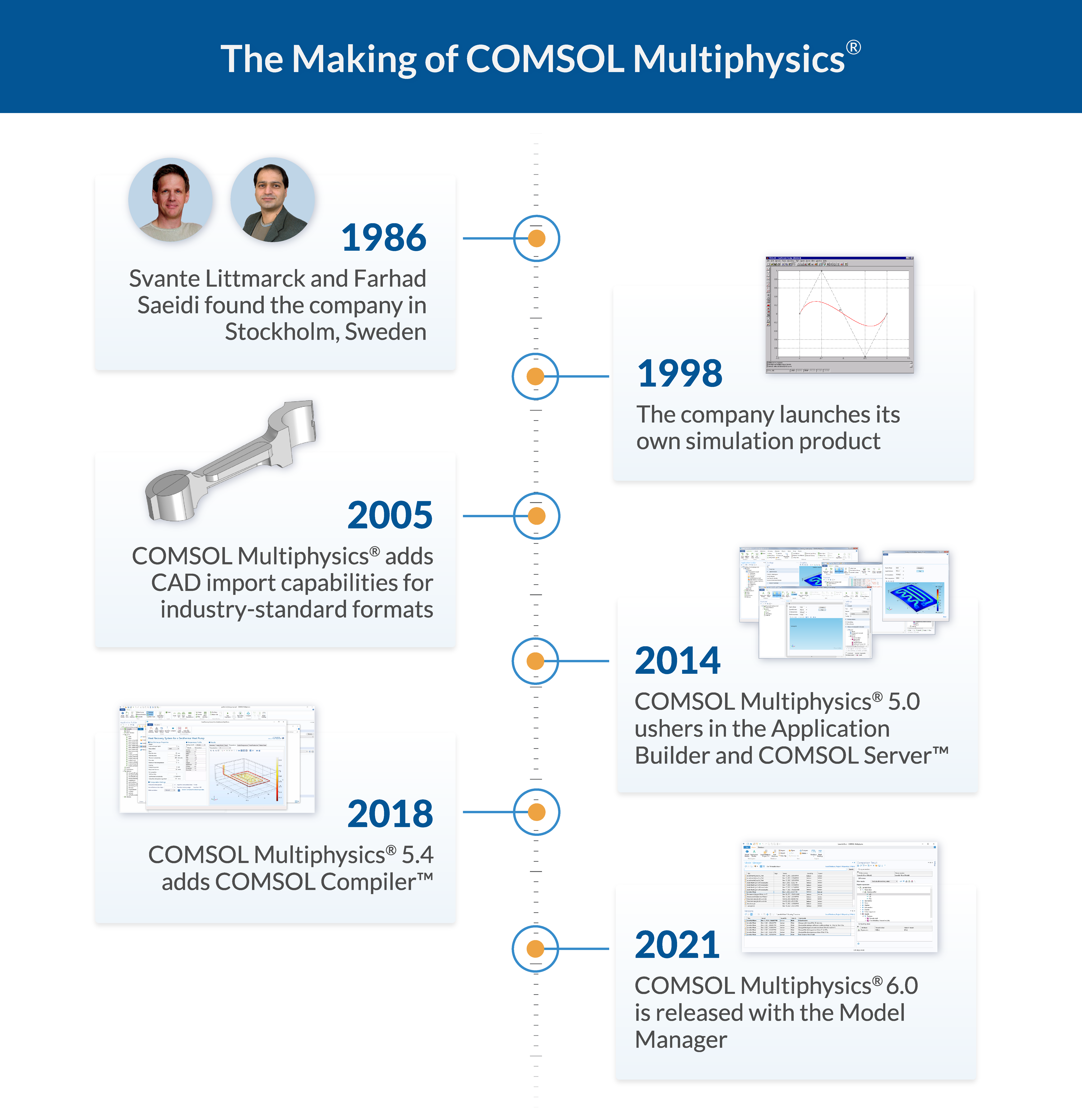
In 1986, COMSOL was founded to help engineers, researchers, and innovators solve complex design challenges and bring their best ideas to life through simulation. Now, 40 years later, that goal remains unchanged. In honor of this important anniversary, we want to highlight our journey and how the COMSOL Multiphysics® software has evolved.
COMSOL Origins and Software Evolution
COMSOL AB was founded in Stockholm by Svante Littmarck and Farhad Saeidi. The company was originally the distributor of MATLAB® software for all Nordic countries, but it grew into an independent entity in 1998 with its own software release.
“Svante and Farhad were grad students who believed mathematical modeling software was going to be something that engineers and scientists would need in the future,” said Bernt Nilsson, president of COMSOL, Inc. “They were right, and they built a sales organization in the Nordic countries and then released the company’s first multiphysics simulation software package.”
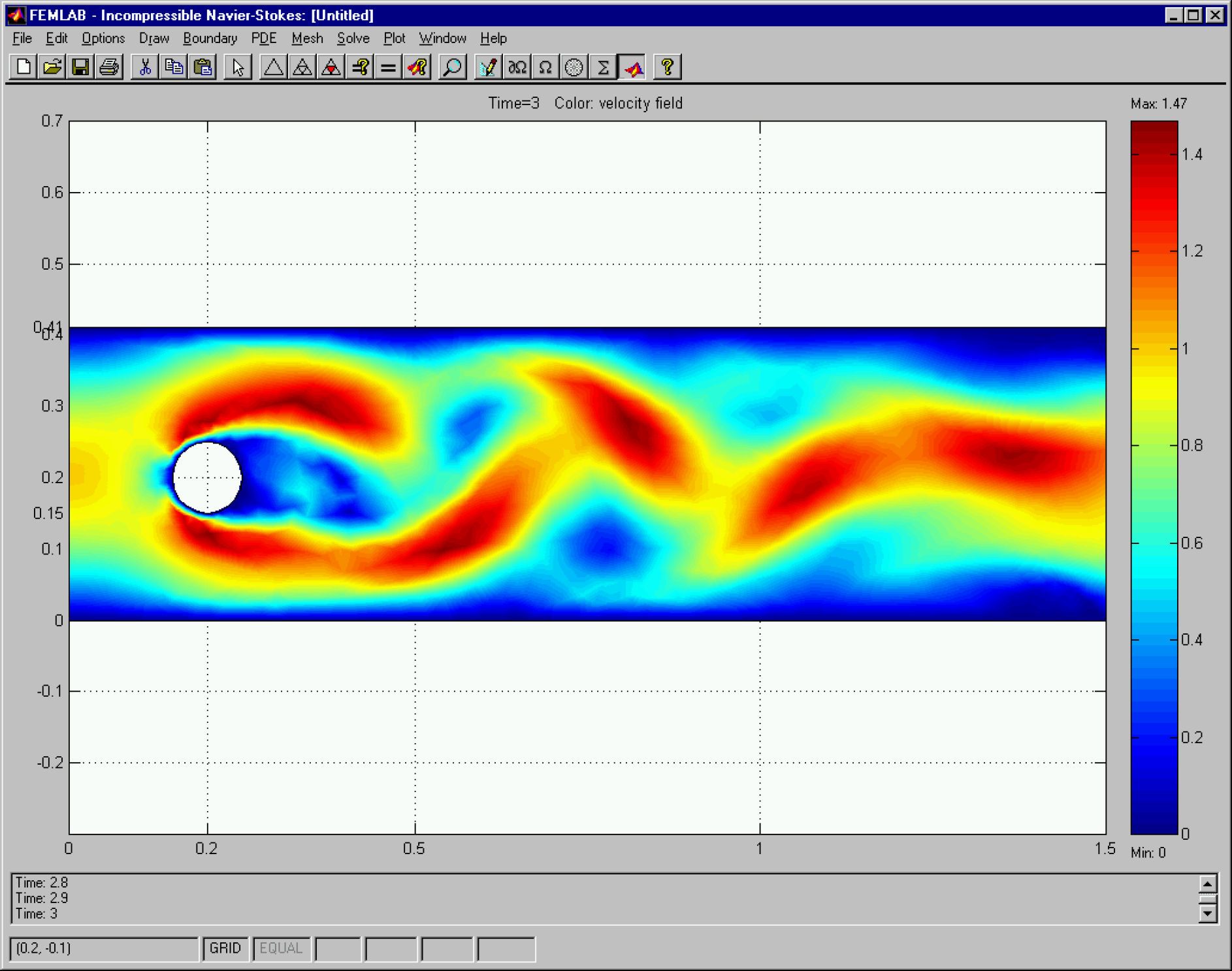
A CFD model from the first version of COMSOL Multiphysics®.
COMSOL Multiphysics® is a physics-based modeling and simulation platform used to predict how devices, processes, and systems behave under real-world conditions. It brings together multiple interacting physical phenomena in a single model and solves the underlying mathematical equations within a unified modeling environment. Advances in numerical methods, such as the finite element method, made it possible to apply these techniques to complex engineering problems involving realistic geometries, materials, and physical effects.
“These solutions did not happen by software alone,” said Svante Littmarck, CEO of COMSOL Group. “Moore’s law gave us rapidly increasing computer power, and at the same time, numerical algorithms improved a lot. Together, this meant that many previously out-of-reach problems could be solved. Once results such as stresses, temperatures, flows, electromagnetic fields, and chemical concentrations could be seen, simulation became not only a calculation tool but also a design tool.”
2000 to 2009: Independence and Growth
With independence came growth and change. COMSOL established its first additional offices in the United States and the United Kingdom in the late 90s and early 2000s, respectively. Additional locations were added across Europe through the 2000s, with offices in Germany, France, the Netherlands, and Switzerland.
This period introduced versions 1.2 through 3.5a. Our developers also created some of our users’ favorite modules, including the AC/DC Module, Acoustics Module, and Heat Transfer Module, as well as the Material Library.
This era also saw the release of the first edition of COMSOL News, our annual user-focused magazine that includes stories of how engineers and researchers use COMSOL Multiphysics® in their daily work. The publication highlights how the software is being used in the development of batteries, loudspeakers, aerospace systems, medical devices, and many other areas.
Additionally, in 2005, COMSOL held a conference in Cambridge, Massachusetts, and in Las Vegas, Nevada. This conference offered a space for COMSOL staff and users to meet in person and discuss modeling and industry trends.
2010 to 2019: Software Improvements and Simulation Apps
The next era of COMSOL saw a focus on enhancing the software and extending the reach of simulation.
We released our LiveLink™ set of products, including LiveLink™ for MATLAB® and LiveLink™ for AutoCAD®, as well as numerous add-on modules, including the Battery Design Module, Nonlinear Structural Materials Module, and Semiconductor Module.
The software underwent significant change during this decade, with major additions that remain to this day. The Model Builder was introduced in version 4.0 and is the central workspace for building simulation models. In this workspace, users can define the geometry, materials, physics, mesh, studies, and results using the structured, easy-to-follow workflow. Like the rest of the COMSOL Multiphysics® user interface, it has the same appearance and organization regardless of the engineering application or physical phenomena being modeled.
Introduced in version 4.2 was the Physics Builder, a graphical environment in which users can create physics interfaces through an interactive user interface without writing code. It is used extensively in the development of the COMSOL add-on modules.
Version 5.0 brought users the Application Builder, which provides a workspace for creating and maintaining custom simulation apps based on COMSOL models.
In 2014, version 5.0.1 introduced COMSOL Server™, which enables organizations to deploy, manage, and run simulation applications built by their in-house simulation experts. Users can then manage and distribute the apps, control who has access to them, and run the apps from a web browser on any computer.
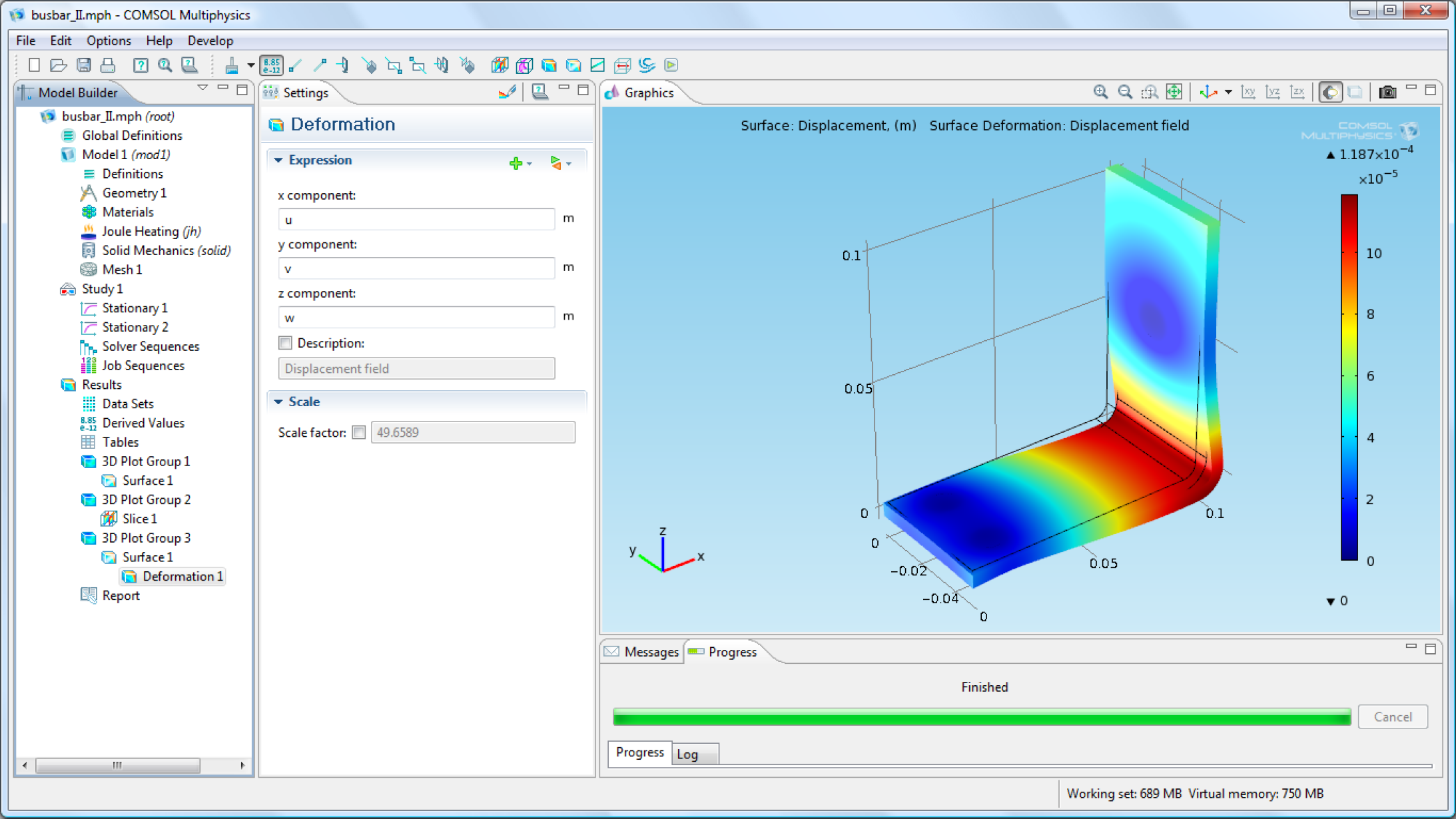
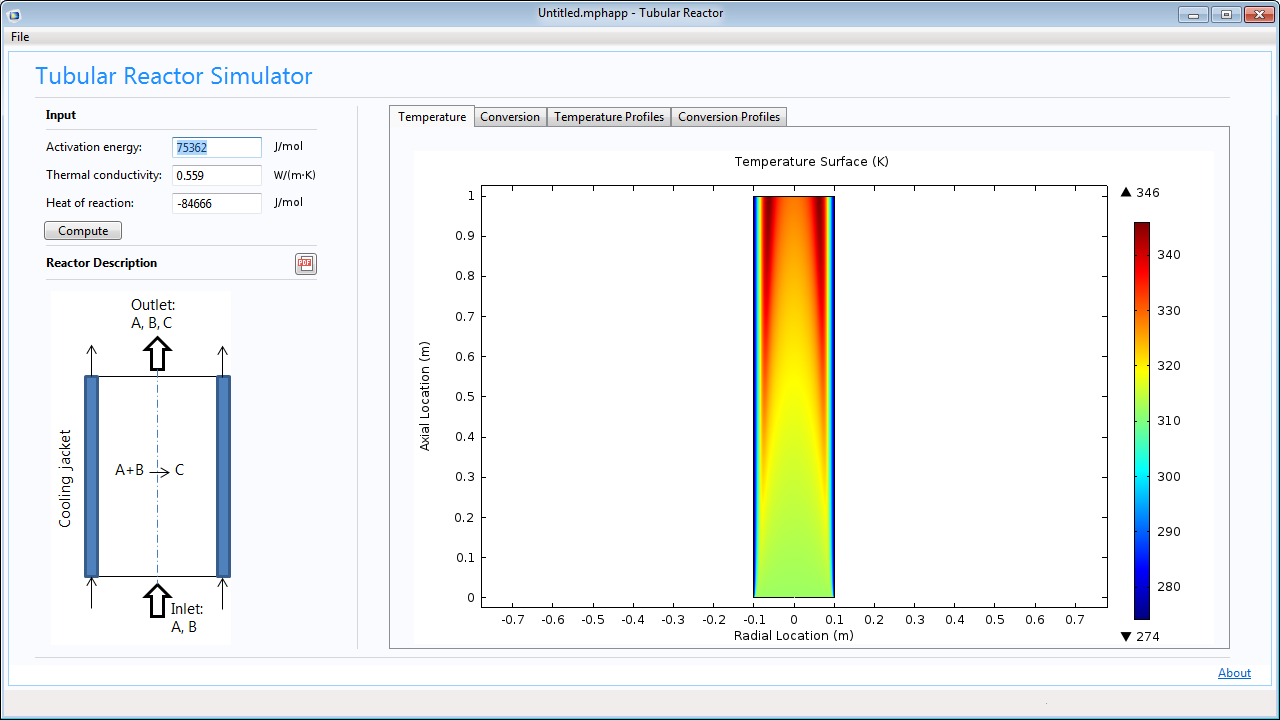
The Model Builder when it was first released in 4.0 (left) and an example simulation app from 5.0 (right).
In 2018, COMSOL Compiler™ was also added to the COMSOL product suite. This product enables users to compile their simulation apps into standalone executable files that can be run with or without internet access and with or without COMSOL licenses. Users can distribute these files for free or charge a fee.
 During this same time period, we continued to grow by adding offices in China and India, and in 2013, we held the COMSOL Conference in Boston, Massachusetts; Bengaluru, India; and Rotterdam, the Netherlands.
2020 to 2026: Simulation Democratization and Acceleration
The 2020s have seen a greater democratization of simulation and an emphasis on reducing solving times for complex models. With version 6.0, we introduced the Model Manager, which enables colleagues to collaborate and centrally organize their custom models, apps, reports, presentations, and other project assets within simulation projects. Version 6.2 introduced a new surrogate model framework that enables users to create compact models that reconstruct simulation results in a fraction of a second. These surrogate models enable fast simulation apps, accelerate optimization and uncertainty quantification, and support the development of effective digital twins. This release also improved the speed of solving CFD models by up to 40%.
In version 6.3, GPU acceleration was added, offering up to 25x faster acoustics simulations and surrogate model training. This version also introduced the Java Shell window, an interactive environment for developing and modifying models using the COMSOL API. An optional AI-powered chatbot window can assist users with Java programming, model development, and many other aspects of using COMSOL Multiphysics®.
These updates bring us to the latest and most powerful version of our software: 6.4. This version features solver performance that is greatly enhanced through the NVIDIA CUDA® direct sparse solver (cuDSS) for NVIDIA GPUs, providing several-fold speedups for both single-physics and multiphysics simulations.
A 40× speedup in a wave-based room acoustics simulation enabled by NVIDIA cuDSS.
With this version, we also released the Granular Flow Module, which enables the simulation of granular materials by modeling the motion and interaction of individual particles in bulk solids processes.
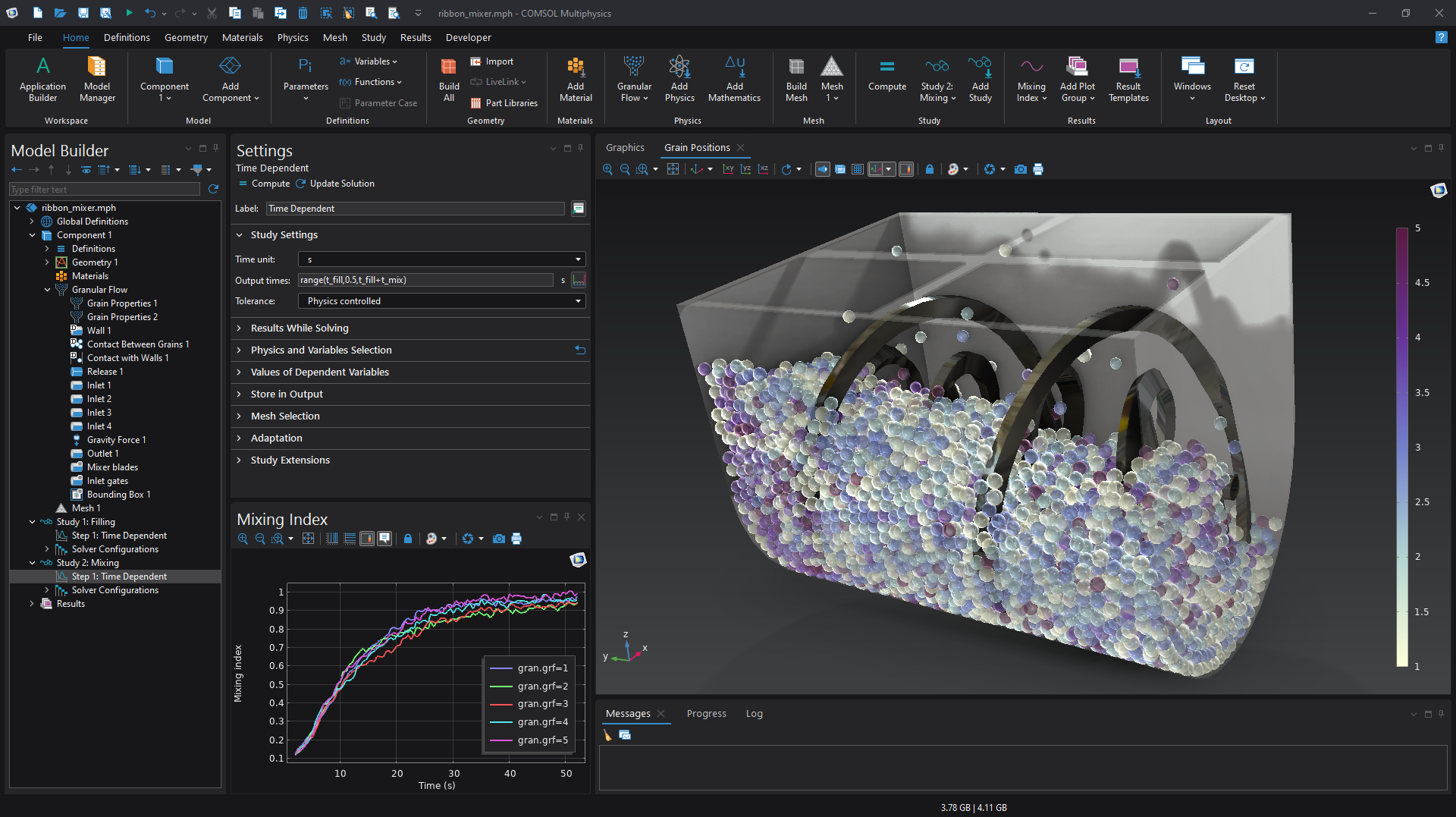 A ribbon mixer model created with the Granular Flow Module, released with version 6.4.
This year, we are continuing to focus on highlighting our users’ innovations. We recently published the 2026 edition of COMSOL News, which features, among other organizations, Volvo Trucks and Resolvent, UK Fusion Energy, and the Technical University of Denmark. Additionally, the COMSOL Conference continues to be a staple for us and the simulation community, with this year’s tour including stops in Cambridge, UK; Boston; Tokyo; Shenzhen; Bengaluru; Málaga; and Taipei. The conference highlights the work of our users through posters, papers, and live presentations, and attendees are able to hear from industry leaders and learn more about modeling. (If you want to learn more about the 2026 COMSOL Conference tour, click here.)
Moreover, in 2026, we hosted our inaugural Simulation Summit in Santa Clara, California. This one-day event brought together engineers and researchers to attend technical sessions, keynote sessions on how leading organizations are using multiphysics simulation, and a panel discussion where experts discussed the future of simulation tools.
The People Who Drive COMSOL
COMSOL has grown to 16 offices worldwide. “Our employees built everything,” said Littmarck. “We have more than 650 people, and we need every single one. Everybody is contributing.”
 Attendees at the COMSOL Conference 2017 Rotterdam.
 The COMSOL team in the US celebrating COMSOL's 40th anniversary.
 Conference guests at the COMSOL Conference 2014 Boston.
 COMSOL's Walter Frei presenting at an internal event in 2016.
 COMSOL staff at the International Microwave Symposium (IMS) 2026 in Boston.
 Svante Littmarck of COMSOL and Katie Gandomi of WPI, who won a Best Paper award and a Best Poster by Popular Vote award at the COMSOL Conference 2019 Boston.
 A group at COMSOL's Simulation Summit in Santa Clara, California.
 Attendees exploring the exhibition hall at the COMSOL Conference 2025 Amsterdam.
 The COMSOL team in the Netherlands celebrating.
 Our booth at this year's Optical Fiber Communication (OFC) conference in Los Angeles, California.
 A Q&A session at the COMSOL Conference 2017 Boston.
 The COMSOL team in Germany celebrating COMSOL's 40th anniversary.
  Lunch on the riverside lawn at the COMSOL Conference 2016 Boston.
 COMSOL employees at the Consumer Electronics Show (CES) 2026 in Las Vegas.
 From left to right: Farhad Saeidi, Ed Fontes, Lars Langemyr, and Svante Littmarck at an internal event in 2014.
 The COMSOL team in Japan at a company outing.


Throughout our many years and the growth of our company, our vision has remained the same: to empower users with the tools they need to improve their designs and processes and bring their ideas to life.
In the age of AI and advanced computing, we are excited about what the future has in store, but we also know that whatever comes next will be shaped by the people who make it all possible: our users and employees. “It’s been an amazing 40 years,” said Nilsson, “but when I think about it, the best is yet to come.”




Comments (0)