Semiconductor Devices Blog Posts

Modeling Thin Conductors Using the Magnetic Field Formulation Interface
Learn how to use the Magnetic Field Formulation interface to model very thin conductors with nonlinear constitutive relationships as boundary conditions.

Accelerating Semiconductor Manufacturing Simulation with NVIDIA cuDSS
Modeling semiconductor manufacturing processes can require detailed geometries, fine meshes, and coupled physics. These complexities can often lead to high simulation times. Learn how NVIDIA-accelerated computing can reduce computation time for these high-fidelity simulations!

Modeling a THz Photoconductive Antenna with COMSOL Multiphysics®
Photoconductive antennas are commonly used in terahertz engineering. Learn how these devices work and how to model one with the Semiconductor Module and RF Module.

Preconditioning of Surface-Mount Devices for Reliability Testing
Explore how modeling and simulation can be used to analyze the thermal stress and hygroscopic swelling of a surface-mount device through the 3 preconditioning stages.

Developing Better Resonators for CMOS Technology
Sub-GHz technologies are used by the billions for home automation, infrastructure monitoring, and more. This growing demand calls for optimally designed RF filters and resonators.

Can COMSOL Multiphysics® Solve the Hydrogen Atom?
In this blog post, you’ll get an introduction to quantum mechanics and learn how to model the hydrogen atom.
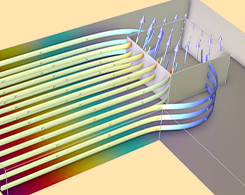
Extracting Specific Contact Resistivity with a Benchmark Model
You can now add contact resistance to metal contacts using the Semiconductor Module. In this blog post, we’ll explore a benchmark model that takes advantage of this new functionality.

Optimizing Solar Cell Designs with a Simulation App
The SolCelSim app, designed by an MSc student at the University of Zilina, enables researchers to simulate solar cell designs, even if they are unfamiliar with simulation software.