
Blog Posts Tagged Structural Mechanics Module
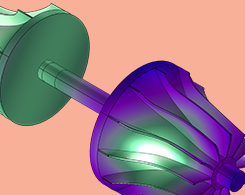
Evaluating a Turbocharger Design with Rotordynamics Analysis
Like a “turbocharged” cup of coffee, an actual turbocharger also increases speed, but in the operation of a combustion engine, not how fast your morning cup wakes you up.
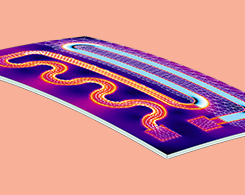
How to Provide Structural Stability in Thermal Expansion Simulations
Say you want to compute thermal expansion and stresses in an object, but you don’t know what constraints you need. That’s where the Rigid Motion Suppression feature comes in.
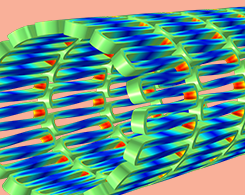
The Elephants of Materials Science: SMAs Never Forget Their Shape
Learn about the history and use cases of shape memory alloys such as nitinol. You can also model the phase transformation of these unique materials in COMSOL Multiphysics®.
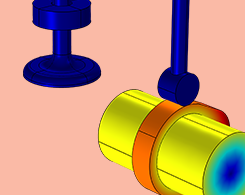
How to Model a Cam-Follower Mechanism
Watch a series of animations that show the different types of cam-follower mechanisms before learning how to model them in COMSOL Multiphysics®.
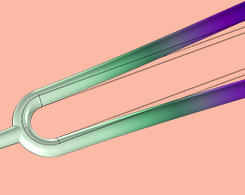
Finding Answers to the Tuning Fork Mystery with Simulation
If you strike a tuning fork and hold it against a tabletop, the peak frequency of the emitted sound doubles. Is there a physical explanation for this “tuning fork mystery”?

Advancing Additive Manufacturing with Sequential Simulations
In some ways, additive manufacturing is like sewing or weaving. We talk to a professor of additive manufacturing about how sequential simulations can be used to analyze and optimize the process.
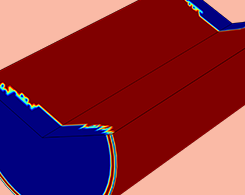
Analyzing Triaxial Testing Methods for Geomechanics
Triaxial testing of soil is important when determining the structural stability of a tunnel, dam, or building. Geomechanics simulation can help ensure that triaxial testing methods are up to par.

Analyzing Vehicle Suspension with Multibody Dynamics Modeling
How much damage can a pothole do to a car? Automotive engineers can set up lumped mechanical systems in COMSOL Multiphysics® to analyze vehicle suspension technology.
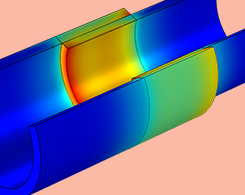
Optimizing the Interference Fit Between 2 Pipes with Structural Analyses
The interference fit between 2 pipes can’t be too tight or too loose. Like the porridge in the “Goldilocks and the Three Bears” story, it has to be just right.
How to Model Roller Bearings in COMSOL Multiphysics®
Roller bearings are one of the most commonly used industrial components, found in gearboxes, conveyors, motors, and rolling mills, among other devices. Learn how to model this part in COMSOL®.
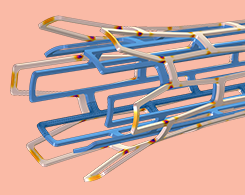
Analyzing the Deformation of a Biomedical Stent with Simulation
By studying deformation in an arterial stent, biomedical engineers can account for unwanted effects like dogboning and foreshortening long before the device is ever implanted.
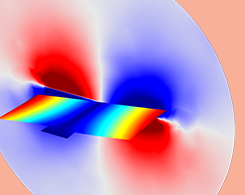
Analyzing the Viscous and Thermal Damping of a MEMS Micromirror
Micromirrors are efficient and inexpensive. Here, we go over 2 types of analyses for a MEMS micromirror design, frequency-domain and transient, using the COMSOL® software.
Applying and Interpreting Saint-Venant’s Principle
Saint-Venant’s principle is found in most structural engineering textbooks, but what is its exact meaning? We go over its history, definition, and relevance to mechanical analyses.

Model Deforming Objects with the Arbitrary Lagrangian-Eulerian Method
The combined efforts of Leonhard Euler and Joseph-Louis Lagrange inspired the arbitrary Lagrangian-Eulerian (ALE) method, which we can use to model deforming objects.
Analyzing the Mechanical Behavior of Cells for Biological Applications
Finite element modeling can be used to analyze the mechanical behavior of biological cells. Guest blogger Björn Fallqvist of Lightness by Design sheds light on this bioengineering topic.
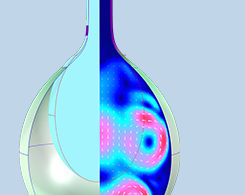
How to Model Fluid-Structure Interaction in a Water Balloon
They’re not just for playing games in the backyard: Water balloons are also an example of fluid–structure interaction in a nonlinear elastic material. Learn how to model this effect…
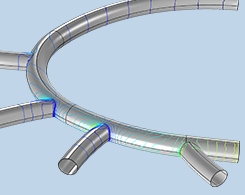
Analyzing Magnetic Flowmeters for Blood Flow Measurement
Biomedical researchers used multiphysics modeling in order to understand how blood vessel movement influences the sensitivity of their flow meter designs. Get the full story here.

Keynote Video: Modeling the Multiphysics Behavior of Nuclear Fuel
A laboratory engineer discusses using multiphysics simulation to understand the complex and challenging behavior of nuclear fuel. Watch his presentation and get a quick summary here.
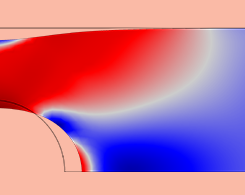
How to Implement Elastoplasticity in a Model Using External Materials
Sometimes the mechanical behavior of a material is not readily expressed in terms of a built-in model. In these cases, you can use external materials. Learn how with an elastoplasticity example.
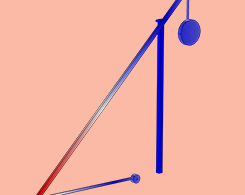
What Is the Physics Behind a Counterweight Trebuchet?
A counterweight trebuchet, a siege weapon commonly seen in movies set in the Middle Ages and fantasy worlds, also happen to be an interesting multibody dynamics problem.
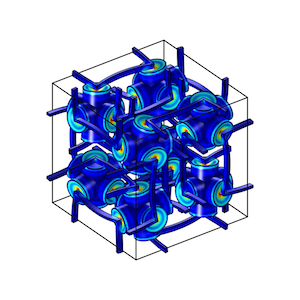
Analyzing a Unique Poroelastic Metamaterial with Simulation
This blog post combines the subjects of 3D printing and metamaterials, featuring a group that used simulation-based research to analyze a unique poroelastic metamaterial.
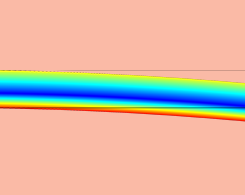
How to Model Generalized Plane Strain with COMSOL Multiphysics®
Learn how to use the generalized plane strain formulation in COMSOL Multiphysics® in order to model elongated structures that are free to extend in the out-of-plane direction.
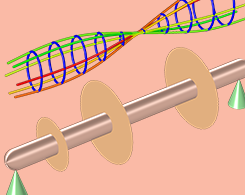
How to Perform Various Rotor Analyses in the COMSOL® Software
Check out all of the different types of rotor analyses you can perform using the specialized features in the Rotordynamics Module, an add-on to COMSOL Multiphysics®.
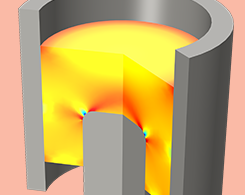
Simulating Powder Compaction with Porous Plasticity Models
Powder compaction is an important and popular technique in many manufacturing industries. You can use porous plasticity models to analyze and improve the powder compaction process.


