
Blog Posts Tagged Structural Mechanics Module

Detecting Corrosion in Embedded Pipelines Using Simulation
A new approach uses guided waves excited by EMAT-based systems to detect corrosion in embedded pressure pipelines. Let’s analyze the guided waves using simulation.

Modeling a Solid-State Battery Cell in COMSOL Multiphysics®
Solid-state batteries offer advantages over lithium-ion batteries, making them promising technology for electric vehicles. Simulation can help battery developers investigate design challenges.

Analyzing the “Muscles” of a Robotic Manta Ray
Robotic manta rays allow scientists to gather data for marine biodiversity studies. Find out how simulation can be used to analyze the “muscles” of these soft robots.

Modeling Electromigration in COMSOL Multiphysics®
Computers, smartphones, and other devices rely on integrated circuits. Over time, an interconnect can experience damage due to electromigration. Explore how to model this phenomenon here.

Understanding Different Types of Interaction Curves
What would be the effect if you combine 2 or more independent sources? In this blog post, we introduce interaction curves and discuss how they can be used to help answer this question.

How to Test Numerical Material Models in COMSOL Multiphysics®
Understanding the physical behavior of a material can be achieved with material models. Get an in-depth introduction to testing material models in COMSOL Multiphysics® here.

Preconditioning of Surface-Mount Devices for Reliability Testing
Explore how modeling and simulation can be used to analyze the thermal stress and hygroscopic swelling of a surface-mount device through the 3 preconditioning stages.
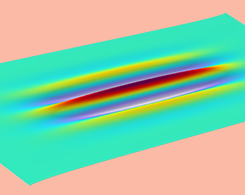
Modeling Wrinkling with COMSOL Multiphysics®
Wrinkling is important for space engineering, mechanical engineering, and bioengineering. See how to analyze the underlying mechanism of wrinkling with nonlinear structural materials modeling.
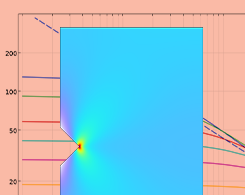
How Should I Evaluate Singular Stress Fields?
Explore the properties of singular stress fields and see some possible approaches for evaluating them in COMSOL Multiphysics®.
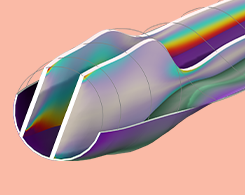
Introduction to the Composite Materials Module
Explore the Composite Materials Module, an add-on to COMSOL Multiphysics® that includes specialized functionality for modeling layered composite structures.
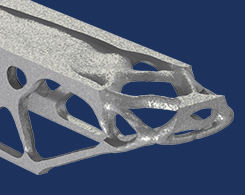
Maximizing Eigenfrequencies with Shape and Topology Optimization
Mechanical resonance can cause fatigue problems in machines. See how to mitigate unwanted resonance with shape and topology optimization.
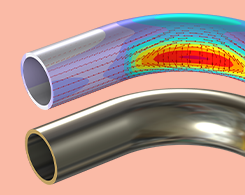
The Intriguing Stresses in Pipe Bends
Explore beam theory, the classical beam equations, and the various features in COMSOL Multiphysics for analyzing complex piping systems.
New Functionality for Buckling Analysis in COMSOL Multiphysics®
COMSOL Multiphysics® version 6.1 introduces functionality for handling a combination of fixed and varying loads in a buckling analysis. Get the details here.
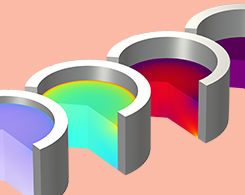
Simulating the Pharmaceutical Tableting Process
Powder compaction is widely used in the pharmaceutical industry due to its high flexibility and control over quality. Here, we explore this process with the Capped Drucker-Prager model.
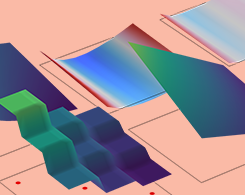
How to Evaluate Stresses in COMSOL Multiphysics®
Get a comprehensive introduction to evaluating various stress quantities in COMSOL Multiphysics®.
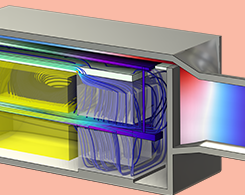
Modeling Speaker Drivers: Which Coupling Feature to Use
Explore how to model 4 different speaker drivers, including moving-coil transducers, balanced armature receivers, piezoelectric drivers, and electrostatic drivers.
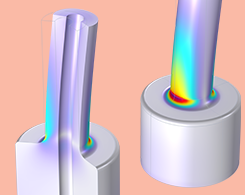
Axisymmetric Solid Mechanics with a Twist
As of version 6.0, you can easily include circumferential displacements in 2D axisymmetric models using the Solid Mechanics interface. Check out one example here.
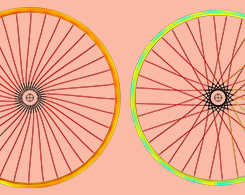
Why Do Road and Mountain Bikes Have Different Spoke Patterns?
Why do some bicycle rims come with warnings? Why do some bicyclists prefer rim brakes? To find answers, we model the forces in a bicycle rim for different brake types and spoke lacing patterns.
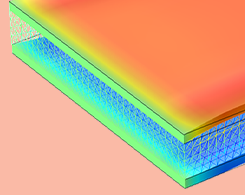
Modeling Piezoelectricity: Which Module to Use?
Acoustics Module, MEMS Module, Structural Mechanics Module: Which one should you use for your piezoelectric device modeling? Get a comprehensive overview of your options here.
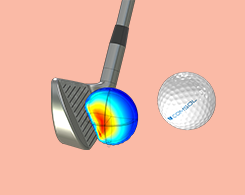
Fore! Analyzing the Performance of a Golf Ball with Simulation
Did you know that golf balls were originally made out of wood? We discuss the evolution of the golf ball and how simulation can be used to analyze modern golf ball designs.

The History and Science Behind Vinyl Records
As vinyl records explode in popularity, we take a look back at the history of records, as well as the interesting science behind how they are produced — and how they play music.
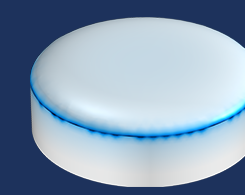
Curve Fitting of Solution Data in COMSOL Multiphysics®
We discuss curve fitting of continuous solution data, the concept of orthogonality, and how to fit solution data to a set of orthogonal functions for a simple and convenient postprocessing operation.
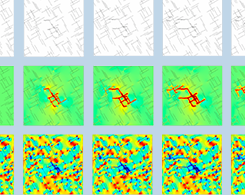
Fully Coupled Hydromechanical Modeling of Fractured Media
Dr. Qinghua Lei of ETH Zürich demonstrates a novel method for modeling fully coupled hydromechanical processes in fractured media with 2 examples: fluid injection and underground excavation.
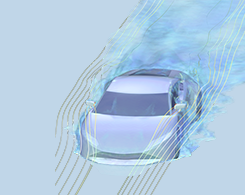
Simulating Wind Load on a Sports Car’s Side Door and Mirror
Vroom vroom: In this blog post, we use large eddy simulation (LES) and structural analysis to analyze wind loads and airflow on the door and side mirror of a sports car driving at high speeds.


