
Blog Posts Tagged Structural Mechanics Module
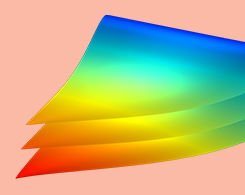
Verification Model: Postbuckling Analysis of a Spherical Cap
Think about what happens to a soda or beer can when you crush it. This phenomenon is called buckling, in which compressive stress causes sudden failure in a structure.

Defying Gravity with a Realistic Acoustic Levitator Model
It’s not just science fiction: Objects really can levitate. 1 way this is possible is by using sound waves to lift and suspend particles midair. Simulation can broaden the use of this technology.
Modeling Multi-Ply Materials with Composite Materials Technology
In a follow-up to a previous blog post on paper mechanics modeling, Eric Linvill of Lightness by Design compares 3 methods of analysis for multi-ply materials such as paperboard.
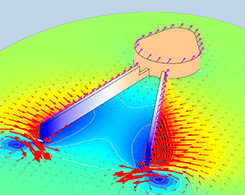
Modeling Fluid-Structure Interaction in Multibody Mechanisms
To model advanced FSI scenarios, such as swimming mechanisms or airflow around a wind turbine blade, you can use the Fluid-Structure Interaction, Pair multiphysics coupling.
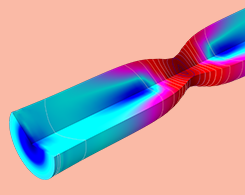
Evaluating the Necking of an Elastoplastic Metal Bar Benchmark Model
To determine the strength of elastoplastic materials, engineers often use uniaxial testing to analyze necking instability. This benchmark model proves that simulation is also a reliable method.
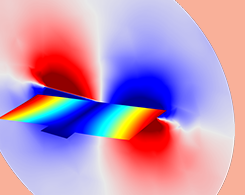
How to Model Different Types of Damping in COMSOL Multiphysics®
Structural dynamics analyses can be difficult if you have to account for damping. Get a demonstration of how to use the different numerical models for damping in COMSOL Multiphysics. Part 2 of 3.
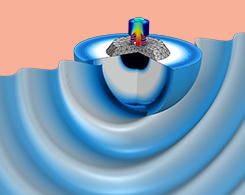
Damping in Structural Dynamics: Theory and Sources
Here’s your introduction to the theory behind damping in vibrating structures, as well as its sources, including internal losses, friction, sound emission, and more. Part 1 of 2.
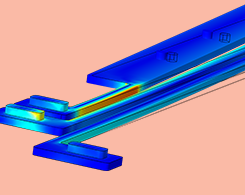
Performing a Multiphysics Analysis of a Thermal Microactuator
To design an optimized thermal microactuator for use in a specific device, you need to account for tightly coupled electrical, thermal, and structural phenomena in your analysis.
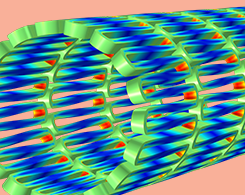
Analyzing an Arterial Self-Expanding Stent with COMSOL Multiphysics®
Interested in bioengineering? Read this overview of a self-expanding arterial stent modeled in COMSOL Multiphysics® with an implemented shape memory alloy material.
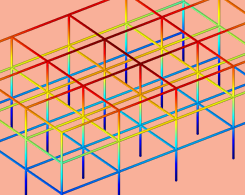
How to Perform Structural Analyses Using Shock Response Spectra
Mechanical engineers: Learn how to find shock response spectra, use combination methods for eigenmodes, perform missing mass correction, and display your results with the COMSOL® software.

Keynote Video: EPFL Uses Simulation to Design a Hyperloop Pod
The EPFLoop team used multiphysics simulation to design the aeroshell, pressure vessel, and braking system of their hyperloop pod for the SpaceX 2018 competition. Get an inside look here.
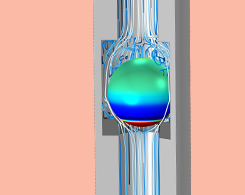
Simulating Fluid-Structure Interaction in a Ball Check Valve
Simulate FSI in a ball check valve to find the flow rate, fluid pressure, and fluid velocity. The COMSOL® software includes a predefined multiphysics coupling that makes it simple.

Comparing 2 Shock Response Analyses for a Computer Circuit Board
Before hitting the market, motherboards and other fragile electronic components need to be able to withstand certain mechanical shock loads. That is where shock response analysis comes in.
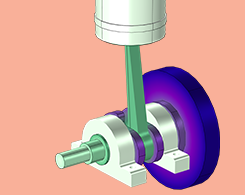
How to Model Fluid Friction in Joints with COMSOL Multiphysics®
Follow along as we demonstrate how to model fluid friction in joints using 2 rotordynamics examples: a piston and a reciprocating engine.
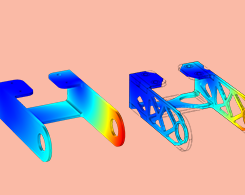
Performing Topology Optimization with the Density Method
The density method simplifies the process of topology optimization. Get an overview of how to use a special density feature for topology optimization in the COMSOL® software.
Evaluating a Fire-Resistant Overpack for Nuclear Waste
Confinement system overpacks are used to safely store radioactive waste. Sogin uses heat transfer modeling to design safe and reliable overpacks that are resistant to fire.
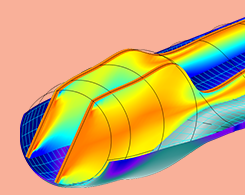
Analyzing Wind Turbine Blades with the Composite Materials Module
Take a look at the dedicated functionality for analyzing thin, layered structures in the Composite Materials Module with this example: a wind turbine blade made of composite materials.
How to Activate Material in Simulations of Manufacturing Processes
Do you model manufacturing processes such as welding or additive manufacturing? You can activate or deactivate a material in a material deposition simulation using specialized functionality.
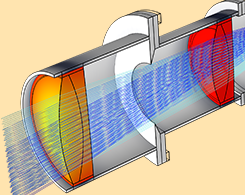
How to Perform a STOP Analysis with COMSOL Multiphysics®
Interested in structural-thermal-optical performance (STOP) analysis? We go over the theory, background, and how to perform such an analysis in the Ray Optics Module.

Studying Presbyopia with an Optomechanical Model of the Human Eye
You have to see this multiphysics simulation research: To help combat the effects of presbyopia in aging eyes, Kejako built a 3D optomechanical model of a full human eye.
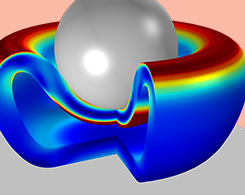
How to Model the Compression of a Hyperelastic Foam
When characterizing hyperelastic materials, how do you ensure accuracy? Here, we show how to model the compression of a sphere made of an elastic foam using experimental data.
Examining Vibration in a Lumped Model of the Human Body
Engineers working to reduce the effects of whole body vibration (WBV) in transportation methods can analyze their systems and designs using a lumped model of the human body.
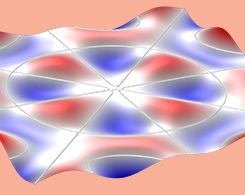
How Do Chladni Plates Make It Possible to Visualize Sound?
Is it possible to see sound? Find out for yourself in this blog post on the acoustics behind Chladni plates.
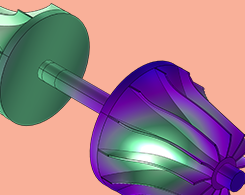
Predicting the Stability of Rotor Systems with the COMSOL® Software
Instability in a rotor system can lead to catastrophic failure. Fortunately, engineers can predict the stability of rotor systems by performing stability analyses with the Rotordynamics Module.


