

One of the most impactful inventions is something hardly anyone notices; in fact, this invention is not designed to be seen but to be seen through. I’m talking, of course, about eyeglasses. In 2025, it was estimated that approximately 57% of the global population wears prescription glasses (Ref. 1). This number only climbs if you include other forms of eyewear like reading glasses, sunglasses, or contact lenses. As a glasses wearer myself, I decided to take a look at the history of this commonplace yet impactful technology.
Precursors to Glasses
Reading Stones
One of the earliest examples of people using a lens to assist vision came not in the form of glasses but in the form of a small quartz stone. Reading stones, as they were dubbed, are small, hemispherical stones carved out of quartz, beryl, or glass and shaped in such a way to function as a convex lens. When placed upon paper, this lens would magnify the text written on it for those whose vision was failing. The invention of these stones is often attributed to Ibn Sahl, a 9th-century Persian mathematician, but they have been found all across the world, including in Viking graves in Sweden.
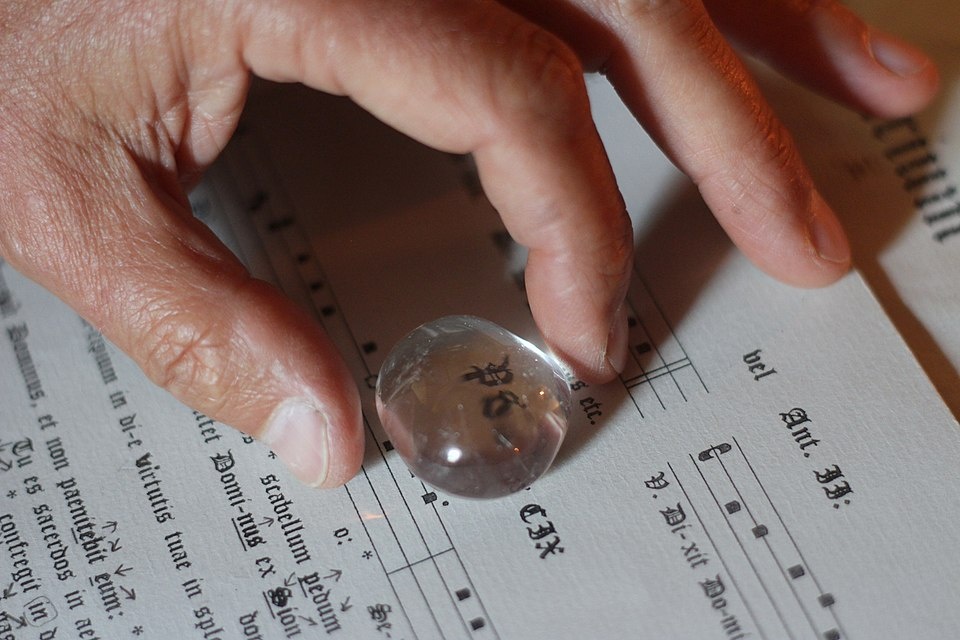 A glass reading stone in Archeon historical theme park in the Netherlands. Image licensed under the Creative Commons Attribution-Share Alike 4.0 International license via Wikimedia Commons.
Sunglasses
Another early precursor to the corrective glasses we know today? Sunglasses, which were developed by multiple cultures around the world, some of the earliest of which were found in 12th-century China and featured flat panes of smoky quartz. Another example of early noncorrective eyewear is traditional Inuit snow goggles. These goggles, typically carved from antler, driftwood, or ivory, reduced exposure to sunlight and helped prevent glare from the reflective snow.
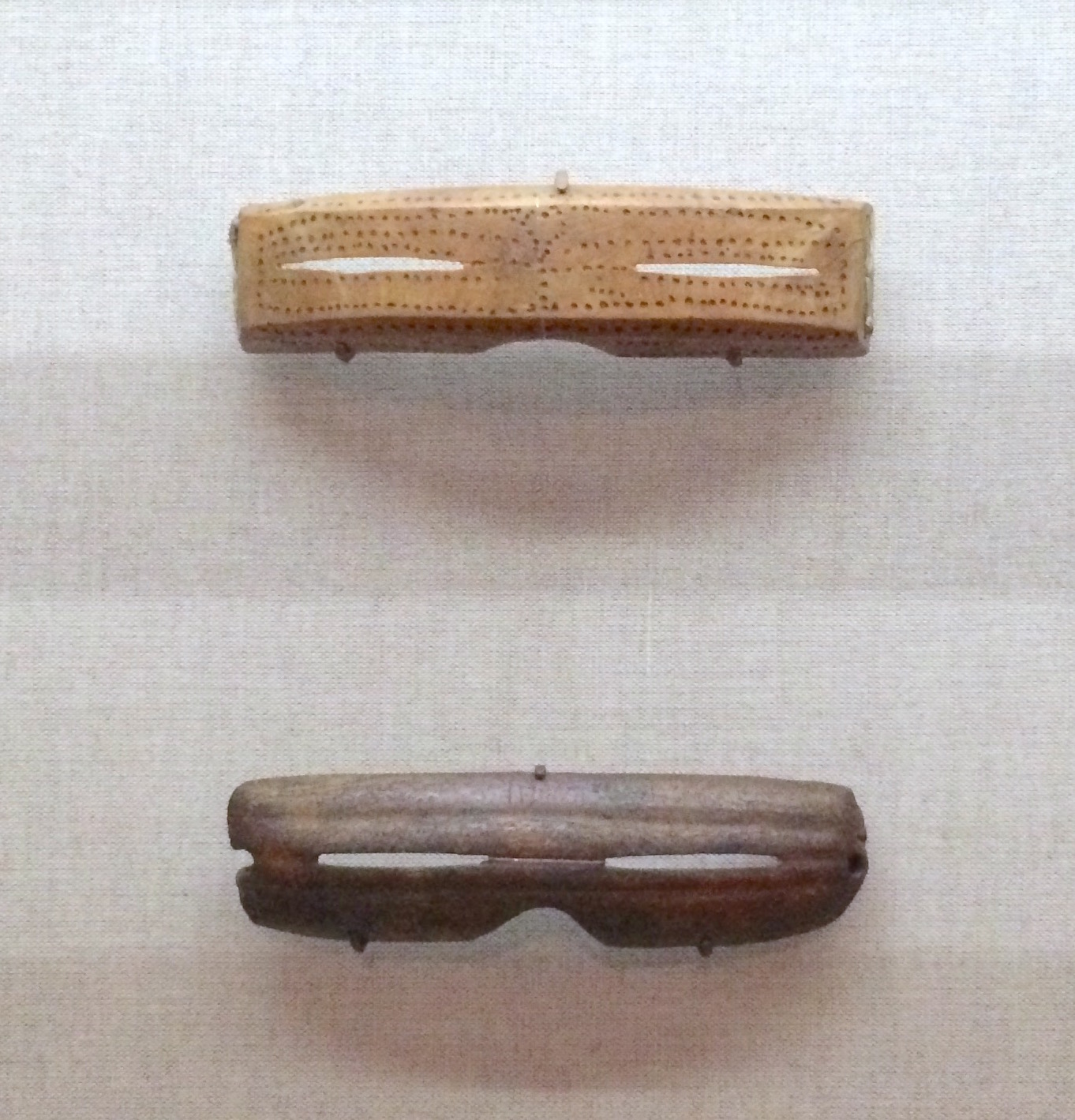 Two pairs of Inuit snow goggles from Alaska. Image licensed under the Creative Commons Attribution-Share Alike 4.0 International license via Wikimedia Commons.
Early Corrective Lenses
Most sources attribute the invention of the first corrective lenses to late 13th-century Italy, although their inventor is unknown. Early evidence lines up with this, as paintings and sermons involving lenses began appearing around this time throughout Europe. There is further evidence of rules and regulations having been set in place for early lens makers by the 14th century, during the Venetian Renaissance. These “glasses” looked a good deal different than those that exist today; they were often held by hand, made of two magnifying glasses attached to a pair of riveted handles to form an almost scissor-like shape.
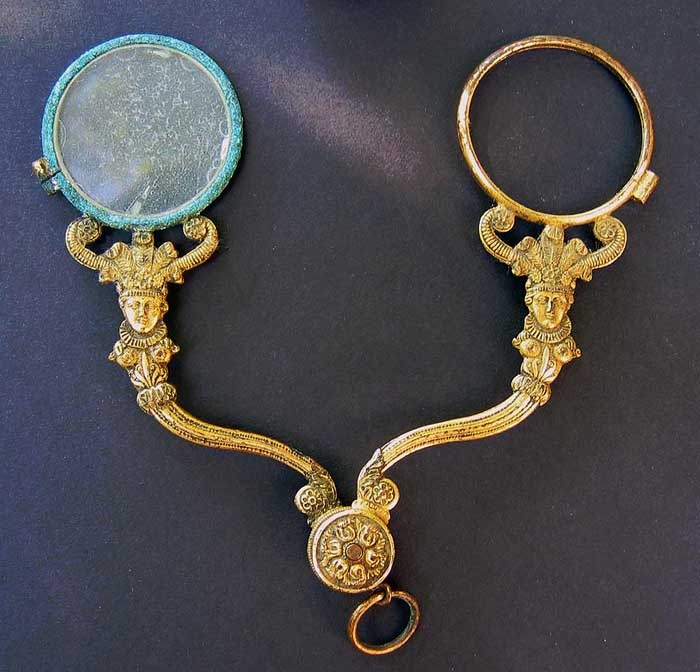 A pair of French “scissors glasses”. Image licensed under the public domain via Wikimedia Commons.
How Do Glasses Work?
How Do We See?
Before looking into how glasses work, it helps to first understand vision itself. Seeing is a complex process that takes place in milliseconds. At a high level, the eye can be loosely thought of as two focusing lenses that project incoming light into an image on the retina. The cornea, which is the outer layer of the eye, refracts the incoming light toward the crystalline lens, which in turn focuses the light onto the retina. The retina is where the light is absorbed into our eye’s photoreceptors, the rods and cones. These photoreceptors then send electrical signals to our brain, which can then interpret what we see. To focus on objects at different distances, tiny muscles deform the crystalline lens to change its focus. The last crucial elements are the iris and pupil, which are between the cornea and the crystalline lens. The iris is muscular tissue in the shape of an annular disc, and the pupil is the hole in its center. The iris expands or shrinks the size of pupil to adjust the amount of light that reaches the retina.
Issues with vision can happen during any part of this process but most commonly stem from natural imperfections in eye shape. These include things like the eyeball being misshapen (e.g., excessively oblong), the cornea itself being uneven or not convex enough, or the crystalline lens being damaged. As we age, the crystalline lens also becomes stiffer, causing presbyopia.
How Do Glasses Help?
Glasses use lenses to bend beams of light before they reach the eye, refocusing them based on the eye condition. In the case of myopia, or nearsightedness, the light naturally comes to focus before hitting the retina, causing objects that are far away to appear blurry. Lenses with a concave shape help send the focal point of the light farther away from the retina. In cases of hyperopia, or farsightedness, the opposite happens, so a convex lens is used to move the focal point of the light closer to the retina. When the cornea is uneven, also known as having an astigmatism, corrective lenses are shaped in more complex ways.
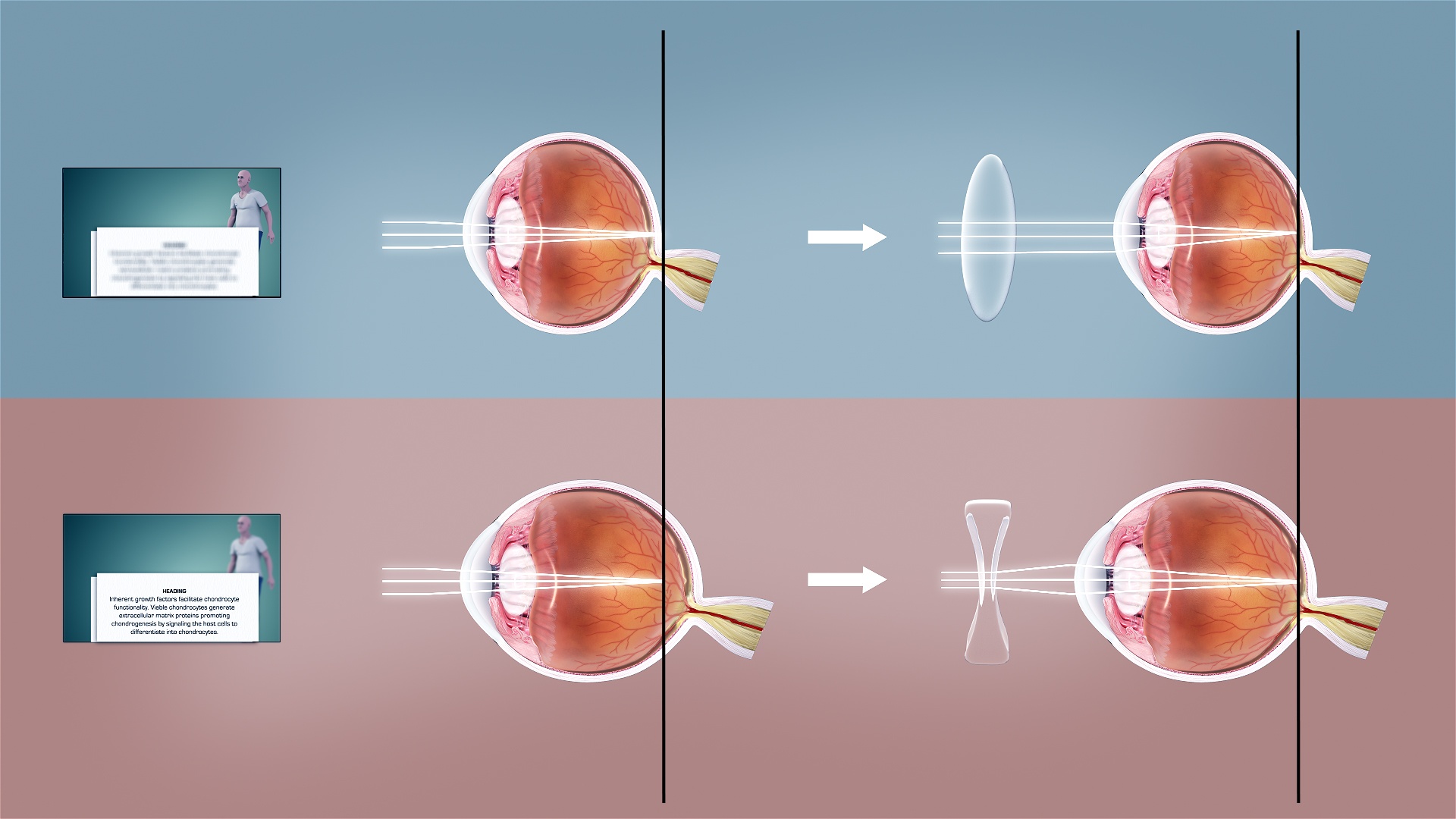 Top: By moving the focal point of light beams closer to the retina, a convex lens corrects farsightedness. Bottom: By moving the focal point farther from the retina, a concave lens corrects myopia. Image licensed under the Creative Commons Attribution-Share Alike 4.0 International license via Wikimedia Commons.
How Have Glasses Evolved?
Bifocals
The invention of bifocals is often attributed to Benjamin Franklin, who used them in court to read the lips of French speakers while also taking and reading notes. While Franklin is rumored to have fashioned his bifocals by sawing in half the lenses of two pairs of his glasses and then attaching them together in a new frame, modern bifocals are made by molding a high magnification segment onto a regular corrective lens.
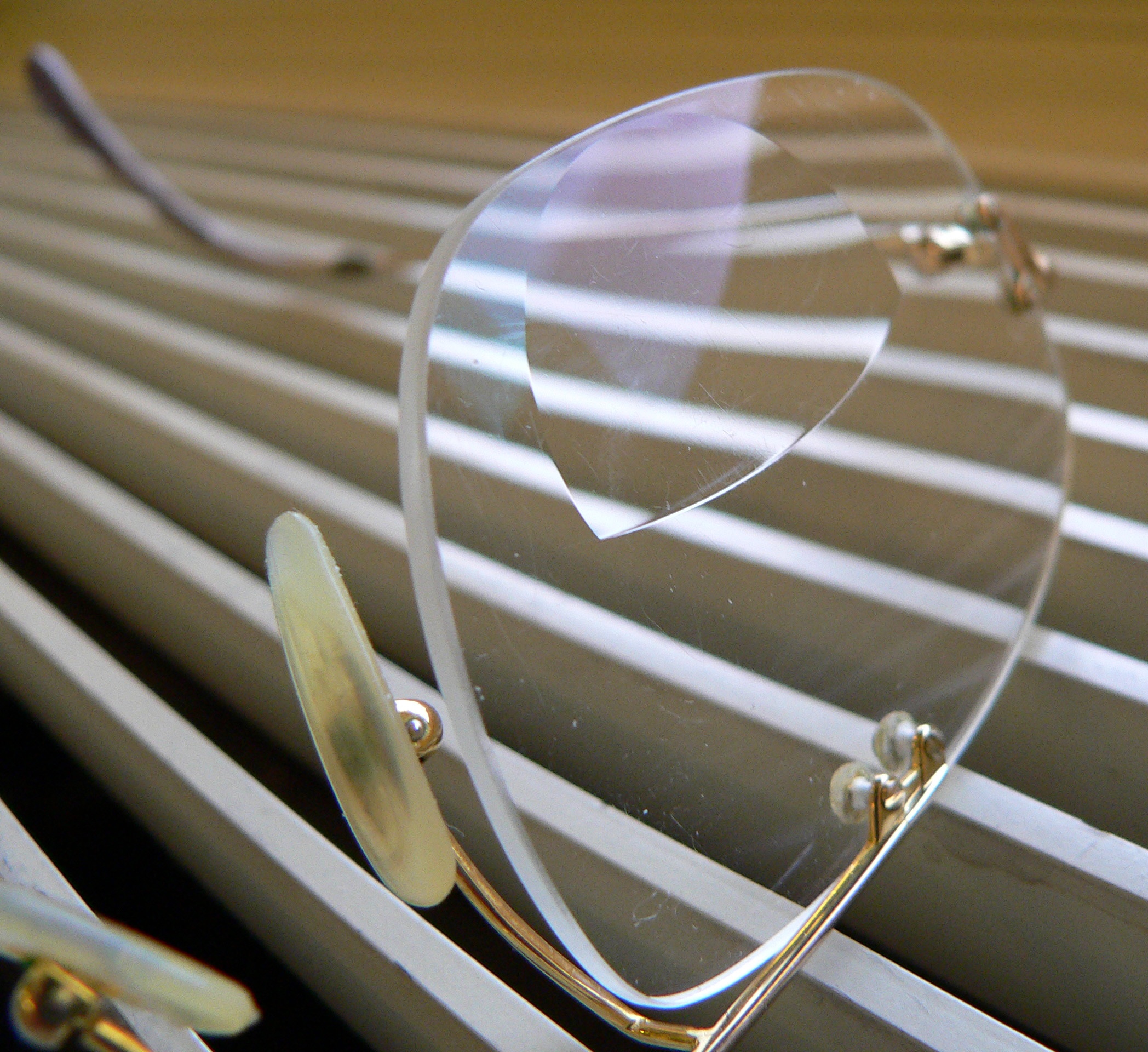 A pair of bifocal glasses. Image licensed under the Creative Commons Attribution-Share Alike 3.0 Unported license via Wikimedia Commons.
Progressive lenses take bifocals a step further, providing three or more magnification levels in a single pair of glasses and allowing wearers to see at multiple distances.
Modern Lens Technology
By the late 19th century, glass had long since replaced costly quartz and beryl as the primary material for lenses, and in Germany, physicist Ernst Abbe and chemist Otto Schott experimented with adding other elements into the melted glass to increase factors like durability, clarity, and weight. In the 21st century, many lenses are made of specialized plastics that further reduce cost and weight while increasing durability.
Additional modern developments include blue-light, scratch-resistant, anti-glare, and photochromic technologies that involve coating and/or impregnating lenses with various materials. Anti-glare lenses were originally developed for military optics during World War II but were made available for public use in the late 1940s. These coated lenses help glasses to not appear distorted in photographs and improve visual acuity in situations with inconsistent or bright light, such as driving at night or viewing a computer screen. Photochromic lens material (which may be applied as a coating or within the lens) is UV reactive and darkens in sunlight, removing the need for a person to own a pair of prescription sunglasses and glasses.
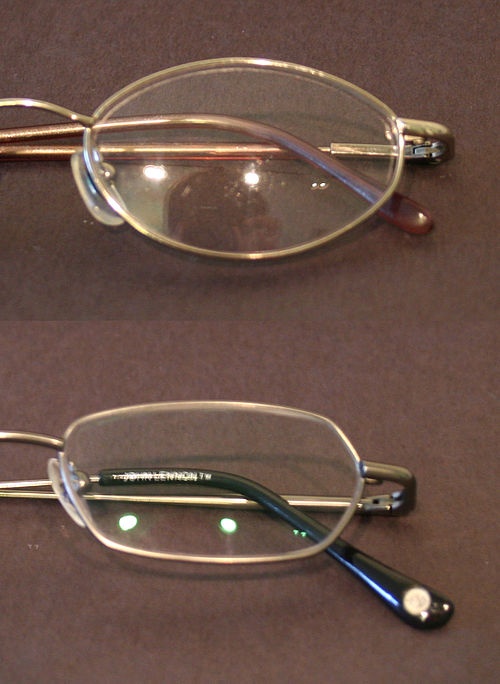 An uncoated pair of glasses (top) compared to one with an anti-glare coating (bottom). Notice the reflection of the photographer in the top frame and the blue-tinted lights reflected in the bottom pair. Image licensed under the Creative Commons Attribution-Share Alike 3.0 Unported via Wikimedia Commons.
Contact Lenses
Compared to glasses, contact lenses offer better peripheral vision and are less impacted by weather conditions. The precursor to contact lenses was proposed in the 16th century by Leonardo da Vinci, who suggested wearing water-filled glass hemispheres over the eyes. The first contact lenses, developed in the 19th century, were rigid and made of glass and wax. It wasn’t until the early 1960s that modern soft lenses were invented.
Looking Forward
While we’ve mentioned a few recent developments in corrective eyewear here, other innovations are on the horizon. For example, researchers have used simulation to develop liquid lenses that dynamically change optical power and reduce eye fatigue when using AR/VR devices. Others are using virtual modeling to investigate lighter and more durable frames and specialized coatings for glasses. As advancements to eye care continue to be made and wearable tech devices like smart glasses come closer to everyday availability, we only have to wait and see where this technology will take us in the future.
To drive innovation in eye care technology and other optical systems, many engineers turn to ray optics modeling. The Ray Optics Module, an add-on to COMSOL Multiphysics®, enables the modeling of electromagnetic wave propagation through ray tracing. With this approach, propagating waves are represented as rays that can reflect, refract, or be absorbed. Learn more about the module via the button below.
Reference
- O. Wilson, “What Percentage of People Wear Glasses? The Global Vision Correction Reality,” GLASSON, 18 Dec. 2025; https://www.glasson.app/blog/what-percentage-of-people-wear-glasses-the-global-vision-correction-reality/.



Comments (0)