

Earlier this year, the optical communications community gathered at the Los Angeles Convention Center for the Optical Fiber Communication Conference and Exhibition (OFC) 2026, the world’s largest event dedicated to optical networking and communications. This year, COMSOL exhibited at OFC for the first time, joining a global community of innovators shaping the future of photonics and high-speed connectivity. Take a look at our recap below!
Key Themes from OFC 2026
OFC continues to be the premier event where the optical ecosystem converges, from component manufacturers and system designers to network operators and researchers. With hundreds of companies presenting the latest solutions, the event provides a unique opportunity to see how research and development is being translated into real-world applications.
Over 17,000 industry members from 91 countries attended this year’s conference, and participants attended panels and tutorials led by representatives from companies like Nokia, NVIDIA, and Google.
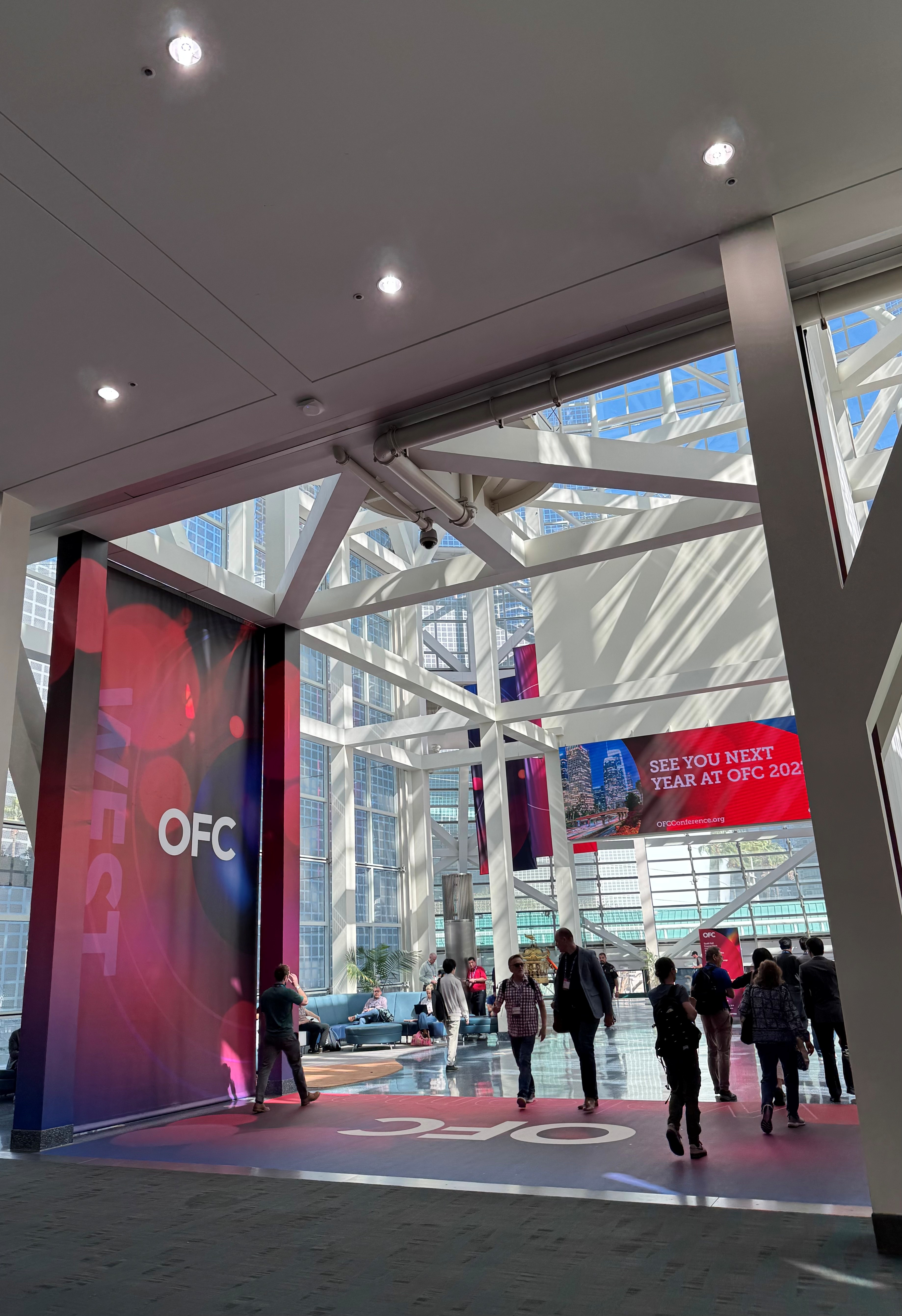
The venue for OFC 2026.
Across the exhibition floor, the main focus was on AI and enabling technologies that increase bandwidth, decrease latency, and improve energy efficiency. This was reflected in the wide range of technologies on display, from hollow-core and multicore fibers to optical transceivers and modulators and even thermal management solutions. These innovations highlight how the industry is evolving to support the AI boom as it both scales up and scales out.
Insights from the Show Floor
Beyond showcasing the technologies themselves, the exhibition floor offered a valuable opportunity for attendees to connect directly with engineers, researchers, and industry professionals. Conversations throughout the event highlighted how rapidly the optics space is evolving, particularly as new demands are placed on network infrastructure. For COMSOL, exhibiting at OFC for the first time provided us with the chance to engage with attendees working across a wide range of applications.
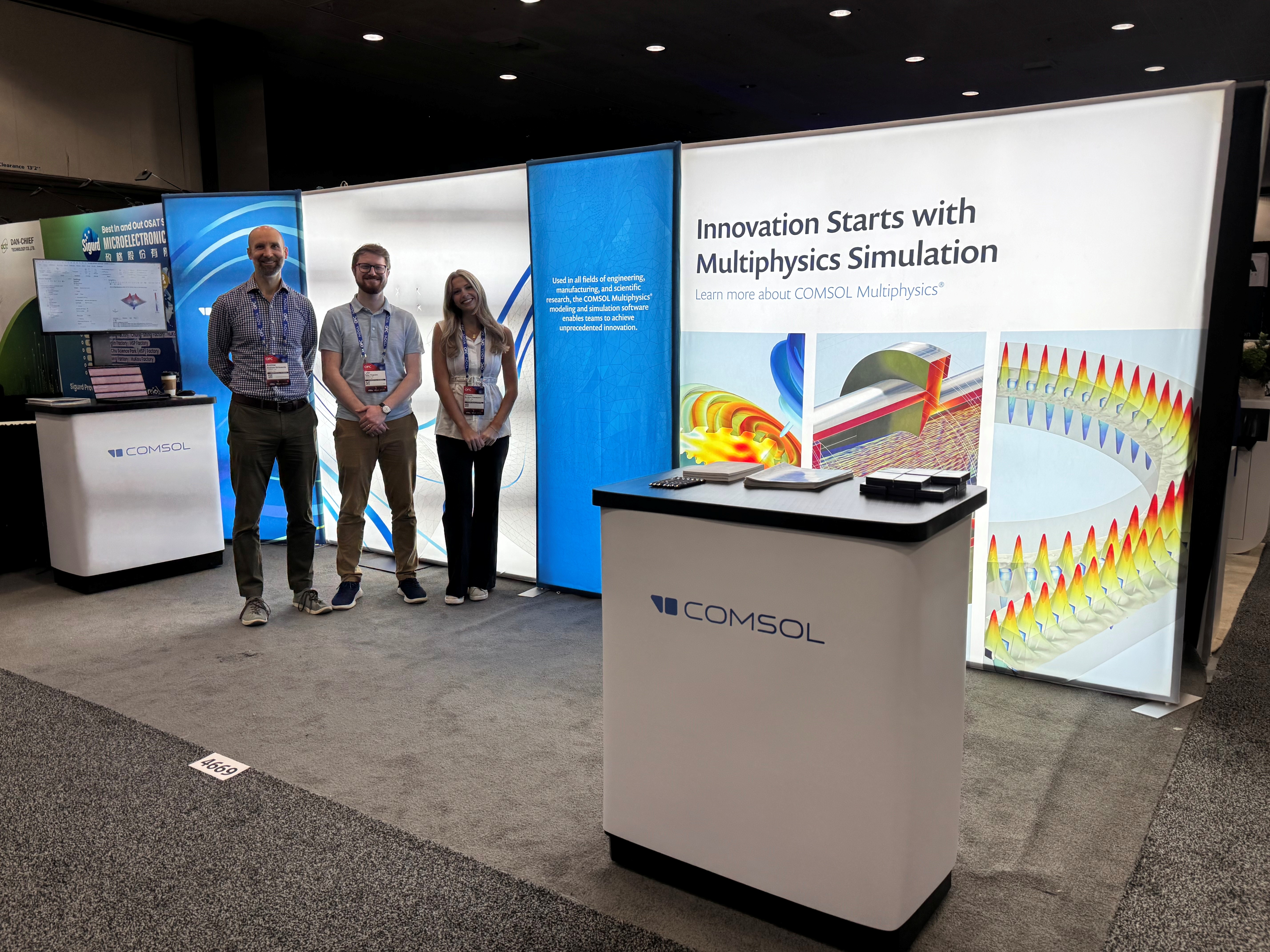 Andrew Strikwerda, Tyler Tippens, and Morgan Castadoro at COMSOL’s exhibition booth.
Many discussions centered around the challenges of integration and packaging for these complex devices, especially as systems become more compact and performance expectations continue to rise. The variety of companies present also underscored how interconnected the industry has become. From component-level innovations like hollow-core fibers to enabling technologies like co-packaged optics, it was clear that advancements across the entire ecosystem are contributing to the next generation of communication technologies.
The Role of Simulation in Optical Design
As the technologies showcased at OFC continue to advance, the need for accurate and efficient design tools becomes increasingly important.
Engineers are often required to consider multiple physical effects simultaneously, particularly when working with high-performance optical and electronic systems. Simulation addresses these challenges by allowing teams to model and evaluate designs before moving to physical prototypes. The multiphysics modeling capabilities of the COMSOL® software are especially valuable when working with components like photonic chips, connectors, and high-speed interconnects, where performance can be influenced by a combination of electromagnetic, thermal, and structural factors.
Andrew Strikwerda, senior application manager at COMSOL and attendee of OFC, further emphasized this point, saying, “With the growth of AI and the ever-increasing need for high bandwidth and low-latency data transfer, the field of fiber optics is growing rapidly. Simulation is more important than ever, not only for designing next-generation fibers like the hollow-core antiresonant fiber but also for complex optical packaging problems where thermal, mechanical, and optical effects interact.”
By enabling a deeper understanding of the interplay of these effects, multiphysics modeling software helps reduce development time while improving overall design accuracy. As systems continue to scale and evolve, this approach becomes even more critical.
Simulation in the Future of the Optics Industry
OFC 2026 highlighted the growing importance of optical technologies in supporting the demands of an increasingly connected and data-driven world. From advancements in hardware to broader system-level innovation, the event showcased how the industry is adapting to meet the needs of modern communication networks. For COMSOL, exhibiting at OFC marked an important step in connecting with optical communications professionals to best support the development of next-generation technologies.
Modeling Wave Optics
If you’re interested in learning more about how to use the COMSOL® software to model optical technologies, take a look at the Wave Optics Module add-on product below.





Comments (0)