

What do mixed nuts, breakfast cereal, and asteroids have in common? They all hide a mystery that has puzzled researchers across various fields of science. Formally known as size separation in vibrated granular materials, the Brazil nut effect (sometimes called the muesli effect) is a phenomenon that can be studied using the COMSOL Multiphysics® software and the add-on Granular Flow Module.
What Is the Brazil Nut Effect?
The Brazil nut effect refers to the counterintuitive behavior observed when a mixture of particles of different sizes is subjected to vibration. Under shaking, the larger particles consistently migrate upward and eventually accumulate near the top of the mixture, even though they possess greater mass than the surrounding smaller particles. This seemingly paradoxical behavior has been observed in industrial processes and everyday experiences such as opening a can of mixed nuts.
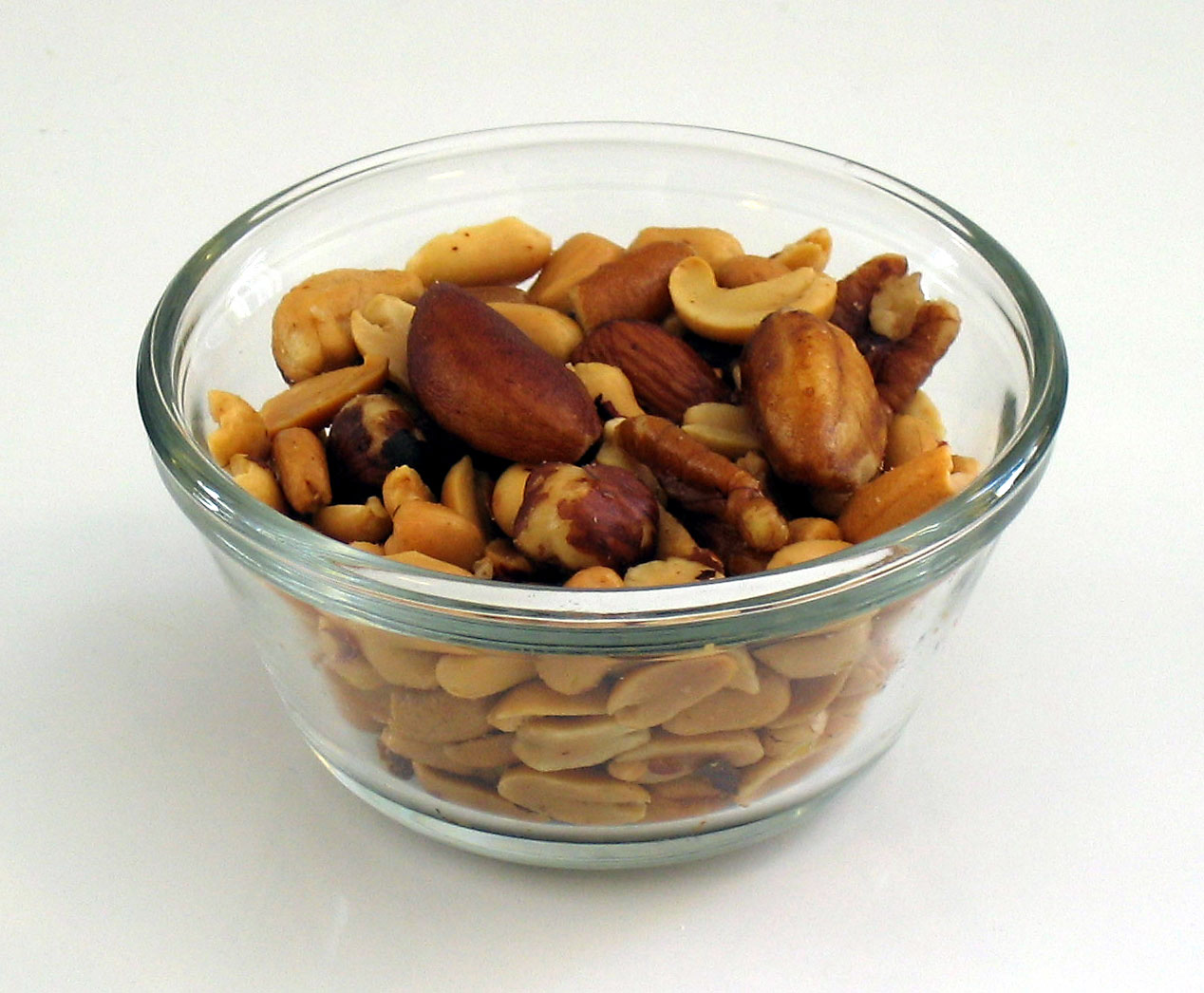 Mixed nuts popularly demonstrate the Brazil nut effect. Image in the public domain, via Wikimedia Commons.
Understanding the mechanisms behind this effect remains a topic of considerable interest because it has practical implications for systems where granular segregation must be either enhanced or avoided.
In this blog post, we explore the Brazil nut phenomenon to reveal the principles governing agitated granular flows. With the introduction of the add-on Granular Flow Module in version 6.4 of COMSOL Multiphysics®, we can perform such simulations of granular material using the discrete element method.
Using the Discrete Element Method for Granular Flow Analysis
The discrete element method (DEM) is a simulation technique that tracks the motion and collisions of individual distinct interacting grains by solving Newton’s laws for every grain in the system, including both translational and rotational dynamics. This allows us to examine how each grain interacts with its neighbors and the system as a whole.
DEM captures the small-scale collisions and motions that lead to the larger flow patterns. It is especially useful for simulating granular materials, powders, and bulk solids where particle-scale interactions govern macroscopic behavior. It is a powerful tool to understand granular flows and test how changes in particle size or operating conditions affect mass transfer in granular systems.
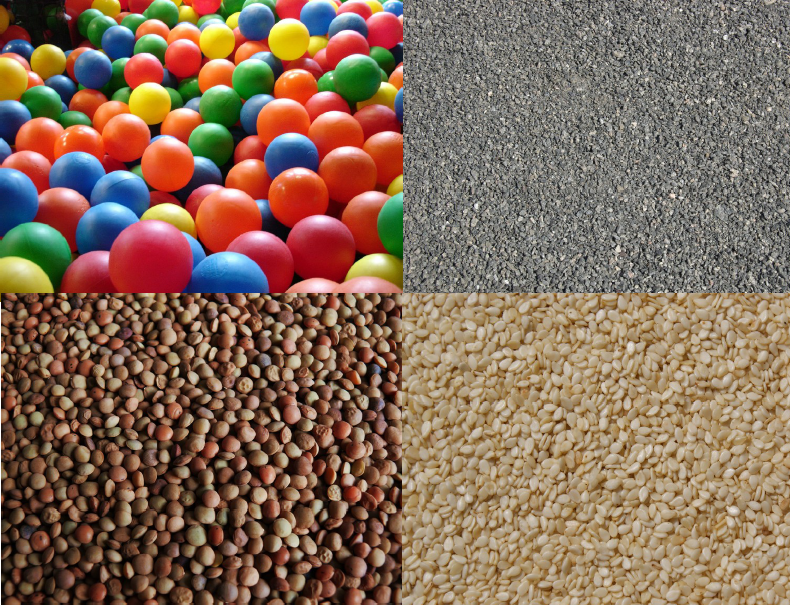 Examples of granular material. Clockwise from top left: plastic balls, gravel, sesame seeds, and lentils. Image in the public domain, via Wikimedia Commons.
Using the Granular Flow Module you can perform DEM simulations to model dynamics of powders; pellets; or bulk solids such as rocks, seeds, or tablets. Grains are modeled as soft particles that deform upon contact. Their trajectories are updated for each time step, accounting for grain–grain and grain–wall collisions, as well as external forces, to predict the bulk motion of the system.
Simulating the Brazil Nut Effect
Let’s use the Granular Flow Module to simulate a single large grain placed in a bed of smaller grains. In a 2D model consisting of a 1 m square domain, we release a single large grain that is
80 mm in diameter and several smaller grains that are 20 mm in diameter, at various positions with small random initial velocities.
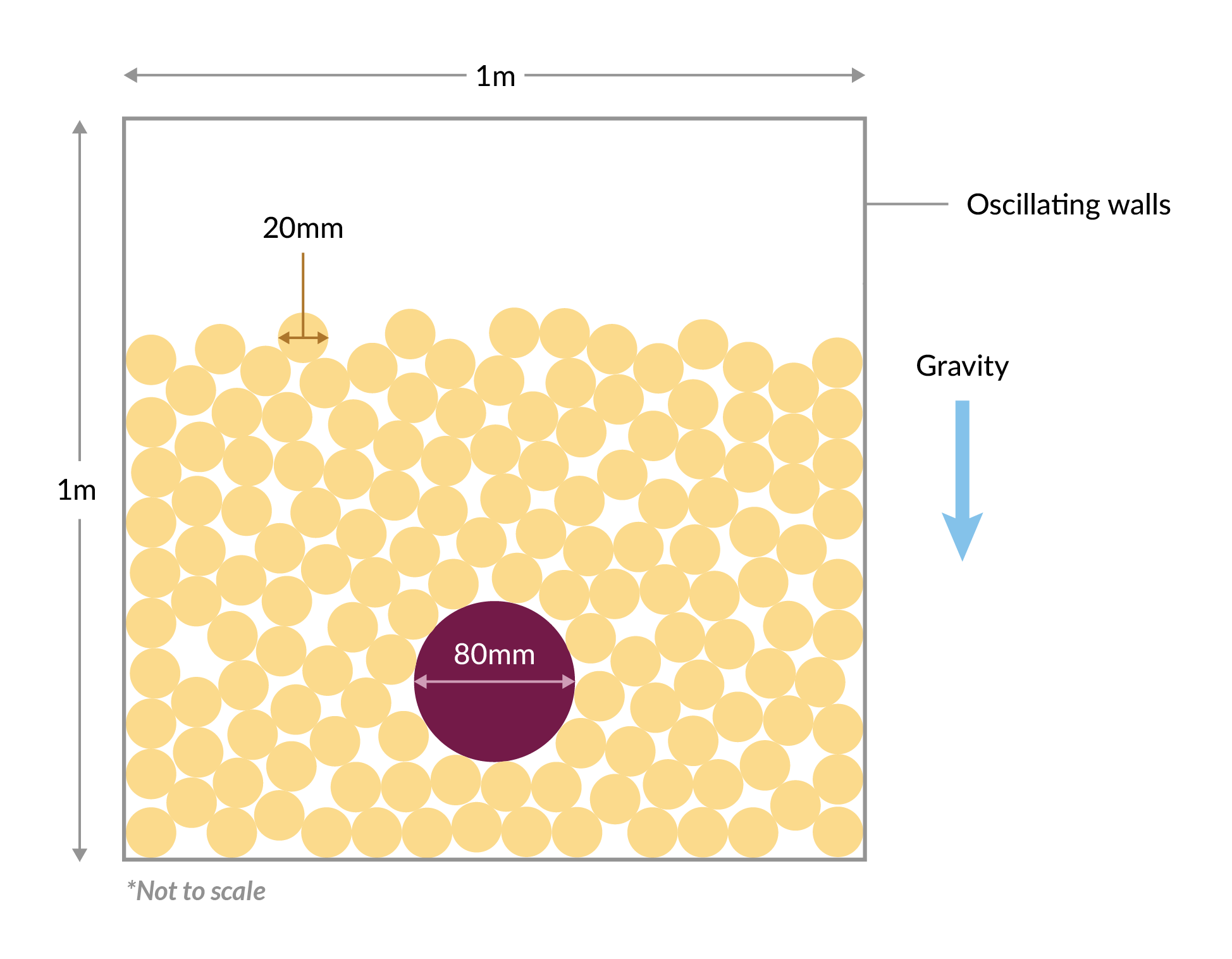 Schematic representation of the model setup.
A sinusoidal translation is defined on all the rigid boundaries in the y direction with an amplitude of 20 mm and a period of 0.1 s. Gravity is defined in the negative y direction. The Hertz-Mindlin-Deresiewicz (Hertz-MD) contact force model is employed. Besides Hertz-MD, the Granular Flow Module also supports the linear elastic contact force, adhesive contact forces, and van der Waals forces. We omit discussing the details of the grain–grain and wall–grain contact dynamics for brevity. The results of a time-dependent study conducted from 0 to 17 seconds are shown in the animation below.
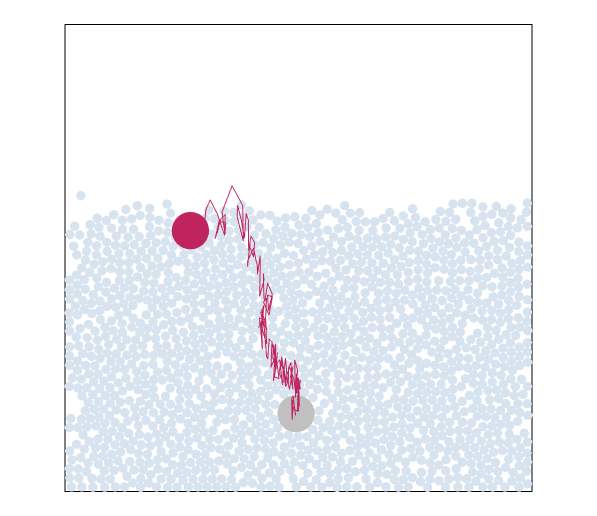
The position (left) and the pathline traced by the large grain (right) show that it rises to the top of the pile.
In the model shown above, the larger grain is 64 times heavier than the smaller grains due to its size. To further emphasize this point, the larger grain is modeled as 50% denser than the smaller grains, demonstrating it can still rise despite being denser and heavier. This behavior can seem counterintuitive and is the crux of the Brazil nut effect. Let’s take this analysis one step further.
Understanding Granular Convection
We’ve successfully modeled the Brazil nut effect and have visualized the behavior using a simulation. Interestingly, researchers are still unable to provide a unified physical and mathematical description of what drives this phenomenon.
In general, it is agreed that it is a combination of a few key mechanisms that have been identified in these systems:
- Percolation: Smaller particles percolate through the granular bed; i.e., fall into the gaps between particles created under the vibrating load.
- Inertial effects: Larger particles can resist downward motion due to their inertia and interaction with surrounding grains.
- Convection currents: The vibrations create an upward flow in the center and downward flow near the walls, carrying large particles upward.
Visualizing percolation: Notice how one of the grains (highlighted in blue) “falls” into the gaps created below the large grain, i.e., the position center of mass of the blue grain “falls” over time with respect to that of the large red grain.
While the first two mechanisms seem intuitive, it is somewhat difficult to visualize convection currents forming in this system. Let’s build another model to examine how these currents develop and drive the Brazil nut effect.
In an identical 2D model, we eliminate the grain size variation to create a bed of uniformly sized particles (20 mm in diameter) and perform a transient study for 40 seconds. We see that the particles begin to move in coherent flow loops characterized by upward flow typically occurring in the central core of the container and downward flow occurring along the container walls. In this way, we are able to visualize the convective flows that develop in vibrated granular systems.
The positions (left, colored by initial height) and pathlines of a few grains (right, colored by time) of a few grains show the circulation zones that develop in the system.
This circulation creates convection rolls analogous to the Bénard cells in fluid thermal convection, which were confirmed by a study group using magnetic resonance imaging (Ref. 2). An active research area is the reverse Brazil nut effect, which is observed to cause large particles to sink (Ref. 3). DEM is essential for capturing these mechanisms because they rely heavily on particle-scale geometry, collisions, and nonlinear frictional interactions. The Granular Flow Module provides the functionality needed to simulate these interactions realistically.
Concluding Thoughts on Granular Flow Modeling
Granular convection is a widely observed phenomenon in which discrete particles like sand, grains, powders, or any other granular material undergoes bulk motion that resembles the convective circulation of heated fluids, even though the medium itself is not a continuous fluid.
The Granular Flow Module provides a powerful framework for simulating and understanding the complex particle interactions in granular flows. Understanding granular convection is crucial in industries where particle segregation can compromise product quality. Granular convection is found in several fields of study including agricultural grain handling and sorting (Ref. 4), asteroid and planetary formation (Ref. 5), and archaeology (Ref. 6).
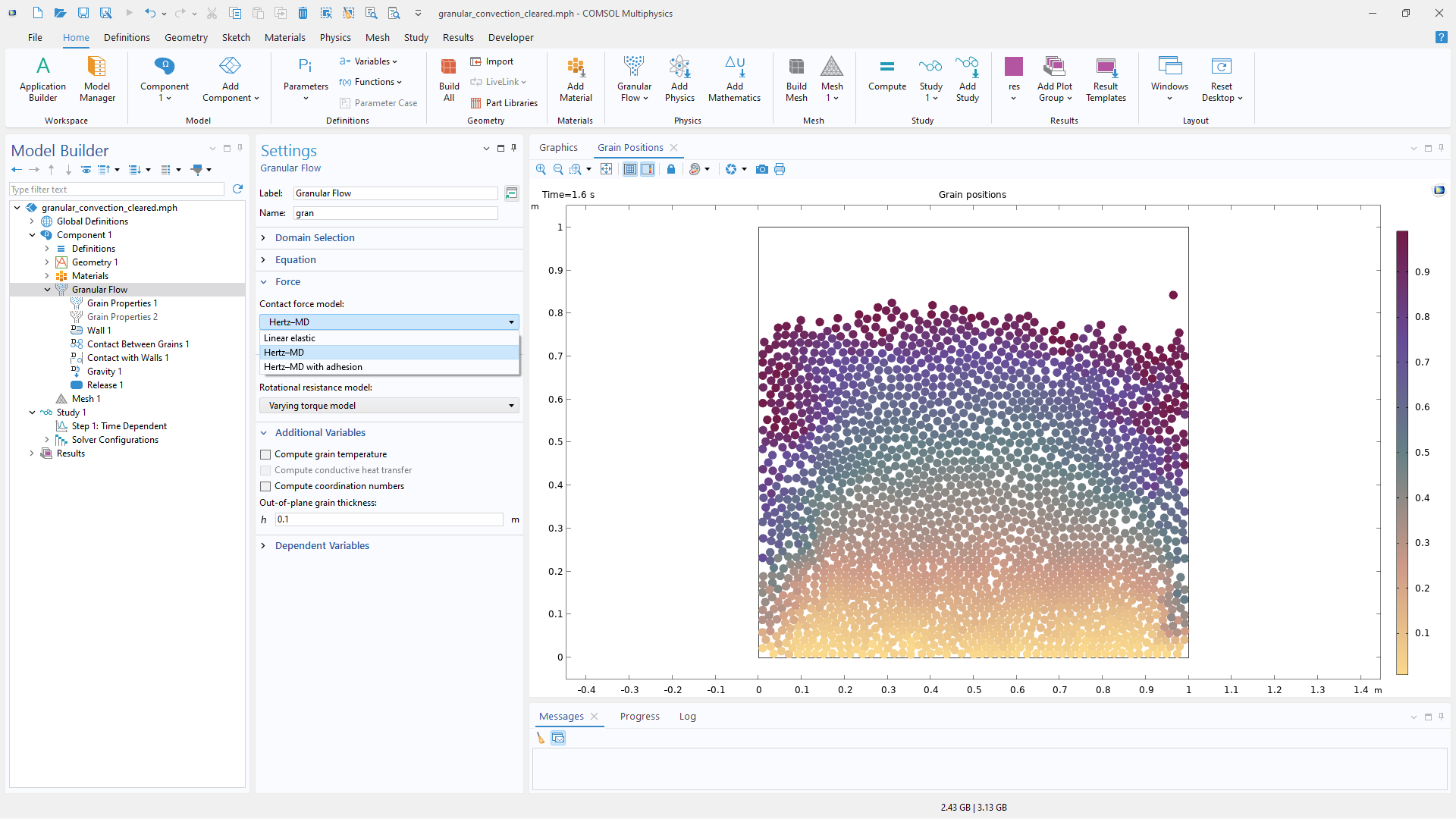 The graphics user interface remains familiar when modeling with the Granular Flow interface.
Engineers and researchers can use the Granular Flow Module to study various applications, including:
- Hopper discharge
- Silo storage
- Chute transport
- Powder spreading
- Mixing processes
- Packing density
- Grain compaction
- Segregation effects
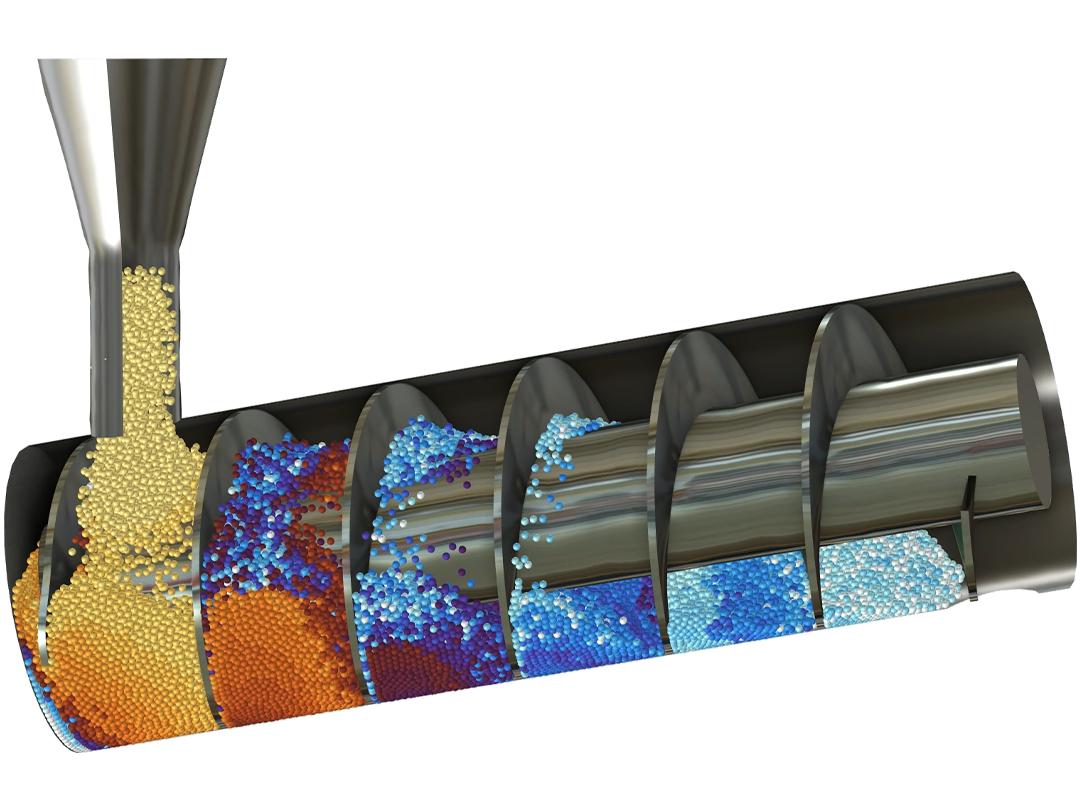
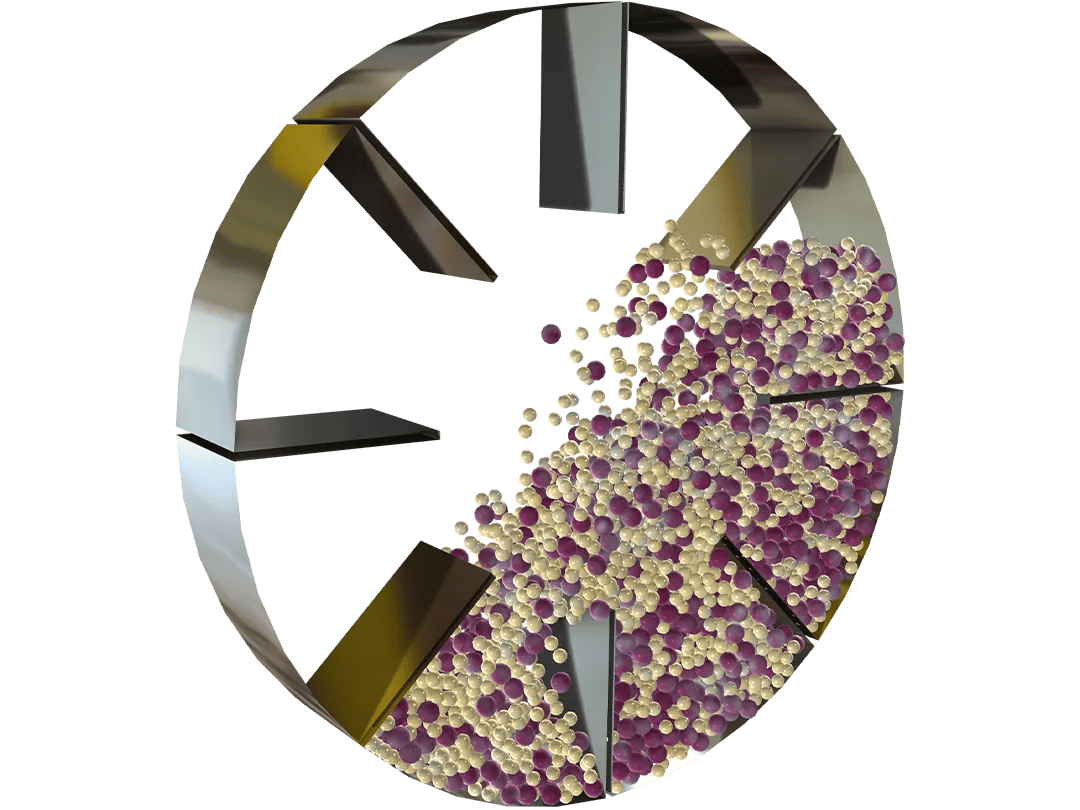
The Granular Flow Module can be used to simulate grains being transported using a screw conveyor (left) and grains mixed in a rotating drum with baffles (right).
By resolving the motion of individual grains, the module helps predict bulk behavior such as mixing efficiency, blockages, and uneven flow, making it valuable for industries including pharmaceuticals, chemical processing, agriculture, and mining.
Next Steps
Try out the Granular Convection model yourself by clicking the button below. Please note that in order to use this model, the Granular Flow Module in addition to COMSOL Multiphysics® is required:
References
- A. Kudrolli, “Size separation in vibrated granular matter”, Reports on Progress in Physics, vol. 67, no. 3, p. 209, 2004
- E.E. Ehrichs et al., “Granular convection observed by magnetic resonance imaging”, Science, vol. 267, no. 5204, pp. 1632–1634, 1995.
- F. Ludewig and N. Vandewalle, “Reversing the Brazil nut effect”, The European Physical Journal E, vol. 18, no. 4, pp. 367–372, 2005.
- S. Zhang et al., “A calibration method for contact parameters of agricultural particle mixtures inspired by the Brazil nut effect (BNE): The case of tiger nut tuber-stem-soil mixture”, Computers and Electronics in Agriculture, vol. 212, p. 108112, 2023.
- V. Perera et al., “The spherical Brazil Nut Effect and its significance to asteroids”, Icarus, vol. 278, pp. 194–203, 2016.
- D. Luria et al., “Identifying the Brazil nut effect in archaeological site formation processes”, Mediterranean Geoscience Reviews, vol. 2, no. 2, pp. 267–281, 2020.




Comments (0)