
Granular Convection and the Brazil Nut Effect
Application ID: 144401
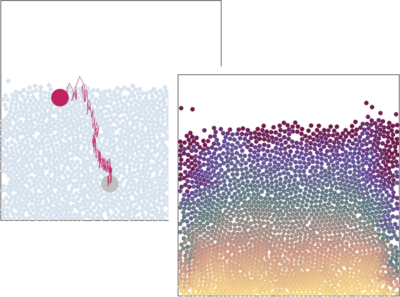
Formally known as size separation in vibrated granular materials, the Brazil nut effect (BNE) (and sometimes the Muesli effect) is a phenomenon that causes large grains to separate from small ones and rise to the top of a granular bed under vibrations. This phenomenon can be studied using the power of numerical methods and the discrete element method.
Two models that use the Granular Flow interface are included in this asset to demonstrate the Brazil Nut effect and help visualize some of the processes including percolation and granular convection that strongly influence granular flows under vibration.
To learn more about this model, see our accompanying blog post “Understanding Granular Convection and the Brazil Nut Effect”.
This model example illustrates applications of this type that would nominally be built using the following products:
however, additional products may be required to completely define and model it. Furthermore, this example may also be defined and modeled using components from the following product combinations:
The combination of COMSOL® products required to model your application depends on several factors and may include boundary conditions, material properties, physics interfaces, and part libraries. Particular functionality may be common to several products. To determine the right combination of products for your modeling needs, review the Tabella delle Funzionalità and make use of a free evaluation license. The COMSOL Sales and Support teams are available for answering any questions you may have regarding this.


