
Blog Posts Tagged Technical Content
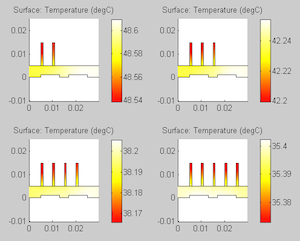
Automatically Handling Selections in COMSOL Multiphysics®
Part 3 of a blog series on how to handle selections and entity numbers with LiveLink™ for MATLAB® and the COMSOL® API. In this post, we show you how to handle selections and entity numbers.
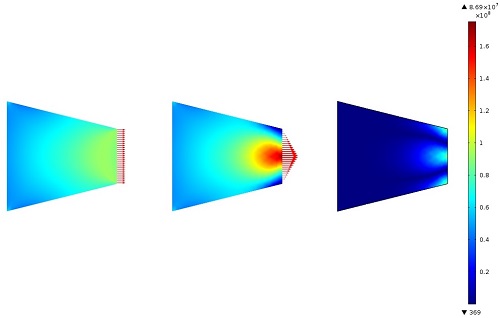
How to Join Solutions in COMSOL Multiphysics
In certain modeling scenarios, you will need access to more than one dataset. Read this blog post to see how to do so in COMSOL Multiphysics® by joining solutions.

Getting the Most out of Client-Server Mode
Learn how to use Client-Server mode when modeling in COMSOL Multiphysics® on a Floating Network License — and see why it is beneficial for you to do so.
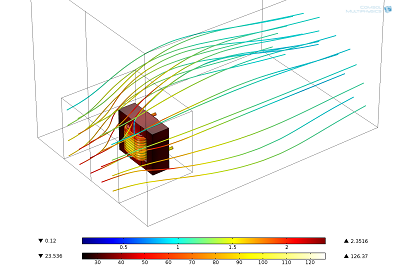
Modeling Convective Cooling of Electrical Devices
We developed a model that includes all of the important details of thermal management in a high-power electrical device. To do so, we needed to use high performance computing with hybrid modeling.
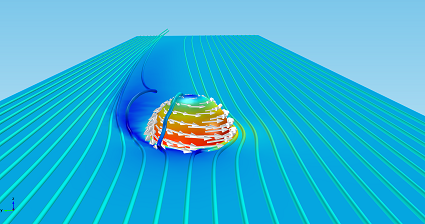
The Magnus Effect and the FIFA World Cup™ Match Ball
In celebration of the 2014 FIFA World Cup™, we show you some interesting CFD analyses of the FIFA World Cup™ match ball — and how it exhibits the Magnus effect when in play.
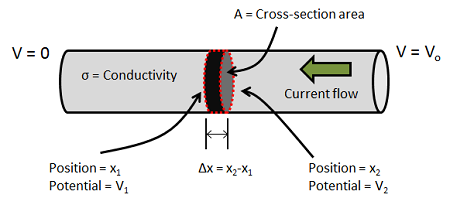
Computing Total Normal Flux on a Planar Surface
1 way to bridge the gap between simulation and experiment? Compute the total normal flux through a cross-sectional plane passing through your simulation geometry. Here’s how >>

Improving Your Golf Swing with a Multibody Analysis
The outcome of a golf stroke is determined by the movement of the club head just prior to impact with the ball. Therefore, one theoretically could improve their golf swing via multibody analysis.
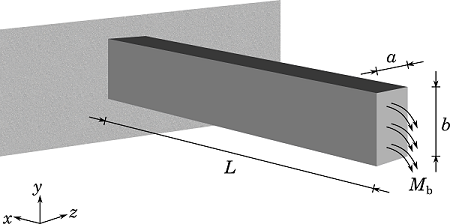
How to Model Residual Stresses Using COMSOL Multiphysics
Learn how to compute the residual stresses in your structural mechanics models. To demonstrate, we use the example of a deep metal drawing process. Read on…


