
Low-Frequency Electromagnetics Blog Posts
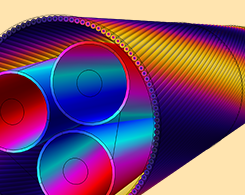
Using 3D Models to Investigate Inductive Effects in a Submarine Cable
It takes a modern desktop computer ~30 minutes to compute a 3D cable model with twisted magnetic armor. Consequently, 3D cable models are replacing empirical models in the power cable industry.
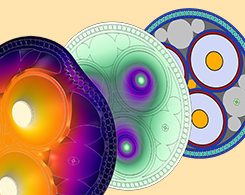
Modeling Cables in COMSOL Multiphysics®: 8-Part Tutorial Series
Your roadmap to modeling cables with the AC/DC Module and COMSOL Multiphysics®: An 8-part tutorial series that starts with the basics and gradually adds complexity and multiple physics.

Who Discovered the Integrated Circuit?
Like many of the world’s greatest innovations, credit for developing the integrated circuit is shared by many names, including Geoffrey Dummer, Jack Kilby, and Robert Noyce.
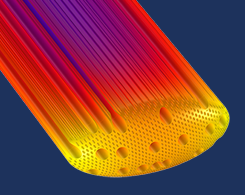
6 Ways Engineers Are Using Simulation to Help the Environment
Energy-efficient buildings and appliances. Safe nuclear waste storage. Well-preserved freshwater lakes. These are just a few examples of how simulation is being used to help the environment.
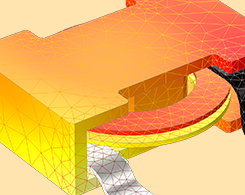
How Do I Use Gauge Fixing in COMSOL Multiphysics®?
Here’s your guide to using gauge fixing in your electromagnetics simulations in COMSOL Multiphysics®, from determining if it is necessary to imposing current conservation.
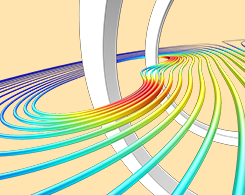
What Is Gauge Fixing? A Theoretical Introduction
Investigate the consequences of Helmholtz’s theorem when applied to Maxwell’s equations, and when using scalar and vector potentials to represent physical fields.
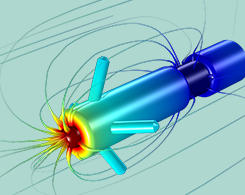
Modeling a Pacemaker Electrode in COMSOL Multiphysics®
What happens when the heart doesn’t pump the way it should? Pacemakers maintain the heart rate by monitoring natural electrical signals. Pacemaker electrodes are a key part of these devices.
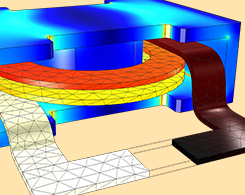
Which Study Type Should I Use for My Electrothermal Analysis?
What’s the best interface to use when implementing electrothermal analyses in COMSOL Multiphysics? We go over the interfaces, study types, and multiphysics couplings for high and low frequencies.


