
Blog Posts Tagged Technical Content
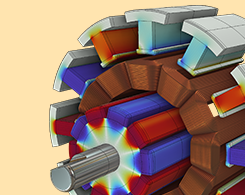
Computing Loss, Temperature, and Efficiency in Electric Motors
Follow along as we investigate the variation of iron and copper losses, the resulting temperature rise, and its effect on the efficiency of a permanent magnet machine.
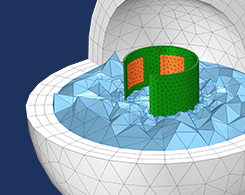
Wrapping and Warping Geometries for Analysis in COMSOL®
CAD parts are typically designed in an undeformed, as-manufactured state. When it comes to analysis, however, we are only interested in the deformed, as-assembled state.

Simulating the Pressure in an Ultrahigh Vacuum System
The ETpathfinder research facility in the Netherlands was built in anticipation of the proposed Einstein Telescope (ET), a third-generation observatory of gravitational waves.

How to Model Metabolic Reaction Networks with COMSOL®
Certain ice creams, puddings, and candies have an extremely vivid yellow color that comes from vitamin B2. The manufacturing of this supplement is one example of a metabolic reaction network…
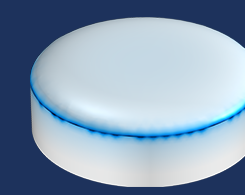
Curve Fitting of Solution Data in COMSOL Multiphysics®
We discuss curve fitting of continuous solution data, the concept of orthogonality, and how to fit solution data to a set of orthogonal functions for a simple and convenient postprocessing operation.
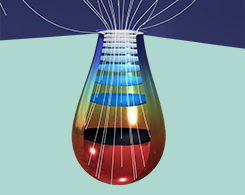
Modeling Pitting Corrosion in COMSOL Multiphysics®
When the process of generalized corrosion is allowed to continue, the initialization of a pit may occur on the metal surface, which is also referred to as the Evans drop experiment.

Designing Antireflecting Microstructures for Infrared Applications
Explore how 2 microstructure designs can improve the bulk transmittance of silicon (~70%) and cadmium zinc telluride (~79%) to more than 90% within the specific wavelength spectrum.
Voltage and Ground When Modeling Wave-Like EM Fields
We continue our discussion of voltage and ground by defining and interpreting these terms for sinusoidally time-varying electromagnetics models.


