
Blog Posts Tagged Technical Content

How to Simulate the Carrier Dynamics in Semiconductor Devices
Learn how to simulate carrier dynamics in semiconductor devices with 2 examples: reverse recovery and forward recovery PIN rectifier models.
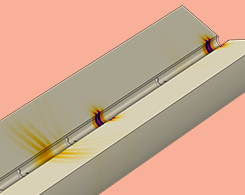
How to Model Piezoelectric Devices as Both Transmitters and Receivers
Certain types of transducers can act as both transmitters and receivers. We demonstrate how to use 2 features for modeling this type of piezoelectric device.
How to Model the Interface Trapping Effects of a MOSCAP
Looking to analyze interface trapping effects in a MOSCAP? Learn how to use a feature in the Semiconductor Module that enables you to add charging and carrier capture/release effects to a model.

FEM vs. FVM
Finite element methods, finite volume methods, or a hybrid approach: Which is the best choice for CFD? It depends on the fluid flow problem you’re trying to solve.

Using Discontinuous Meshes for Conjugate Heat Transfer Modeling
You can use different discontinuous meshes in neighboring domains in COMSOL Multiphysics®. This capability comes in handy, particularly when modeling conjugate heat transfer problems.
Global Modeling of a Non-Maxwellian Discharge in COMSOL®
Keep reading for a demonstration of how to model a non-Maxwellian discharge with the Boltzmann equation in the two-term approximation using COMSOL Multiphysics®.
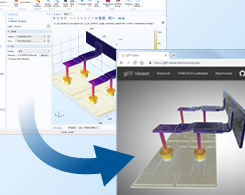
How to Export (and Share) Your 3D Result Plots as glTF™ Files
Wow your project stakeholders by sharing your 3D COMSOL Multiphysics® results as glTF™ files. We show you how to export plots and share them in third-party graphics viewers.
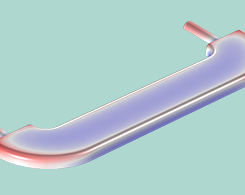
The Art and Science of Electrochemical Plating
Electrochemical plating, a surface finishing technique used in the automotive, electronics, corrosion protection, aerospace, and defense industries, is both an art and a science. Let us explain.


