
Blog Posts Tagged Technical Content

Using Web Browser Translation Tools for COMSOL Documentation
COMSOL documentation includes a lot of helpful information. Most web browsers include an automatic translation tool that enables you to read the documentation in the language of your choice.
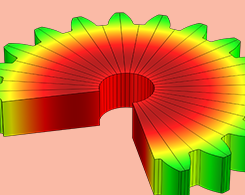
Introducing the Metal Processing Module
The Metal Processing Module includes 2 interfaces for analyzing diffusive and displacive metallurgical phase transformations: Metal Phase Transformation and Austenite Decomposition.
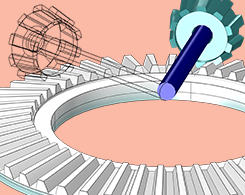
How to Automate the Setup of Your Multibody System Models
The Automated Model Setup functionality includes 2 features that will speed up your modeling process for multibody systems: Create Rigid Domains and Create Gears.
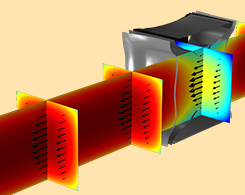
Three Semiconductor Device Models Using the Density-Gradient Theory
You can use the density-gradient theory to model semiconductor devices. Here are 3 examples: a Si inversion layer, Si nanowire MOSFET, and InSb p-channel FET.
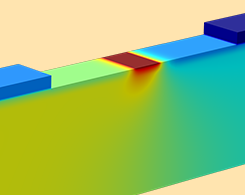
Intro to Density-Gradient Theory for Semiconductor Device Simulation
The density-gradient theory is a computationally efficient way to include quantum confinement in the conventional drift-diffusion formulation commonly used for simulating semiconductor devices.
Simulating Radiation Effects in Semiconductor Devices
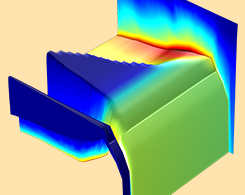
Analyzing radiation effects in semiconductor devices is an important capability for consumer electronics, medical imaging, nuclear engineering, aerospace, and a wide range of other industries.

How to Use the Platonic Solids as Geometry Parts in COMSOL®
The Platonic solids, named after Plato, are regular, convex polyhedra that consist of the tetrahedron, cube, octahedron, dodecahedron, and icosahedron.
Finding the Best Way to Make Crêpes with Fluid Dynamics Research
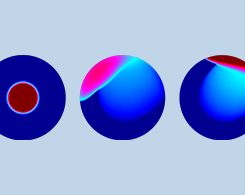
The recipe for the perfect crêpe calls for flour, eggs, milk, sugar, butter, and…simulation? Fluid dynamicists used simulation to solve the optimal coverage problem for crêpe making.


