
Blog Posts Tagged Chemical Reaction Engineering Module
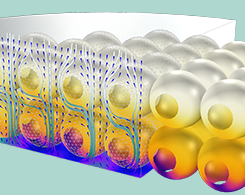
Introduction to Modeling Surface Reactions in COMSOL Multiphysics®
Bioengineers and electrochemists will appreciate this detailed introduction to modeling surface reactions with the COMSOL® software.

How to Model Heat and Moisture Transport in Porous Media with COMSOL®
Modeling the transport of heat and moisture in porous media, like building envelopes and other construction materials, is a simple process with a predefined Heat and Moisture Transport interface.
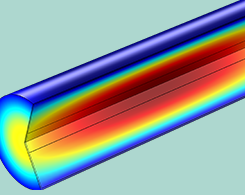
Modeling the Performance of an Evaporative Emission Control System
Researchers turned to COMSOL Multiphysics to model the adsorption and desorption in an evaporative emissions control system for enhanced automotive efficiency.
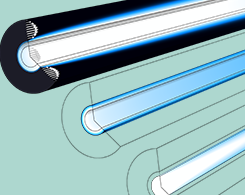
Study Contaminant Removal in Membrane Dialysis Devices with an App
We discuss treating renal failure with hemodialysis, analyzing contaminant concentration in a membrane dialysis device, and optimizing a membrane dialysis device with a numerical modeling app.

Designing Effective Transdermal Drug Delivery Patches with Simulation
Transdermal drug delivery (TDD) patches are more effective and convenient than traditional drug delivery methods. See how Veryst Engineering simulated the diffusion process in a TDD patch.

Studying the Migration of Mineral Oil Hydrocarbons in Food Packaging
Food packaging can contain hazardous mineral oils. To analyze the migration patterns of mineral oil hydrocarbons for various food packaging scenarios, German researchers used COMSOL Multiphysics®.
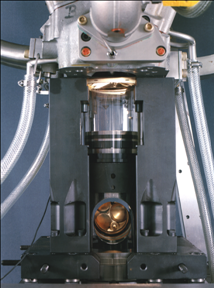
Model Methane HCCI Combustion to Optimize Engine Ignition Control
Environmental demands have sparked an interest in finding an alternative to traditional spark- and compression-ignition engines. One of the suggested alternatives is HCCI engines.
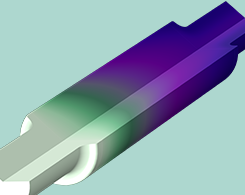
New Reacting Flow Multiphysics Interface Delivers Greater Flexibility
Get an introduction to the Reacting Flow interface, which can be used to simulate fluid flow and reactions in gases and liquids in COMSOL Multiphysics®.

Studying Bioreactor Landfills to Solve a Growing Trash Problem
How are researchers using heat transfer and chemical reaction simulations to help solve the world’s growing trash problem? Get the details here.
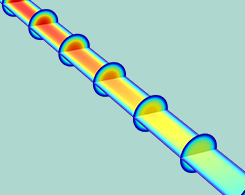
Analyzing the Dissociation Process in a Tubular Reactor
To accurately analyze tubular reactor designs, chemical engineers can model the dissociation process. But is it better to use a isothermal or nonisothermal simulation to do so?
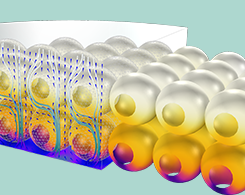
Protein Adsorption: Batch and Space-Dependent Modeling
We take you step by step through developing a detailed protein adsorption reactor model. We start with a simple, perfectly mixed batch reactor and move onto space-dependent modeling.
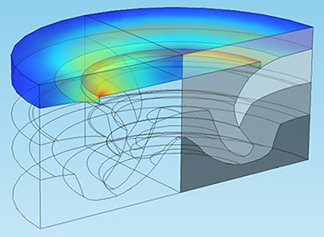
Using Simulation in the Race Against Corrosion
A German research institute and a well-known car manufacturer joined forces to investigate the corrosion occurring in automotive rivets and sheet metal. Get the full story.
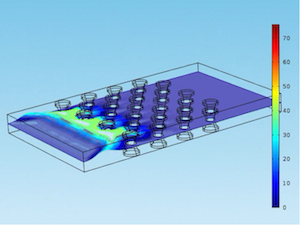
Sensing the Bio in Biosensor Design with a Simulation App
The Biosensor Design demo app predicts the results from measurements of a biomolecule’s concentration (or activity) from an understanding of this molecule’s attachment to an enzyme.
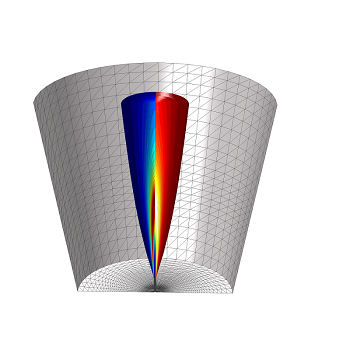
An Analysis of Syngas Combustion in a Round-Jet Burner
By combining the Reacting Flow interface and the Heat Transfer in Solids interface, we can study the syngas combustion in a round-jet burner. Get details…
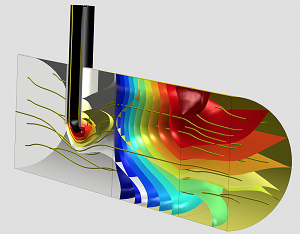
Using Simulation to Optimize Biopharmaceutical Processes
Did you know that you can use COMSOL Multiphysics® to study biopharmaceutical processes? Examples include pharmaceutical mixers, injection devices, dielectrophoretic separation, and more >>
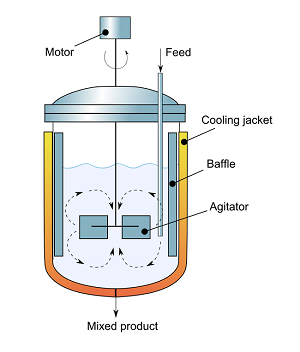
Simulating an Ideal Stirred Tank Reactor System
The Generic CSTR reactor type in the Reaction Engineering interface can be used to easily model continuous stirred tank reactors (CSTRs), or ideal stirred tank reactors.
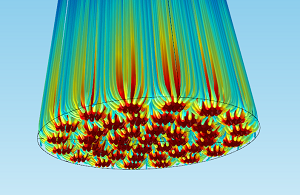
New and Revamped Chemical Engineering Interfaces
Get an overview of the modeling interfaces for reaction engineering and mass transport in COMSOL Multiphysics®, including the Chemistry and Reaction Engineering interfaces.
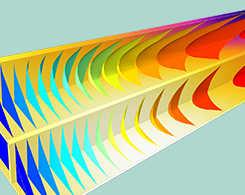
Modeling Approaches in Heterogeneous Catalysis
Get an introduction to heterogeneous catalysis, the main steps for chemical species in heterogeneous catalytic reactions, adsorption-desorption models, surface reactions, and much more…
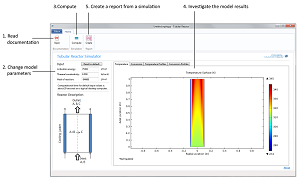
Apps for Teaching Mathematical Modeling of Tubular Reactors
Chemical engineering students can use the Tubular Reactor app to model a nonideal tubular reactor and investigate the impact of different operating conditions. Learn more >>
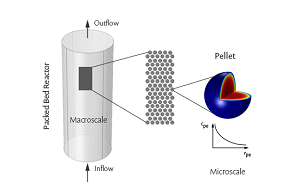
Multiscale Reactors: Cleaning the Flows
Packed bed reactors are used in chemical synthesis and for effluent treatment and catalytic combustion, are often required for heterogeneous catalysis, and commonly include catalyst pellets.
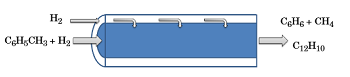
Modeling Hydrodealkylation in a Membrane Reactor
Hydrodealkylation is a hydrogen-intensive process. We demonstrate using the thermodynamics modeling features in the COMSOL® software to analyze this process in a membrane reactor.
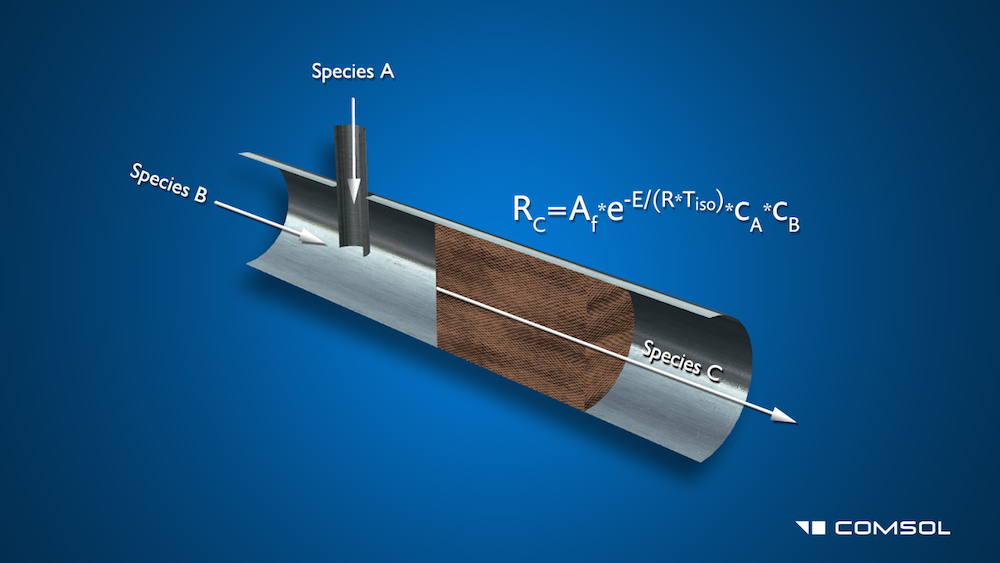
Modeling Reacting Flow in Porous Media
This blog post and embedded tutorial video demonstrate what inputs are required and what results you can obtain when modeling a porous reactor in COMSOL Multiphysics®.
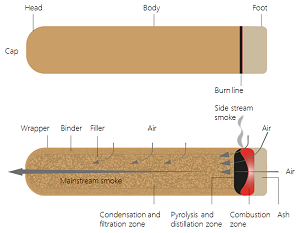
Sometimes a Cigar Is More Than Just a Cigar
Are you a casual stogie fan? A cigar aficionado? We show off a simple model of a cigar to study the temperature distribution of the smoke and concentration of oxygen.
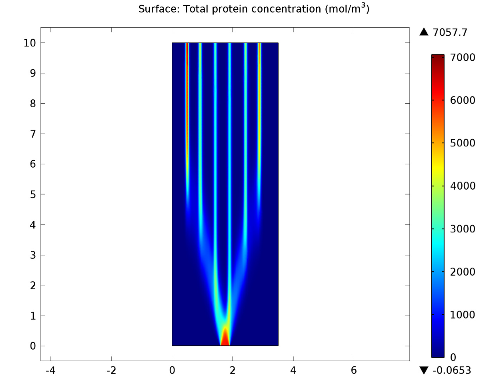
Isoelectric Focusing and the Migration of Chemical Species
Isoelectric focusing is a type of electrophoresis used by researchers to identify small chemical differences between molecules. Learn about using the COMSOL® software to analyze this process.


