
Blog Posts Tagged Acoustics Module
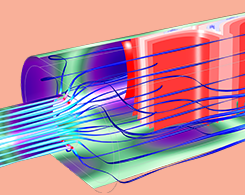
Seeing Through Solids: Discovery and Applications of Photoacoustics
The field of photoacoustics started with Alexander Graham Bell and some sunlight. Now, photoacoustic imaging is used for nearly anything involving generating images of opaque material samples.
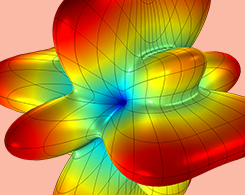
Analyzing a Loudspeaker Array with a Bessel Panel Benchmark Model
Engineers can design optimized loudspeaker arrays and other acoustics systems by analyzing a benchmark model of a Bessel panel system like the one featured in this blog post.
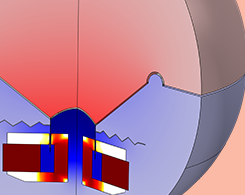
How to Perform a Nonlinear Distortion Analysis of a Loudspeaker Driver
For a thorough and complete analysis of a loudspeaker driver design, acoustics engineers need to perform nonlinear time-domain studies in addition to frequency-domain studies.
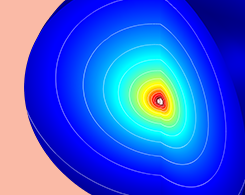
What Is the Doppler Effect?
A siren passes by and you hear a change in pitch. A bug swims across a puddle, causing ripples on the surface. A star in the sky has a reddish hue. These are all examples of the Doppler effect.

Teaching Students About Acoustics Phenomena with Apps
Acoustics concepts and their underlying theories can be difficult for engineering students to visualize. For one university, simulation applications proved to be an effective teaching tool.
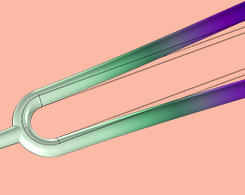
Finding Answers to the Tuning Fork Mystery with Simulation
If you strike a tuning fork and hold it against a tabletop, the peak frequency of the emitted sound doubles. Is there a physical explanation for this “tuning fork mystery”?
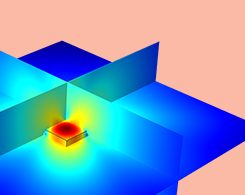
How to Use the Boundary Element Method in Acoustics Modeling
Learn advantages and strategies for using the boundary element method (BEM) for acoustics modeling. Plus, we go over a hybrid approach that combines BEM with the finite element method (FEM).
Acoustic Topology Optimization with Thermoviscous Losses
A guest blogger from GN Hearing discusses including thermoviscous losses in the topology optimization of microacoustic devices, such as hearing aids, mobile phones, and metamaterial geometries.
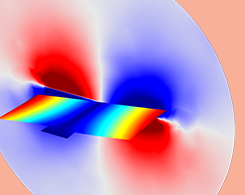
Analyzing the Viscous and Thermal Damping of a MEMS Micromirror
Micromirrors are efficient and inexpensive. Here, we go over 2 types of analyses for a MEMS micromirror design, frequency-domain and transient, using the COMSOL® software.
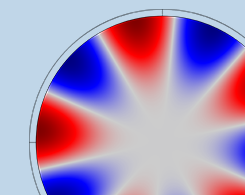
How to Use Dispersion Curves to Analyze Fluid-Filled Pipes
Modeling a fluid-filled pipe is both a time-consuming and computationally expensive process, but there’s a way to streamline the process: a guided wave propagation approach via dispersion curves.

Keynote Video: Using Simulation to Develop Reliable Audio Transducers
An engineer from a loudspeaker company discusses using simulation to design a component that can handle fatigue, environmental conditions, and user wear and tear. Watch the presentation.
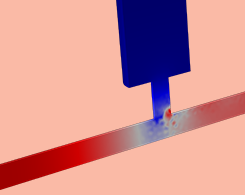
Is That a Ghost? Vibroacoustic Explanations for False Poltergeists
Creepy sounds are often misinterpreted as paranormal activity, when in fact, they can be explained with vibroacoustics, mechanical resonance, and attenuating sound.
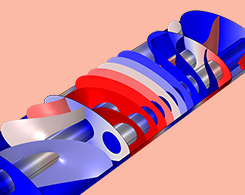
Evaluating the Effect of Shell Thickness on Muffler Performance
Guest blogger Linus Fagerberg from Lightness by Design follows up a previous post with a discussion of one design consideration for the radiated sound in a muffler design: shell thickness.
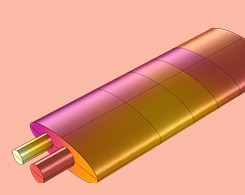
Predicting the Sound Emission of a Muffler Design via Simulation
Cars with subpar mufflers are annoyingly loud. Guest blogger Linus Fagerberg from Lightness by Design discusses a novel, simulation-based approach to predict noise generation in muffler designs.
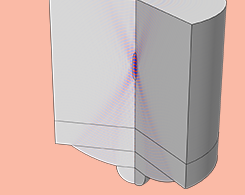
Using Simulation to Study Ultrasound Focusing for Clinical Applications
Guest blogger Thomas Clavet of EMC3 Consulting discusses the simulation of ultrasound focusing via phased array and geometrically focused probe designs for clinical uses.
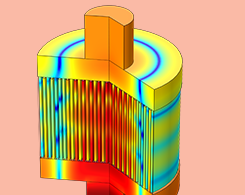
Analyzing the Acoustics in a Simplified Particulate Filter Model
A diesel particulate filter catches exhaust emissions in some automotive systems. It’s important to study the acoustic properties of these filters, as they can affect mufflers and other parts.
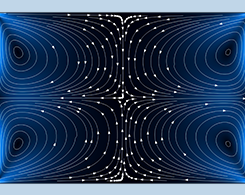
Efficiently Analyze Acoustic Streaming with Multiphysics Modeling
Acoustic streaming is when sound waves are used to generate steady fluid motion. You can use multiphysics modeling for an efficiency way to analyze this phenomenon.
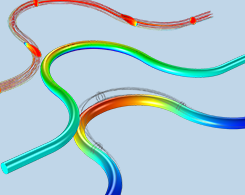
Modeling Aeroacoustics with the Linearized Navier-Stokes Equations
Get a comprehensive introduction to aeroacoustics modeling, as well as the linearized Navier–Stokes equations and how to implement them in COMSOL Multiphysics®.
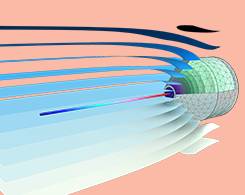
Analyzing a Probe Tube Microphone Design with Acoustics Simulation
Probe tube microphones are an important component in hearing aids. Learn about how you can use acoustics modeling to analyze the design and predict the performance of these devices.

How to Model Gearbox Vibration and Noise in COMSOL Multiphysics®
Compute the NVH, an important design consideration for automobiles, industrial machinery, and more, in a gearbox design using multibody analysis. Part 5 of a series on gear modeling.
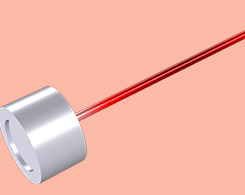
Analyzing Hearing Aid Receivers with Lumped-Parameter Modeling
Modeling complete hearing aid systems is extremely computationally expensive. Enter lumped-parameter modeling, which enables you to couple a system component to a test setup for validation.
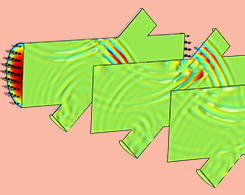
Using the Discontinuous Galerkin Method to Model Linear Ultrasound
You can easily model acoustically large problems, like linear ultrasound, with a predefined physics interface that uses a memory-efficient approach called the discontinuous Galerkin method.
Keynote Video: Locating Leaks in Pipe Networks with a Simulation App
Sebastien Perrier of Echologics discusses a simulation application used to locate leaks in underground pipe networks in his keynote presentation at the COMSOL Conference 2016 Boston.

How to Model an Anechoic Coating
Modeling an anechoic coating involves finding the smallest unit cell, truncating the geometry, and analyzing the wave diffration. The COMSOL® software includes predefined interfaces to do so.