
Search Results
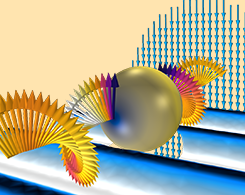
How to Couple Radiating and Receiving Antennas in Your Simulations
Learn how to couple radiating and receiving antennas in your simulations by using the scattered field formulation. Part 3 of a series on multiscale modeling in high-frequency electromagnetics.
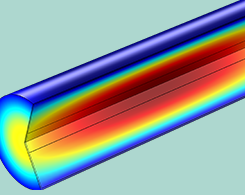
Modeling the Performance of an Evaporative Emission Control System
Researchers turned to COMSOL Multiphysics to model the adsorption and desorption in an evaporative emissions control system for enhanced automotive efficiency.
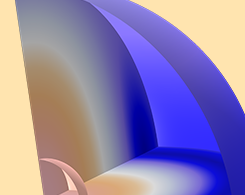
2 Methods for Simulating Radiated Fields in COMSOL Multiphysics®
2 ways to model radiated fields: the Far-Field Domain node and the Electromagnetic Waves, Beam Envelopes interface. Part 2 of a series on multiscale modeling in high-frequency electromagnetics.
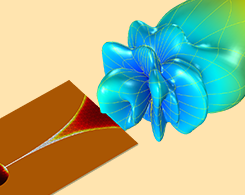
Introduction to Multiscale Modeling in High-Frequency Electromagnetics
Here’s an introduction to performing multiscale analyses of antennas and communication systems. Part 1 of a series on multiscale modeling in high-frequency electromagnetics.
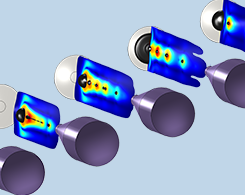
Designing Inkjet Printheads for Precise Material Deposition
The design of an inkjet printhead nozzle is important in order for the device to have precise material deposition, whether it is used in a 2D or 3D printer.

Perform Rotordynamic Analyses of a Reciprocating Engine’s Crankshaft
You can use the Rotordynamics Module, an add-on to COMSOL Multiphysics®, to analyze the design of a crankshaft for a reciprocating engine.
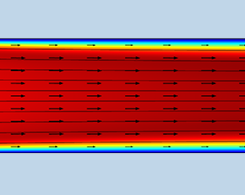
How to Assign Fluid Pressure in CFD Simulations
What is the difference between relative and absolute pressure? Why does COMSOL Multiphysics® use relative pressure to solve CFD problems? Get answers here…

Investigating Whale Behavior with an Innovative Tagging Device
Using a durable tracking device, marine biologists and oceanographic researchers can enhance their understanding of whale behavior and investigate ocean conditions.