
Search Results
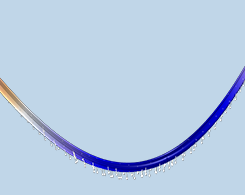
Understand Phenomena in the Viscous Catenary Problem via Simulation
The viscous catenary problem is theoretically and experimentally significant in many industries due to the complex phenomena it entails. Simulation can help us understand this problem.

Designing CSRR-Based Sensors to Monitor Chronic Kidney Disease
Chronic kidney disease can be effectively diagnosed, prevented, and treated through the use of noninvasive CSRR-based sensors. Researchers optimized the design of these sensors with simulation.
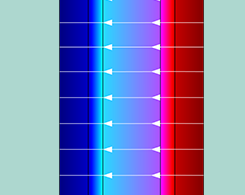
Analyzing Reverse Electrodialysis Units with Multiphysics Modeling
Pass the salt…for a clean energy solution. Salinity gradient power relies on osmosis between fresh- and saltwater to generate power, and simulation can help analyze and optimize such systems.
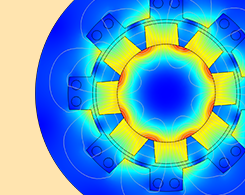
Simulating the Electrothermal Transients in Superconducting Magnets
In order to design superconducting magnets for a particle accelerator, such as the Large Hadron Collider at CERN, researchers need to simulate and optimize their electrothermal transients.
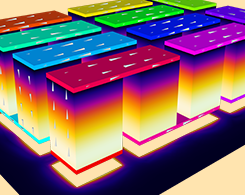
How to Analyze Thermoelectric Cooler Designs with a COMSOL App
A simulation application, such as one for a thermoelectric cooler design, can be used to test a variety of parameters in order to optimize a device for a specific use.
How to Compute Distances Between Objects in COMSOL Multiphysics®
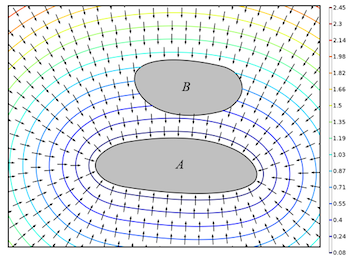
Compute the distance between two deforming objects in the COMSOL Multiphysics® software. Here’s how…
How to Implement the Fourier Transformation from Computed Solutions
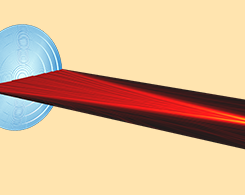
In this wave optics demonstration, learn how to implement the Fourier transformation for computed solutions, using the example of an electromagnetic simulation of a Fresnel lens.
Improving the Design of Monolithically Integrated Magneto-Optic Routers
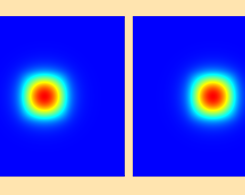
Magneto-optic (MO) routers are an efficient alternative to electro-optic (EO) routers for communication systems. Learn about a modeling approach used by researchers to improve MO router designs.