
Latest Posts
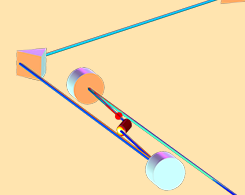
Ray Optics Simulation of Sagnac Interferometers and Ring Laser Gyros
Have you ever been in a revolving restaurant that slowly spins as you dine? This same concept can be used to understand the operating principles of Sagnac interferometers and ring laser gyros.
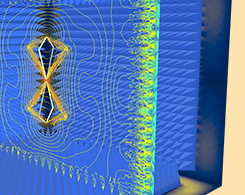
Smart(er) Healthcare: Designing RFID Tags for Biomedical Applications
Bioengineering meets RF simulation in this blog post about designing RFID systems that can be used for safe and optimized patient care.
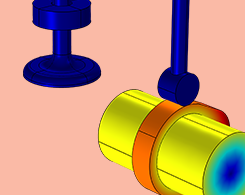
How to Model a Cam-Follower Mechanism
Watch a series of animations that show the different types of cam-follower mechanisms before learning how to model them in COMSOL Multiphysics®.

Common Pitfalls in Electrothermal Analysis
In the real world, electromagnetic heating often involves a nonlinear temperature. Learn some common pitfalls that occur during this type of electrothermal analysis and how to overcome them.
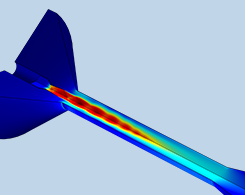
Analyzing a Supersonic Ejector with CFD Simulation
From food refrigeration in a local market to debris removal in the outer corners of space, ejectors have a wide range of uses. You can use the CFD Module to analyze a supersonic ejector design.

Happy Birthday, Leonhard Euler
His last name is pronounced “oiler” and he is considered one of the greatest mathematical scientists of all time. Learn about the life and work of Leonhard Euler.
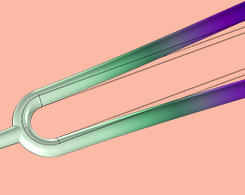
Finding Answers to the Tuning Fork Mystery with Simulation
If you strike a tuning fork and hold it against a tabletop, the peak frequency of the emitted sound doubles. Is there a physical explanation for this “tuning fork mystery”?

Multiphysics Modeling of Stress Corrosion in Underground Pipelines
Stress corrosion is a phenomenon that causes degradation in underground pipelines. Learn how to use multiphysics modeling to understand and predict its occurrence.
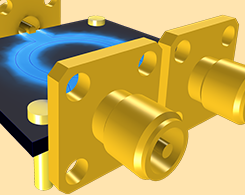
Simulating an SMA Connector on a Grounded Coplanar Waveguide
SMA connectors are used in cellphone antennas and PCB testing. To optimize their performance for a specific use, electrical engineers can evaluate their designs with simulation.
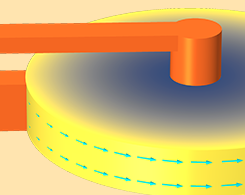
Redesigning Faraday’s Wheel: Creating Efficient Homopolar Generators
Acyclic generator, unipolar generator, disc dynamo, Faraday wheel, homopolar generator: Whatever you call it, this device has an interesting history and a variety of applications.
How to Model Linear and Nonlinear Optics in the COMSOL® Software
See how to model the Kerr effect, and other linear and nonlinear optical phenomena, using the Wave Optics Module and COMSOL Multiphysics®.
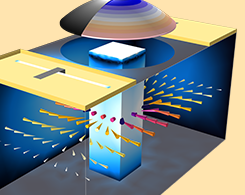
High-Fidelity Modeling of a Tunable Filter via Multiphysics Simulation
Tunable cavity filters can enhance the development of high-speed, wireless communication networks. To optimize these devices for such a purpose, we can turn to high-fidelity modeling.

How to Perform Multimaterial Optimization in COMSOL Multiphysics®
Does a tuning fork sound better when made out of aluminum instead of copper or steel? In COMSOL Multiphysics®, you can perform an optimization study for multiple materials to find out.
How to Use the Parameter Estimation Study Step for Inverse Modeling
This blog post includes a tutorial video. Watch it to learn the steps for performing a parameter estimation study for inverse modeling in COMSOL Multiphysics®.
Coastal Erosion Uncovers Buried Tracks from Throughout History
In 2018, a series of winter storms caused severe erosion along a U.S. coastline, uncovering footprints and horse-and-buggy tracks from centuries earlier.
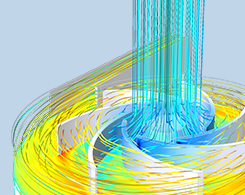
Using the Algebraic Multigrid (AMG) Method for Large CFD Simulations
There’s an ideal method for solving large CFD simulations that involve complex geometries. It’s called the algebraic multigrid (AMG) method, and you can learn all about it here.
Happy Birthday, Pierre-Simon Laplace
Pierre-Simon Laplace contributed to celestial mechanics and helped develop an equation for pressure across a curved surface. He also had his demons. The Laplace demon thought experiment, that is.
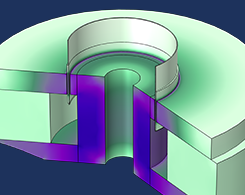
Topology Optimization of a Magnetic Circuit for Loudspeakers
By optimizing the topology of loudspeaker components, such as magnetic circuits, we can develop speaker designs that are portable, lightweight, and high quality.

Keynote Video: Moving Beyond Simulation for Biopharma Applications
At Amgen, researchers build simulation applications for biopharmaceutical uses, such as researching biological and synthetic drugs. Learn more in this blog post featuring their keynote talk.

How to Use Interpolated Material Data to Model Irregular Geometries
Learn how to model an irregular geometry in COMSOL Multiphysics® by importing material data. The example featured here is for an RF simulation of a human head.
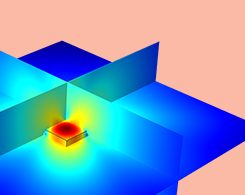
How to Use the Boundary Element Method in Acoustics Modeling
Learn advantages and strategies for using the boundary element method (BEM) for acoustics modeling. Plus, we go over a hybrid approach that combines BEM with the finite element method (FEM).

Using the Inflow Boundary Condition in Nonisothermal Flow Simulations
Nonisothermal flow is a multiphysics problem, as it combines CFD and heat transfer analysis. Learn how to implement the Inflow boundary condition when simulating these types of scenarios.
Happy Birthday, Albert Einstein
Albert Einstein, Nobel prize winner and “Person of the Century”, is known for developing the special and general theories of relativity and the law of the photoelectric effect.
Modeling Phase Change in a Thermosiphon
A guest blogger from Noumenon Multiphysics writes about modeling phase change in a thermosiphon, a device that has been keeping houses warm since the 1800s.


