

When not being held, our cellphones are rarely more than an arm’s reach away. With so much handling, dropping them is a common occurrence. According to a survey by Allstate, around 78 million Americans reported damaging their cellphones in 2023, with cracked screens accounting for 67% of that damage (Ref. 1). Your phone may be unscathed after some drops and shattered after others, so how do we know what conditions are most likely to cause damage? Version 6.4 of the COMSOL Multiphysics® software introduces new functionality for performing time-explicit structural dynamics analyses, including simulating a phone drop test.
Introducing Explicit Structural Dynamics Features
The explicit structural dynamics functionality introduced in COMSOL Multiphysics® version 6.4 enables engineers to simulate transient and highly nonlinear events such as impact, wave propagation, and metal forming. This new framework analyzes rapid events such as impacts and explosions, using very small time steps.
The software update introduces two interfaces that use explicit time integration optimized for large deformations, high strain rates, and general contact conditions involving many objects: Solid Mechanics, Explicit Dynamics and Truss, Explicit Dynamics. The explicit formulation supports a wide range of nonlinear materials such as hyperelasticity, plasticity, viscoplasticity, and creep and can also be combined with dynamic fracture simulations.
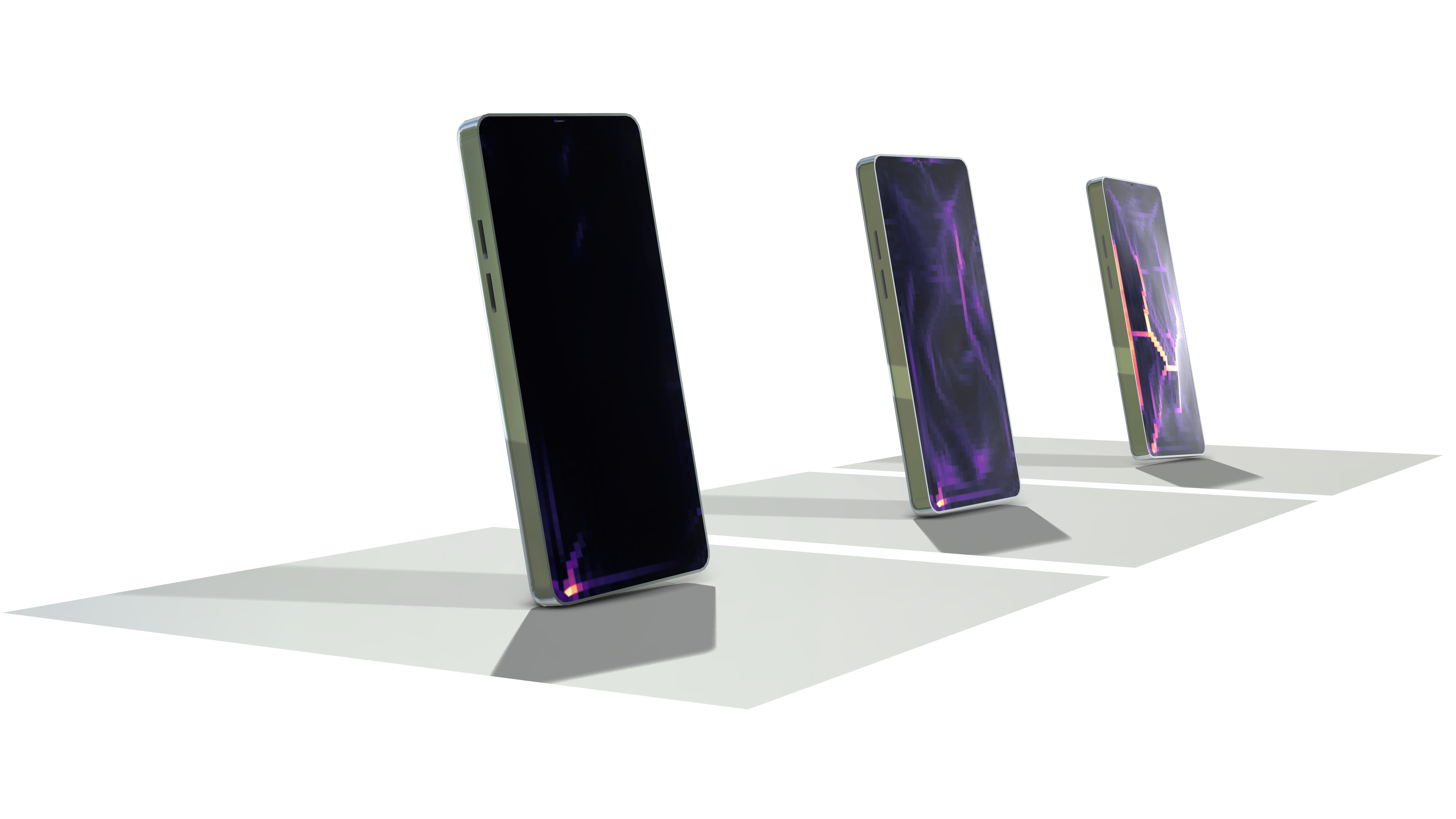 COMSOL Multiphysics version 6.4 introduces explicit structural dynamics capabilities, such as simulating drop tests of cellphones.
Modeling a Phone Drop Test
COMSOL Multiphysics® has previously offered software capabilities to design the mechanical and electrical elements working together in a cellphone and to model the chemical reactions of the battery. However, until now, there has been one important scenario that users could not simulate: the drop test.
Simulation of a drop test of a cellphone with crack propagation visualized on the front of the phone.
One of the advantages of this new functionality is that it exists within COMSOL Multiphysics®. An engineer who is developing a cellphone may need to simulate the cellphone in both implicit and explicit structural dynamics scenarios. For example, when a cellphone is packaged into a box and shipped with dozens of other boxes stacked on top of it, implicit structural dynamics — characterized by longer time steps and slower operating phenomena — can be used to analyze whether the phone on the bottom of the stack can withstand the weight of all the other boxes on top of it. At the same time, engineers need to know how well the phones can withstand being dropped. With the new functionality, explicit structural dynamics analysis can be performed within the same software environment for a comprehensive analysis of how the device will operate in the real world.
Simulating High-Speed Events
The Phone Drop Test tutorial model featured in this blog post shares an example of how to use the explicit structural dynamics functionality to identify the areas of the aluminum casing that would be damaged when a phone is dropped and track where the damage in the screen would spread to based on the height from which it is dropped. Users can study how the acceleration affects the internal components by modeling how strain develops from the point of impact.
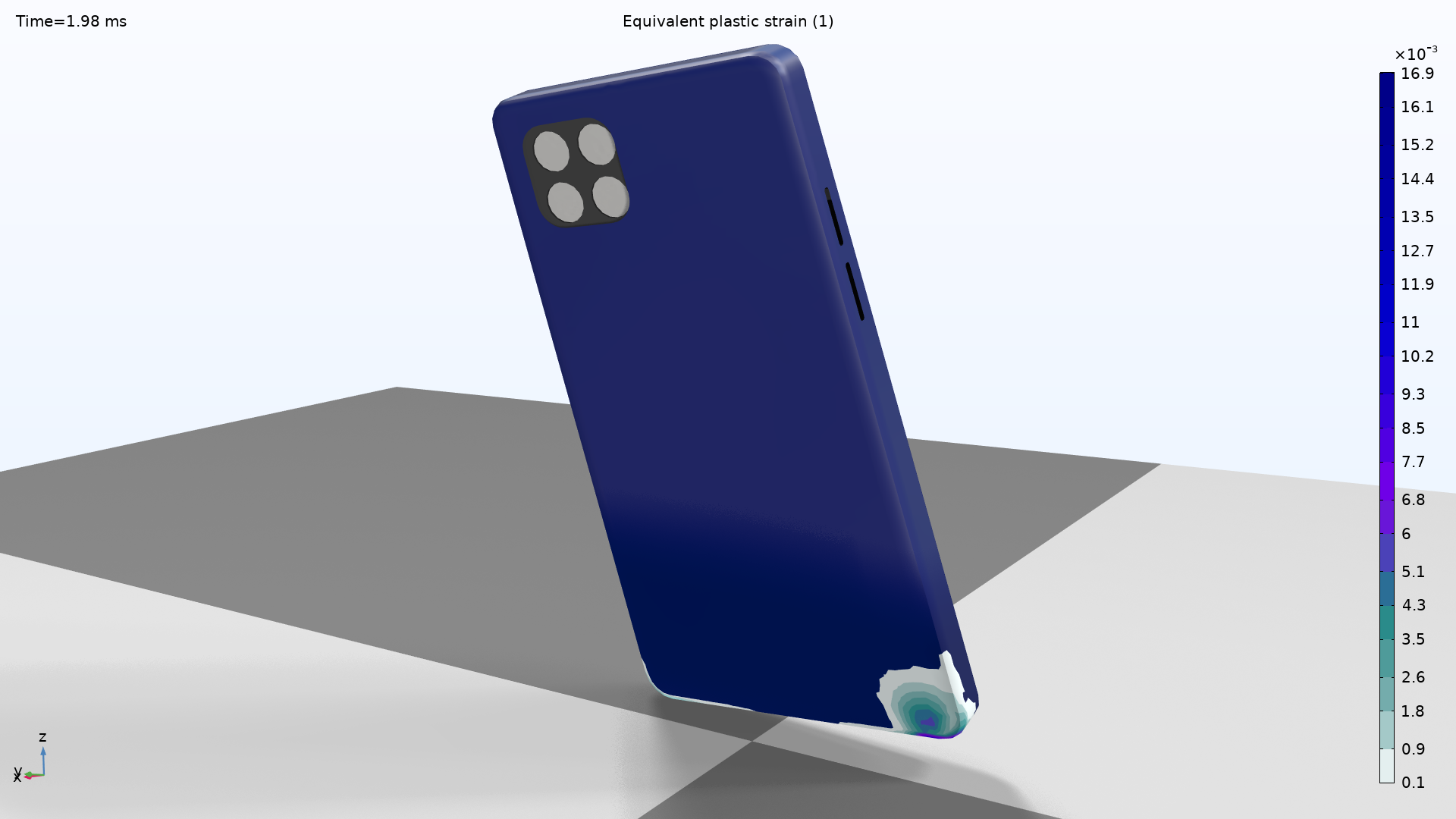
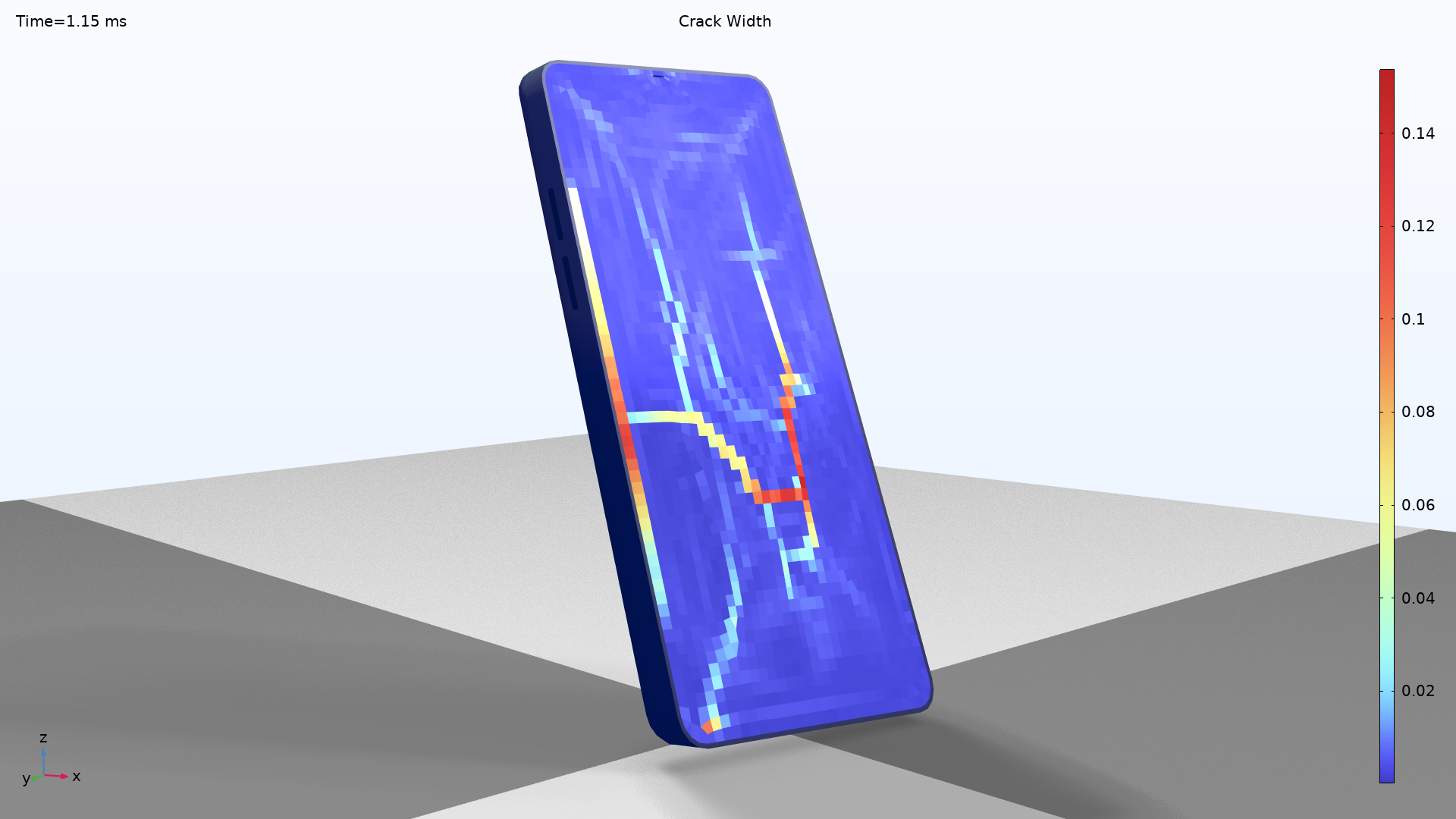
Permanent strain develops from the corner where the phone impacts the ground (left) and from the width of the crack on the glass screen at the last computed time in the analysis (right).
Users can also simulate the evolution in time of various energy quantities. The total kinetic energy quickly reduces at first due to the high acceleration during the impact with the ground. Some of this energy is dissipated as irrecoverable plastic deformation, while the rest is stored as elastic strain energy. Over time, the vibrations induced by the impact are witnessed in the graph through an exchange between kinetic and strain energy. The dissipated energy increases due to crack propagation and artificial viscosity.
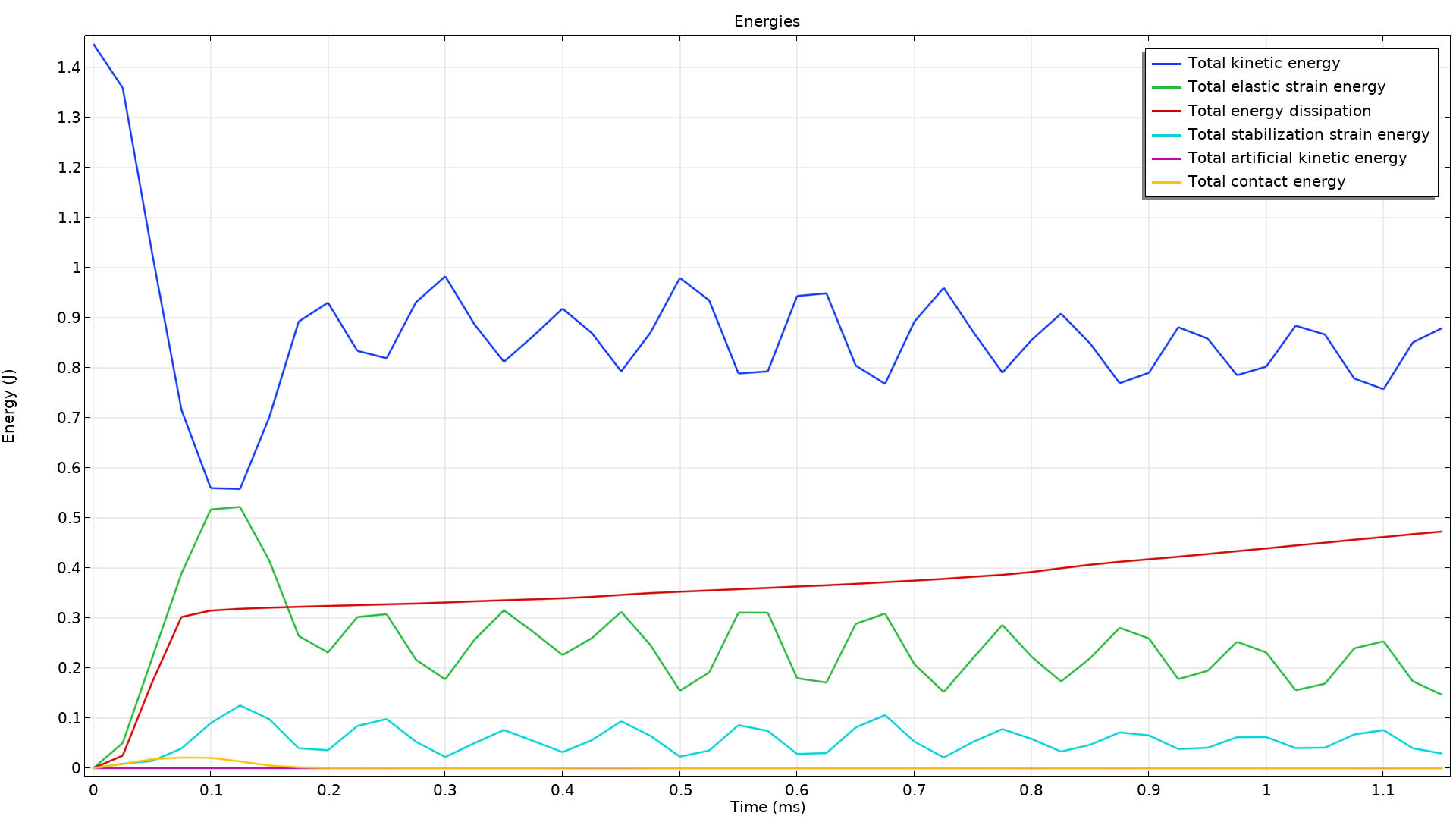 Time evolution of energy quantities, with kinetic energy shown in blue, strain energy shown in green, and dissipated energy shown in red.
The analysis show kinetic, strain, and dissipated energy in the graph, as well as allowing users to monitor the stabilization terms added by the method, which remain low throughout the simulation. The total contact energy peaks in correspondence with the impact between the phone and the ground.
Try It Out
Test out the limits of what a cellphone can withstand when dropped yourself! Download the Phone Drop Test tutorial model by clicking the button below.
Further Resources
Check out these tutorial models featuring explicit structural dynamics available in the Application Gallery:
- Bracket — Structural Mechanics Tutorials
- Objects Falling in a Box
- Seismic Event, Explicit Dynamics
- Indentation of a Cylindrical Battery Cell
References
- Allstate Protection Plans Finds 78 Million Americans Damaged Their Smartphones in the Last Year. The Nation’s Repair and Replacement Bill Now Totals $149 Billion Since the introduction of the Smartphone. (2024, March 14). Allstate https://www.squaretrade.com/press-release/allstate-protection-plans-finds-78-million-americans-damaged-their-smartphones-last/




Comments (0)