
RF & Microwave Engineering Blog Posts
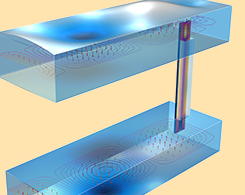
3 Examples of Modeling Transitions for Rectangular Waveguides
Waveguide to planar, coaxial to waveguide, and rectangular to elliptical: These 3 different transitions for rectangular waveguides can be modeled using COMSOL Multiphysics® and the RF Module.
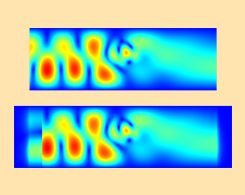
Modeling Waveguides that Support Multiple Modes
2 ways you can model a waveguide that supports multiple modes: add a PML that can be used to absorb any modes, or explicitly add ports for each possible mode.
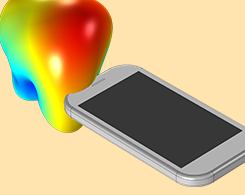
Computational Electromagnetics Modeling: Which Module to Use?
If you work with a particular electromagnetic device or application area, you might be wondering which module in the COMSOL product suite is right for you. Keep reading for a comprehensive intro.
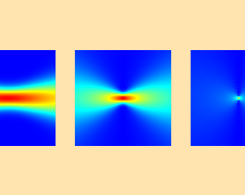
Evanescent Component of the Nonparaxial Gaussian Beam
The evanescent component of the nonparaxial Gaussian beam background field is available as a feature in the Wave Optics and RF modules as of COMSOL Multiphysics® version 5.5.

Measuring the SAR of a Human Head Next to a Wi-Fi Antenna
Many wireless devices include antennas that expose consumers to RF energy. Designers of these devices need to understand the health implications caused by electromagnetic exposure, such as SAR.
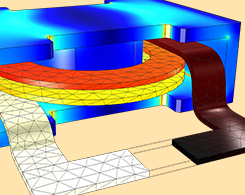
Which Study Type Should I Use for My Electrothermal Analysis?
What’s the best interface to use when implementing electrothermal analyses in COMSOL Multiphysics? We go over the interfaces, study types, and multiphysics couplings for high and low frequencies.
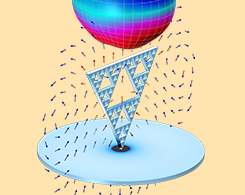
What Is the Curl Element (and Why Is It Used)?
When solving some electromagnetics problems, the curl element (also called the edge element or vector element) can be used in the finite element method.

Optimizing Microwave Ovens with Solid-State RF Cooking
Did you know that conventional microwave ovens use the same magnetron technology that was first used in WWII? These researchers thought it was time for an upgrade…


