
RF & Microwave Engineering Blog Posts

Optimizing Temperature and Pressure Sensor Placement for In-Package Microwave Heating
A team of engineers turned to COMSOL Multiphysics® to simulate the effects that different sensor positions had on microwave heating.

Insights into the Future of RF and Microwave Technology
IMS 2026 welcomed thousands of engineers and industry leaders to Boston, Massachusetts this year for an event focused on the latest RF and microwave technologies. Learn more about this event here!

Tracking Performance in the Beautiful Game
The official match ball for the 2026 FIFA World Cup® has sensors embedded in it that allow for real-time tracking and analysis. For fun, we take a look at how to model such sensors with COMSOL Multiphysics®.

Exploiting Symmetries in RF and Wave Optics Modeling
We can simplify and reduce the size and computational complexity of a wave electromagnetics model by taking advantage of any symmetries it may have. Learn how to do so here.

Designing ESD-Safe Electronic Components
In the design of electronic components, electrostatic discharge (ESD) can be modeled to provide insight into how to prevent damage. Learn about the capabilities in COMSOL® for modeling ESD in this blog post.

Methods That Accelerate the Modeling of Bandpass-Filter-Type Devices
Designing bandpass-filter type high-Q devices with the finite element method in the frequency domain? Here are some methods you can use to speed up the modeling process.

Modeling a THz Photoconductive Antenna with COMSOL Multiphysics®
Photoconductive antennas are commonly used in terahertz engineering. Learn how these devices work and how to model one with the Semiconductor Module and RF Module.
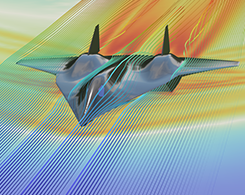
Modeling the Speed and Stealth of the Darkstar
What would the shock waves around the Darkstar really look like at Mach 7.5? How stealthy is this hypersonic jet? Here, we use modeling and simulation to find out.


