
La Galleria delle Applicazioni raccoglie un'ampia varietà di tutorial e di app dimostrative realizzati con COMSOL Multiphysics in diversi ambiti applicativi, inclusi quelli elettrico, meccanico, fluidico e chimico. E' possibile scaricare i file dei modelli e delle app demo pronti all'uso e le istruzioni step-by-step per costruirli, e utilizzarli come punto di partenza per le proprie simulazioni.
Lo strumento di Ricerca Rapida permette di trovare i modelli che si riferiscono alla propria area di interesse.
Si noti che molti degli esempi qui presentati sono accessibili anche tramite le Librerie delle Applicazioni incorporate nel software COMSOL Multiphysics® e disponibili dal menu File.
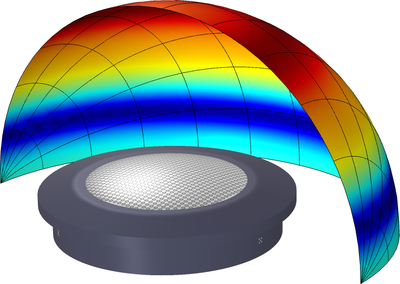
Model used as demonstration in the APEI/AES session on August 11. https://audioproducteducationinstitute.org/speakers-and-microphones-simulation-and-testing/ The geometry is invented and uses parts from two models: https://www.comsol.com/model/head-and-torso-simulator-acoustics-74381 ... Per saperne di più

A fractal is a mathematical form showing self-repeating patterns. By virtue of its geometrical properties, a fractal structure can generate multiple resonances in RF applications. This antenna model uses a 3rd order Sierpinski triangle and the calculated S-parameters shows good input ... Per saperne di più
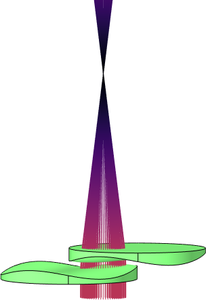
Freefrom optics has generated renewed interest due to advances in fabrication and manufacturing technology. In this Application Library example, we are going to look at a specific design called the Alvarez lens where two complementary conic surfaces are shifted laterally with respect to ... Per saperne di più
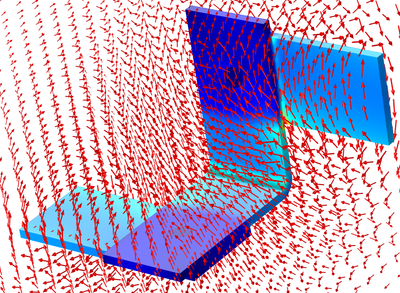
This is a busbar configuration with an AC analysis. The configuration is similar to the introductory tutorial in the book Introduction to COMSOL Multiphysics. However, two conductors are added to represent a more realistic case of magnetic fields surrounding the busbar. The results ... Per saperne di più
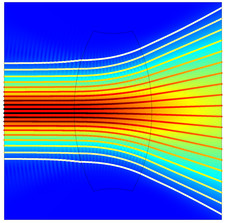
This example demonstrates how to set up a spatially varying dielectric distribution. Here, a convex lens shape is defined via a known deformation of a rectangular domain. The dielectric distribution is defined on the undeformed, original rectangular domain and is mapped onto the deformed ... Per saperne di più
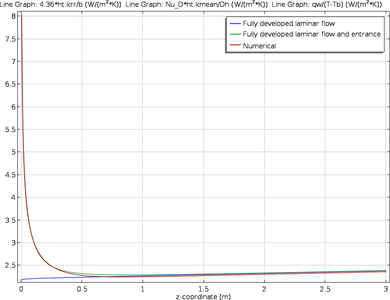
This verification model of nonisothermal laminar flow through a circular tube compares the heat transfer coefficient obtained from simulation with theoretical values based on Nusselt number correlation functions that can be found in the literature. Per saperne di più

This a continuation of the permanent magnet motor model available here . In this model, an heat transfer analysis has been performed to compute the temperature rise for various stator current and rotor speed. A detailed analysis on torque, and losses in iron and copper have then been ... Per saperne di più
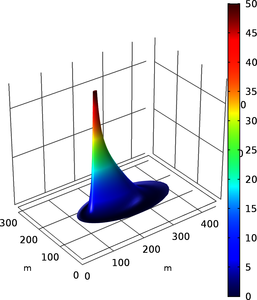
This model tracks a contaminant that enters an aquifer at a point, such as an injection well or toxic spill, and spreads through the aquifer with time. The model has an analytic solution developed by Wilson and Miller. This analytic solution has been used to test several dedicated fluid ... Per saperne di più


