
La Galleria delle Applicazioni raccoglie un'ampia varietà di tutorial e di app dimostrative realizzati con COMSOL Multiphysics in diversi ambiti applicativi, inclusi quelli elettrico, meccanico, fluidico e chimico. E' possibile scaricare i file dei modelli e delle app demo pronti all'uso e le istruzioni step-by-step per costruirli, e utilizzarli come punto di partenza per le proprie simulazioni.
Lo strumento di Ricerca Rapida permette di trovare i modelli che si riferiscono alla propria area di interesse.
Si noti che molti degli esempi qui presentati sono accessibili anche tramite le Librerie delle Applicazioni incorporate nel software COMSOL Multiphysics® e disponibili dal menu File.

This document explains how to install and run COMSOL Multiphysics® and COMSOL Server™ with Amazon Elastic Compute Cloud™ (EC2™). This requires that you have first acquired a Floating Network License (FNL) or COMSOL Server License (CSL) from COMSOL. The license manager ... Per saperne di più

This model demonstrates how to create a rotated helix geometry, i.e., a helix that is winded to form a torus. This is done sweeping a circle along a parametric curve. The radius of the torus and the radius of the coil are given as parameters as well as the number of windings of the coil. Per saperne di più
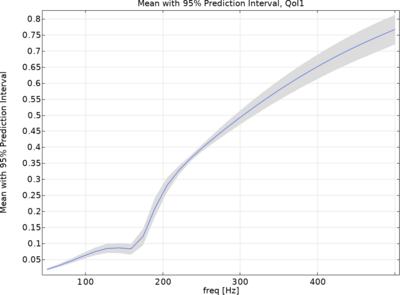
It can in many cases be difficult to get accurate material properties for porous materials. Measuring the properties to high precision can involve lengthy measurements using different techniques. It can therefore be interesting to understand how uncertainties in different material ... Per saperne di più

The miniaturization of electronics devices requires batteries with higher energy density and power. To increase the contact area between the electrodes and the solid electrolyte, 3D configurations such as the trench geometry are used. This example demonstrates how to model a solid-state ... Per saperne di più

The dipole tonal noise generated by flow over a cylinder in free space is modeled using a two step hydrodynamic/acoustic splitting method. First, the unsteady hydrodynamic flow field is calculated using the incompressible Navier-Stokes equations. Second, the Linearized Perturbed ... Per saperne di più

This model demonstrates how to use the chatbot functionality in COMSOL Multiphysics® to add annotations to a model of a pacemaker electrode. To learn more about this model, see our accompanying blog post “Using the Chatbot Window in COMSOL Multiphysics®”. Per saperne di più

This tutorial shows how to simulate coupled heat and moisture transport in a wall. The wall is modeled considering an air flow between interior and exterior varying with time. The 1D model is the third benchmark test defined in HAMSTAD-WP2 Modeling for the validation of numerical ... Per saperne di più

The model estimates the AC breakdown voltage between parallel electrodes in air by simulating charge transport dynamics. To keep computations efficient, it is implemented in one dimension, though it can be adapted for different gases and extended to higher-dimensional setups. The ... Per saperne di più
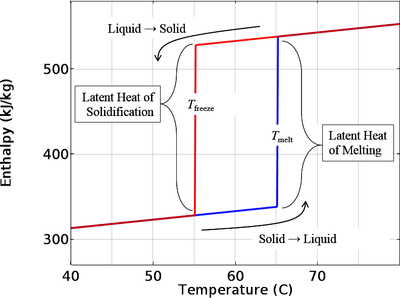
This example exemplifies how to model thermal phase change that is subject to hysteresis. A more detailed description of the phenomenon, and the modeling process, can be seen in the blog post "Thermal Modeling of Phase-Change Materials with Hysteresis" as well as: "How to Use State ... Per saperne di più

In this verification example, the built-in functionality for calculating dynamic coefficients in hydrodynamic bearings is validated. The results are compared with those obtained using the finite perturbation method to ensure consistency and accuracy. The model showcases how numerical ... Per saperne di più


