
La Galleria delle Applicazioni raccoglie un'ampia varietà di tutorial e di app dimostrative realizzati con COMSOL Multiphysics in diversi ambiti applicativi, inclusi quelli elettrico, meccanico, fluidico e chimico. E' possibile scaricare i file dei modelli e delle app demo pronti all'uso e le istruzioni step-by-step per costruirli, e utilizzarli come punto di partenza per le proprie simulazioni.
Lo strumento di Ricerca Rapida permette di trovare i modelli che si riferiscono alla propria area di interesse.
Si noti che molti degli esempi qui presentati sono accessibili anche tramite le Librerie delle Applicazioni incorporate nel software COMSOL Multiphysics® e disponibili dal menu File.

The Hubble Space Telescope (HST) is an example of a standard Cassegrain telescope. The Conic Mirror On Axis 3D part from the COMSOL part library is used to construct the HST Ritchey-Chretien geometry. Multiple release features are used to generate on and off-axis ray and spot diagrams. Per saperne di più

RFIDs are used in a multitude of applications such as tracking or identifying consumer products and their packaging. An RFID system consists of two main parts: A tag or transponder with a printed circuit-board (PCB) antenna A reader unit with a larger RF antennaThe reader antenna ... Per saperne di più

This example minimizes the mass of a bracket that is synchronized from SOLIDWORKS® via the LiveLink™ interface. There are limits both for the lowest natural frequency, and for the maximum stress in a static load case. The size and position for a number of geometrical features ... Per saperne di più
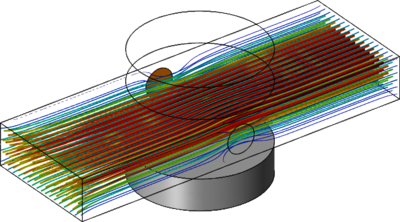
These two models show how to set up a magnetohydrodynamics model using either a fully coupled approach, or a one-way coupled approach. A more detailed description of these models can be seen in the blog post "Building a Magnetohydrodynamic Multiphysics Model in COMSOL®". Per saperne di più

This is a transient model of an electromagnetic plunger consisting of a magnetic core, nonmagnetic guider, multi-turn coil, and magnetic plunger attached to the spring and damper at the far end. The electromagnetic force on the plunger due to the transient current in the coil is ... Per saperne di più

In this verification example, forced random vibrations of a simply-supported deep beam are studied. The beam is loaded by a distributed force with a uniform power spectral density (PSD). The output PSD is computed for the displacement and bending stress response. The computed values are ... Per saperne di più

Acoustic streaming, a steady flow induced by sound waves, has been used in biomedical and engineering industrial., Examples include enhancement of convective heat transfer, ultrasonic cleaning, localized micro-mixing, hemolysis of blood cells, and micropumps etc. The phenomenon is ... Per saperne di più

Microstrip filters can be fabricated directly on a printed circuit board (PCB) with a microstrip line going from the input to the output. Along the microstrip line there are a number of stubs of certain lengths and widths. The design of the filter involves choosing the impedance of the ... Per saperne di più


