
La Galleria delle Applicazioni raccoglie un'ampia varietà di tutorial e di app dimostrative realizzati con COMSOL Multiphysics in diversi ambiti applicativi, inclusi quelli elettrico, meccanico, fluidico e chimico. E' possibile scaricare i file dei modelli e delle app demo pronti all'uso e le istruzioni step-by-step per costruirli, e utilizzarli come punto di partenza per le proprie simulazioni.
Lo strumento di Ricerca Rapida permette di trovare i modelli che si riferiscono alla propria area di interesse.
Si noti che molti degli esempi qui presentati sono accessibili anche tramite le Librerie delle Applicazioni incorporate nel software COMSOL Multiphysics® e disponibili dal menu File.
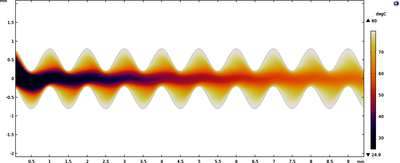
The model has its emphasis on heat transport in a very small heat exchanger that is commonly used in the field of microelectromechanical systems (MEMS). In this case, it might be a reactive processes that needs heating. The heat exchanger itself is constructed by stacking several ... Per saperne di più
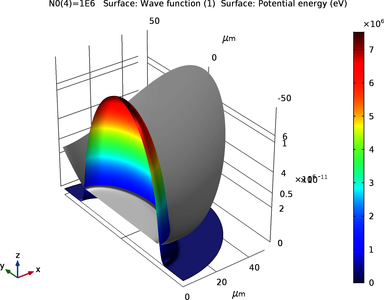
This tutorial model solves the Gross–Pitaevskii Equation for the ground state of a Bose–Einstein condensate in a harmonic trap, using the Schrödinger Equation interface in the Semiconductor Module. The equation is essentially a nonlinear single-particle Schrödinger Equation, with a ... Per saperne di più

A simple model for groundwater contamination portrays a well that is bored into an aquifer. The aquifer consists of a partially saturated layer and a fully saturated layer. The model investigates how much of the contaminant ends up in the well after a contaminant is introduced in the ... Per saperne di più

A Chladni plate is a metal plate that is covered in sand and subjected to vibrations. At certain frequencies, the vibrations produce standing waves, resulting in sand patterns formed on the plate. The vibrations are either formed from a violin bow at the side of the plate or a wave ... Per saperne di più

This model showcases the broadband optimization for the Microstructured antireflective coatings that are modeled in the model (#99011). Following are the parameters that are optimized: Rectangular microstructure: Height and width of the rectangular microstructure. Pyramidal ... Per saperne di più
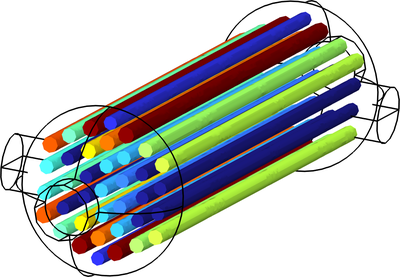
Commercial heat exchangers often feature a complex design. It is significantly easier to build a design with new CAD parameters than to build designs with novel topologies. This model demonstrate how to optimize the size and position of the tubes in a tube and shell heat exchanger. It is ... Per saperne di più
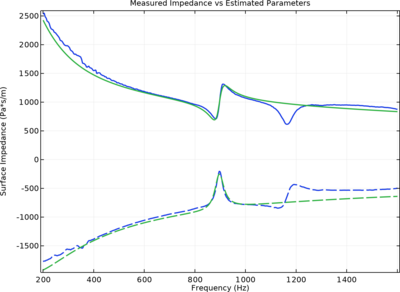
This app is an example of how the poroelastic properties of a porous material can be determined based on measurement done with an impedance tube and parameter estimation. Being able to determine the characteristics of a porous material from a single and simple measurement opens the door ... Per saperne di più
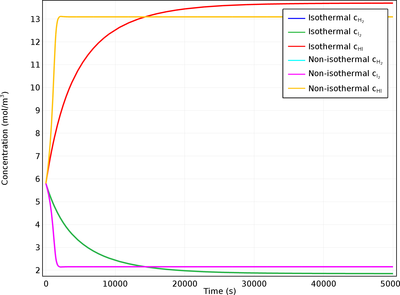
This tutorial example illustrates the versatility of the Reaction Engineering interface. The hydrogen iodine reaction is modeled in a batch reactor with constant volume. Both isothermal and non-isothermal conditions are modeled. Per saperne di più

The eddy currents in a conductive cylinder, generated from currents passing through a surrounding coil, are studied. The skin effect in the coil is also studied. Per saperne di più

This model simulates a cylindrical furnace with isotropic scattering. It validates the use of the Discrete Ordinates Method for 2D axisymmetric cases, comparing the results with the highly accurate Monte Carlo method. The setup and reference Monte Carlo values are given in: R .P. Gupta, ... Per saperne di più


