
La Galleria delle Applicazioni raccoglie un'ampia varietà di tutorial e di app dimostrative realizzati con COMSOL Multiphysics in diversi ambiti applicativi, inclusi quelli elettrico, meccanico, fluidico e chimico. E' possibile scaricare i file dei modelli e delle app demo pronti all'uso e le istruzioni step-by-step per costruirli, e utilizzarli come punto di partenza per le proprie simulazioni.
Lo strumento di Ricerca Rapida permette di trovare i modelli che si riferiscono alla propria area di interesse.
Si noti che molti degli esempi qui presentati sono accessibili anche tramite le Librerie delle Applicazioni incorporate nel software COMSOL Multiphysics® e disponibili dal menu File.
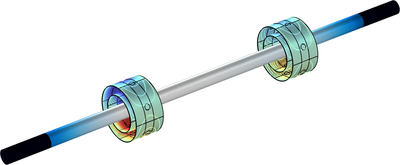
In this model, a turbocharger supported on two floating ring bearings is studied. The film forces on the ring cause it to rotate within the bearing. In steady state, the ring rotates at a constant angular speed and the torque on the ring due to the inner and outer films are balanced. ... Per saperne di più
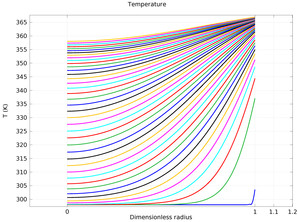
This model approximates 3D spherical transport using a 1D model. Many models of industrial-transport problems allow the assumption that the problem is spherically symmetric. This assumption is of great importance because it eliminates two space coordinates to result in a 1D problem that ... Per saperne di più
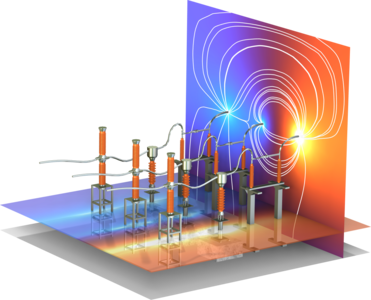
Breaker and disconnector devices are widely used in AC substations in power systems.In this model, the Electrostatics Interface is used to simulate the electric potential and electric field in a 110kV 3-phase high-voltage switchgear operating at 50 Hz. A surrogate model is also trained ... Per saperne di più
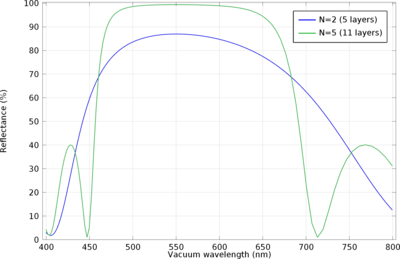
A distributed Bragg reflector (DBR) is a periodic structure formed from alternating dielectric layers that can be used to achieve nearly total reflection within a range of frequencies, with minimal losses. In this tutorial a Bragg reflector is modeled with a central wavelength of 550[nm] ... Per saperne di più
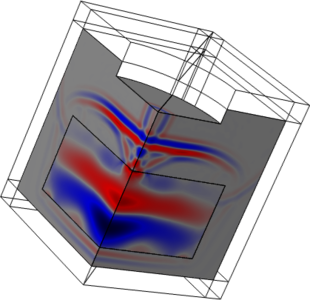
This tutorial showcases the principles of the immersion ultrasonic testing technique. A search unit placed in a water tank sends an ultrasonic pulse signal that scatters off a solid object. Part of the signal is reflected back to the search unit by the object and possible flaws in it. By ... Per saperne di più
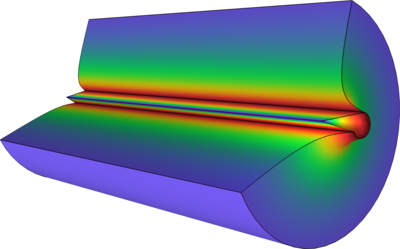
This introduction model creates a simple model of the magnetostatics problem with a wire of infinite length carrying current, which is commonly found in textbooks. Since there is an analytical solution to this problem, the model can be used to compare theory with numerical results from ... Per saperne di più
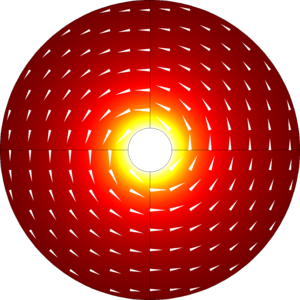
The coaxial cable (coax) is one of the most ubiquitous transmission line structures. It is composed of a central circular conductor, surrounded by an annular dielectric, and shielded by an outer conductor. This model computes the electric and magnetic field distribution inside of the ... Per saperne di più
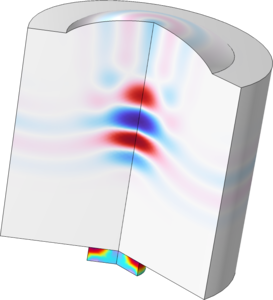
Piezoelectric devices are widely used as sources to generate sound waves or receivers to detect acoustic signals. In applications such as ultrasound imaging and nondestructive testing, the same transducer can be used as a transmitter to send a source signal and receiver to detect ... Per saperne di più


