
Modeling Vibration in an Induction Motor
Application ID: 47871
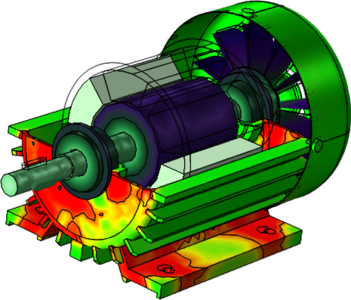
This example illustrates the modeling of an induction motor in which eddy currents are induced in the rotor by time-harmonic currents in the stator windings and by the rotor rotation. The induced currents interact with the magnetic field generated by the stator coils to produce the driving torque. An asymmetric air gap between the rotor and stator gives rise to electromagnetic forces that cause vibrations in the motor.
The electromagnetic behavior is modeled in 2D and coupled to a 3D multibody dynamics model. The electromagnetic torque is computed as a function of time and used to determine the rotor speed while accounting for inertial effects. Resistive losses and the load torque cause the rotor speed to differ from the synchronous speed, resulting in angular slip.
Find out more about this example in a related blog post: "Analyzing the Structural Integrity of an Induction Motor with Simulation."
This model example illustrates applications of this type that would nominally be built using the following products:
however, additional products may be required to completely define and model it. Furthermore, this example may also be defined and modeled using components from the following product combinations:
The combination of COMSOL® products required to model your application depends on several factors and may include boundary conditions, material properties, physics interfaces, and part libraries. Particular functionality may be common to several products. To determine the right combination of products for your modeling needs, review the Tabella delle Funzionalità and make use of a free evaluation license. The COMSOL Sales and Support teams are available for answering any questions you may have regarding this.


