
Thermal Cycle Test of a Flip-Chip Device
Application ID: 131051
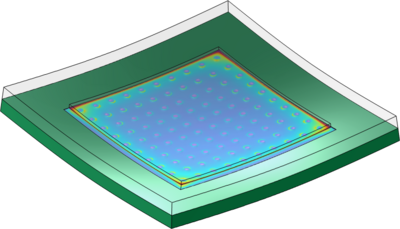
Flip-chip (FC) is one of the advanced forms of semiconductor device packaging that is widely used in today's semiconductor packages for its capability to minimize packaging size while enhancing electrical interconnection density and transmission performance. In FC devices, the active side of the chip is placed face down and the chip is bonded directly to the substrate or other carrier via bumps. Due to self-heating or environmental factors, the devices suffer repeated temperature changes during operation, which affects their lifetime. Therefore, the structural reliability of FC devices under temperature cycling conditions is one of the key concerns in package design and test phases, which can be predicted and evaluated by simulation.
In this model, the stress distribution in the chip, bumps, underfill and other regions as well as the overall warpage are analyzed for a FC device during thermal cycling test. The viscoplasticity of solder bumps is considered and the accumulation of viscoplastic strain in solder bumps is calculated. Based on these results, the damage and failure of package structures can be further studied, for example, the thermal fatigue of bumps.
This model example illustrates applications of this type that would nominally be built using the following products:
however, additional products may be required to completely define and model it. Furthermore, this example may also be defined and modeled using components from the following product combinations:
The combination of COMSOL® products required to model your application depends on several factors and may include boundary conditions, material properties, physics interfaces, and part libraries. Particular functionality may be common to several products. To determine the right combination of products for your modeling needs, review the Tabella delle Funzionalità and make use of a free evaluation license. The COMSOL Sales and Support teams are available for answering any questions you may have regarding this.


