
La Galleria delle Applicazioni raccoglie un'ampia varietà di tutorial e di app dimostrative realizzati con COMSOL Multiphysics in diversi ambiti applicativi, inclusi quelli elettrico, meccanico, fluidico e chimico. E' possibile scaricare i file dei modelli e delle app demo pronti all'uso e le istruzioni step-by-step per costruirli, e utilizzarli come punto di partenza per le proprie simulazioni.
Lo strumento di Ricerca Rapida permette di trovare i modelli che si riferiscono alla propria area di interesse.
Si noti che molti degli esempi qui presentati sono accessibili anche tramite le Librerie delle Applicazioni incorporate nel software COMSOL Multiphysics® e disponibili dal menu File.
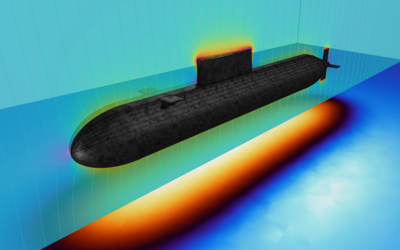
A vessel traveling on the surface or under water gives rise to detectable local disturbances in the Earth’s magnetic field. These disturbances can be used to trigger weapon systems. The magnetic signature of a ship can be reduced by generating a counteracting magnetic field of suitable ... Per saperne di più
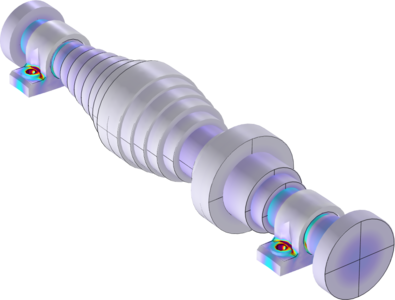
Hydrodynamic bearings generate heat due to the viscous losses in the lubricant. As a result, the temperature of the rotor increases, causing deformation and thermal stresses in both the rotor and the bearing housing. This example shows how to model different physical phenomena involved ... Per saperne di più
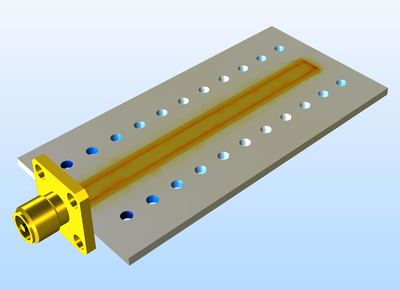
SMA connectors are popularly used on printed circuit boards (PCB) for testing. This model shows how to excite an SMA connector on a microwave substrate and how to terminate a grounded coplanar waveguide (GCPW) with 50 ohm using a lumped port and an air-bridge. Per saperne di più
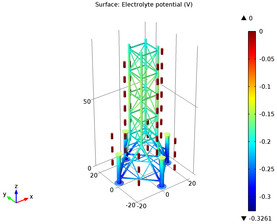
Steel structures immersed in seawater can be protected from corrosion through cathodic protection. This protection can be achieved by an impressed external current or by using sacrificial anodes. The use of sacrificial anodes is often preferred due to its simplicity. This example models ... Per saperne di più

This transient model uses the Two-Phase Flow, Level Set, Laminar Flow interface to model the impact of a water wave on a column. A body of water with a height of 0.3 meters is initially contained behind a gate. At the start of the simulation, the gate is suddenly released and the body of ... Per saperne di più
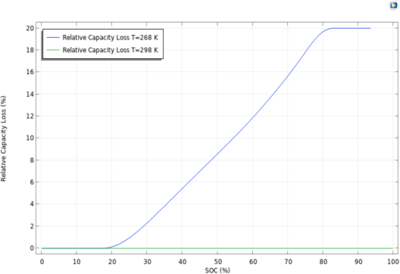
Deposition of metallic lithium on the negative electrode in preference to lithium intercalation is known to be a capacity loss and safety concern for lithium-ion batteries. Harsh charge conditions such as high currents (fast charging) and/or low temperatures can lead to lithium plating. ... Per saperne di più
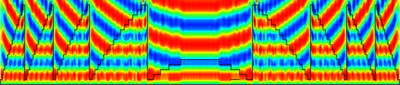
This model simulates a 16-level, first-order, focusing Fresnel lens with 50 µm diameter and 150 µm focal length. In one simulation, the Electromagnetic Waves, Frequency Domain interface computes the electric field in the Fresnel lens and the surrounding air domain extended to the focal ... Per saperne di più
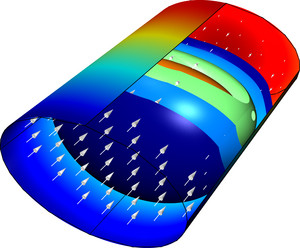
Several factors influence a diesel particulate filter’s (DPF) efficiency and durability. Important issues include the removal of soot particles from the filter membranes and the influence of thermal stress on the ceramic structure, stress that arises during repeated operating cycles. ... Per saperne di più


