
La Galleria delle Applicazioni raccoglie un'ampia varietà di tutorial e di app dimostrative realizzati con COMSOL Multiphysics in diversi ambiti applicativi, inclusi quelli elettrico, meccanico, fluidico e chimico. E' possibile scaricare i file dei modelli e delle app demo pronti all'uso e le istruzioni step-by-step per costruirli, e utilizzarli come punto di partenza per le proprie simulazioni.
Lo strumento di Ricerca Rapida permette di trovare i modelli che si riferiscono alla propria area di interesse.
Si noti che molti degli esempi qui presentati sono accessibili anche tramite le Librerie delle Applicazioni incorporate nel software COMSOL Multiphysics® e disponibili dal menu File.
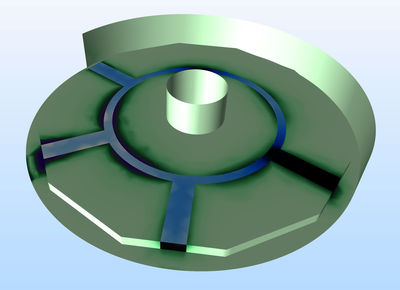
A 180° Ring Hybrid (Rat-Race Coupler) is a four-port network with 180° phase difference between two ports. It is cheaper to manufacture this type of microstrip line component compared to a wave guide 180° hybrid junction, so called magic-T. The objective of this model is to compute the S ... Per saperne di più
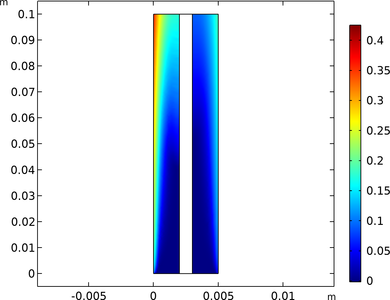
Alkaline water electrolysis is a well-established industrial process for producing hydrogen gas. In the cell, hydrogen gas is formed at the cathode whereas oxygen gas is formed at the anode. The electrolyte is an aqueous liquid, and when the evolved gases form bubbles, the effective ... Per saperne di più
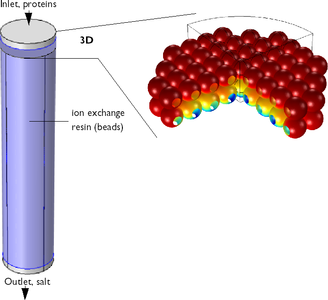
Ion-exchange is a powerful method to separate proteins from solutions and is today readily used in biotechnological and pharmaceutical industry. This model simulates an ion-exchange column for protein adsorption. The fluid phase contains four components: two proteins, solvent, and one ... Per saperne di più

This tutorial example is kindly provided by Dr. James Ransley at Veryst Engineering, LLC. This model continues from the base model “A Micromachined Comb-Drive Tuning Fork Rate Gyroscope”, which is also provided by Dr. Ransley. The model demonstrates how to accurately compute the effects ... Per saperne di più
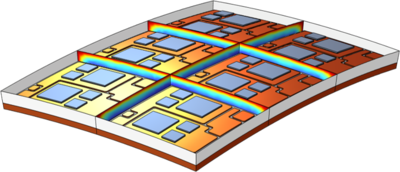
Prior to the reliability testing, surface-mount devices (SMDs) are required to go through a preconditioning process, which represents the effects of storage and the typical reflow operation in the following board assembly process. During the preconditioning process, test samples usually ... Per saperne di più
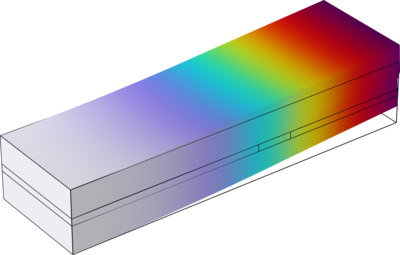
The model performs a static analysis on a piezoelectric actuator based on the movement of a cantilever beam, using the Piezoelectric Devices predefined multiphysics interface. Inspired by work done by V. Piefort and A. Benjeddou, it models a sandwich beam using the shear mode of the ... Per saperne di più
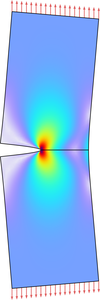
This model deals with the stability of a plate with an edge crack that is subjected to a tensile load. To analyze the stability of existing cracks, fracture mechanics theory can be utilized. A commonly used parameter in fracture mechanics, used to predict if a specific crack will cause ... Per saperne di più
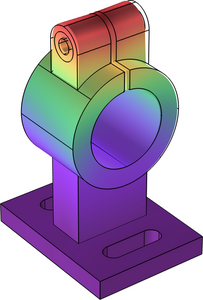
This example analyzes the deformation of a feeder clamp under stress. The clamp secures a feeder that carries high-frequency electromagnetic fields, and it is important that it remains as straight as possible. Forces on the clamp include both those from the feeder as well as those on the ... Per saperne di più


