
La Galleria delle Applicazioni raccoglie un'ampia varietà di tutorial e di app dimostrative realizzati con COMSOL Multiphysics in diversi ambiti applicativi, inclusi quelli elettrico, meccanico, fluidico e chimico. E' possibile scaricare i file dei modelli e delle app demo pronti all'uso e le istruzioni step-by-step per costruirli, e utilizzarli come punto di partenza per le proprie simulazioni.
Lo strumento di Ricerca Rapida permette di trovare i modelli che si riferiscono alla propria area di interesse.
Si noti che molti degli esempi qui presentati sono accessibili anche tramite le Librerie delle Applicazioni incorporate nel software COMSOL Multiphysics® e disponibili dal menu File.

Differential inductance is relevant when a low-frequency electromagnetic system includes magnets, nonlinear magnetic materials, and moving parts. These models present examples of computing the differential inductance and using these within simplified lumped models. To learn more about ... Per saperne di più

It is possible to realize a narrowband bandpass filter using cascaded microstrip coupled lines. In this example, a design composed of cascaded microstrip lines, each approximately a half wave length in size at the resonant frequency, is analyzed. The model is solved for the S-parameters ... Per saperne di più
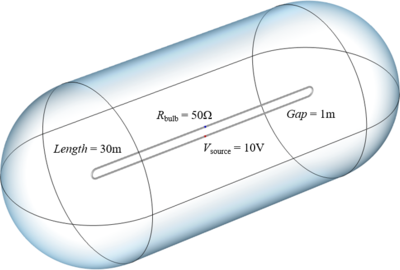
This model is used to demonstrate the solution to a classic brainteaser in electromagnetics. A long loop of wire is connected to a source and a receiver, which are placed 1 meter apart. The objective of the model is to compute how long it takes for the receiver to sense when the source ... Per saperne di più
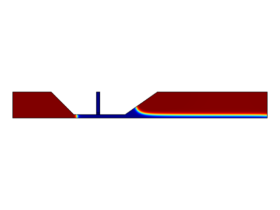
This tutorial shows how to model a slot die coating process with a power-law non-Newtonian fluid in one of the two phases. The model uses a two-phase flow phase-field method. Per saperne di più
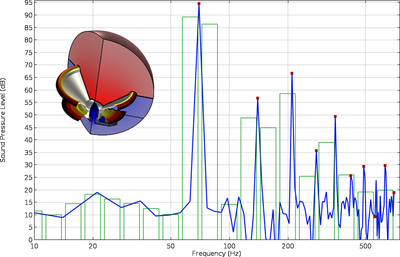
In this model, a full transient analysis of a loudspeaker driver is performed, which allow the modeling of nonlinear effects. It extends the linear frequency domain analysis done in the Loudspeaker Driver tutorial model. The analysis accounts for nonlinear behavior of the soft iron in ... Per saperne di più
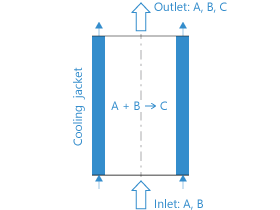
This alternative version of the Tubular Reactor app demonstrates how computational speed can be significantly increased by using a surrogate model instead of a full finite element model. A surrogate model is a simplified, computationally efficient approximation of a more complex and ... Per saperne di più
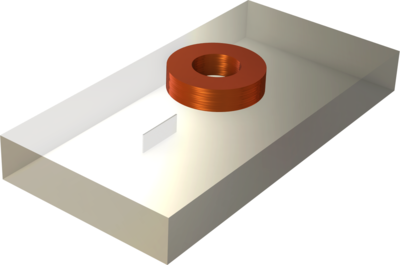
This model is a benchmark problem from TEAM workshop (problem 15 part I, see https://www.compumag.org/wp/team/). The model simulates the behavior of a coil as it scans a conductive plate containing a defect (a crack). The computed coil parameters, which include change in resistance and ... Per saperne di più
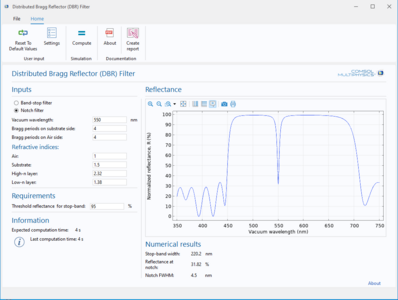
A distributed Bragg reflector (DBR) is a periodic structure formed from alternating dielectric layers that can be used to achieve nearly total reflection within a range of frequencies. The main advantage of DBRs over ordinary metallic mirrors is that DBRs can be engineered to have custom ... Per saperne di più
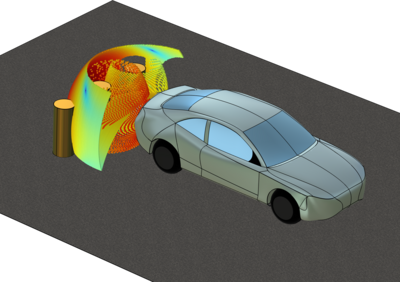
This tutorial demonstrates how to compute the response of an ultrasonic car parking sensor transducer coupling Pressure Acoustics, Frequency Domain, Solid Mechanics, and Piezoelectric Materials. The far-field radiation pattern of the transducer is then used as a source for a Ray ... Per saperne di più

A time-varying current induces a time-varying magnetic field. The magnetic field induces currents in neighboring conductors. The induced currents are called eddy currents. In this model, the phenomenon is illustrated by a time-harmonic field simulation as well as a transient analysis, ... Per saperne di più


