
La Galleria delle Applicazioni raccoglie un'ampia varietà di tutorial e di app dimostrative realizzati con COMSOL Multiphysics in diversi ambiti applicativi, inclusi quelli elettrico, meccanico, fluidico e chimico. E' possibile scaricare i file dei modelli e delle app demo pronti all'uso e le istruzioni step-by-step per costruirli, e utilizzarli come punto di partenza per le proprie simulazioni.
Lo strumento di Ricerca Rapida permette di trovare i modelli che si riferiscono alla propria area di interesse.
Si noti che molti degli esempi qui presentati sono accessibili anche tramite le Librerie delle Applicazioni incorporate nel software COMSOL Multiphysics® e disponibili dal menu File.

This model is a benchmark model for the Slip Flow interface. It is based on both analytic and numeric calculations. Air at atmospheric pressure flows through a conducting micro-channel connecting two reservoirs maintained at different temperatures. A flow between the two reservoirs ... Per saperne di più

In modeling of transport by diffusion or conduction in thin layers, we often encounter large differences in dimensions of the different domains in a model. If the modeled structure is a so-called sandwich structure, we can replace the thinnest geometrical layers with a thin layer ... Per saperne di più
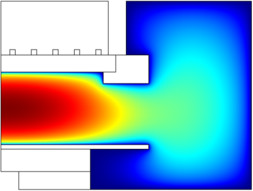
The GEC cell was introduced by NIST in order to provide a standardized platform for experimental and modeling studies of discharges in different laboratories. The plasma is sustained via inductive heating. The Reference Cell operates as an inductively-coupled plasma in this model. This ... Per saperne di più
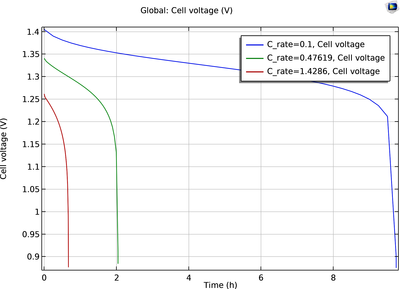
This model reproduces the NiCd battery model and the results presented in De Vidts' and White's paper from 1995. Ref: P. De Vidts, R. E. White, “Mathematical Modeling of a Nickel-Cadmium Cell: Proton Diffusion in the Nickel Electrode”, J. Electrochem. Soc, Vol. 142, No. 5, May 1995. Per saperne di più
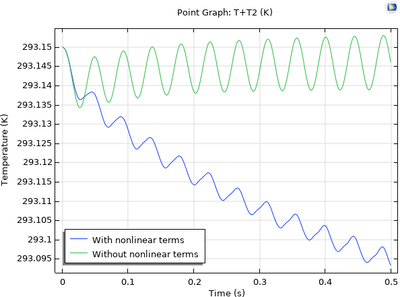
A thermoacoustic engine is a device with no moving parts that can generate acoustic energy from temperature gradients within the engine. It uses the relationship between the movement of oscillating air and the temperature changes in the air compressed and expanded by the acoustic waves. ... Per saperne di più
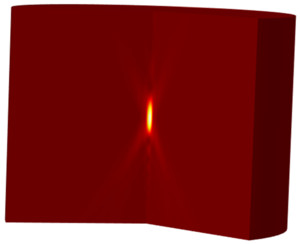
This tutorial shows how to model tissue heating induced by focused ultrasound. First, the stationary acoustic field in the water and the tissue are modeled to obtain the acoustic intensity distribution in the tissue. The absorbed acoustic energy is then calculated and used as the heat ... Per saperne di più

In massive forming processes like rolling or extrusion, metal alloys are deformed in a hot solid state with material flowing under ideally plastic conditions. Such processes can be simulated effectively using computational fluid dynamics, where the material is considered as a fluid with ... Per saperne di più
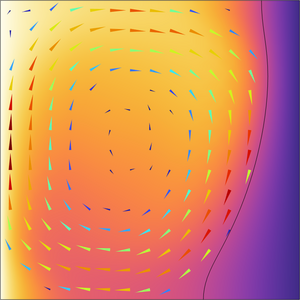
This example demonstrates how to model phase transition by a moving boundary interface according to the Stefan problem. A square cavity containing both solid and liquid tin is submitted to a temperature difference between left and right boundaries. Fluid and solid parts are solved in ... Per saperne di più
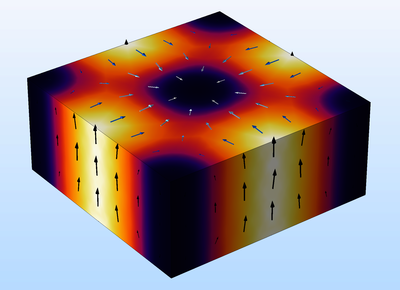
A classic benchmark example in computational electromagnetics is to find the resonant frequency and Q-factor of a cavity with lossy walls. Here, models of rectangular, cylindrical, and spherical cavities are shown to be in agreement with analytic solutions. Per saperne di più
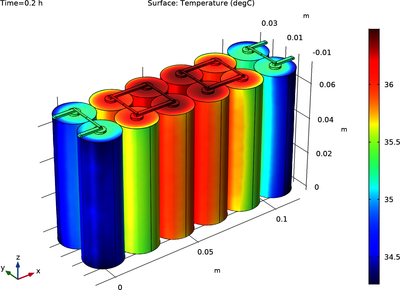
This example demonstrates how to model the temperature distribution in a battery pack during a 4C discharge. The pack is constructed by first coupling two cylindrical batteries in parallel. Six parallel-connected pairs are then connected in series to create the full pack. (This is also ... Per saperne di più