
La Galleria delle Applicazioni raccoglie un'ampia varietà di tutorial e di app dimostrative realizzati con COMSOL Multiphysics in diversi ambiti applicativi, inclusi quelli elettrico, meccanico, fluidico e chimico. E' possibile scaricare i file dei modelli e delle app demo pronti all'uso e le istruzioni step-by-step per costruirli, e utilizzarli come punto di partenza per le proprie simulazioni.
Lo strumento di Ricerca Rapida permette di trovare i modelli che si riferiscono alla propria area di interesse.
Si noti che molti degli esempi qui presentati sono accessibili anche tramite le Librerie delle Applicazioni incorporate nel software COMSOL Multiphysics® e disponibili dal menu File.
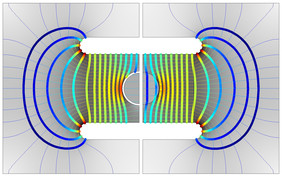
The thin low permittivity gap boundary condition is meant to approximate a thin layer of material with low relative permittivity compared to its surroundings. This boundary condition is available for electrostatic field modeling. This example compares the thin low permittivity gap ... Per saperne di più

Differential inductance is relevant when a low-frequency electromagnetic system includes magnets, nonlinear magnetic materials, and moving parts. These models present examples of computing the differential inductance and using these within simplified lumped models. To learn more about ... Per saperne di più

Many applications involve simulating the electromagnetic behavior of relatively thin material in voluminous domains. To save computer memory and processing time, the thin materials can be treated differently by resolving them with 3D meshes. Here, the modeling domain is a box filled ... Per saperne di più

This introduction model creates a simple model of the electrostatics problem with two concentric cylinders of infinite length, which is commonly found in textbooks. Since there is an analytical solution to this problem, the model can be used to compare theory with numerical results from ... Per saperne di più

A time-varying current induces a time-varying magnetic field. The magnetic field induces currents in neighboring conductors. The induced currents are called eddy currents. In this model, the phenomenon is illustrated by a time-harmonic field simulation as well as a transient analysis, ... Per saperne di più

An operational amplifier (op-amp) is a differential voltage amplifier with a wide range of applications in analog electronics. This tutorial models an op-amp connected to a feedback loop and a capacitive load. The op-amp is modeled as an equivalent linear subcircuit in the Electrical ... Per saperne di più
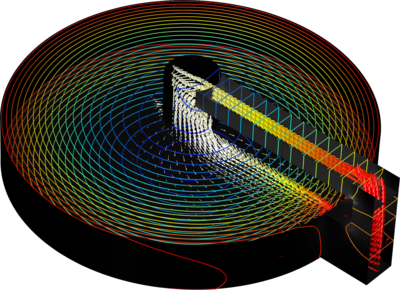
A homopolar generator is composed of an electrically conductive rotating disc placed in a uniform magnetic field that is perpendicular to the plane of rotation. The motion of the conductor through the static magnetic field induces Lorentz currents in the disc. By connecting the outside ... Per saperne di più
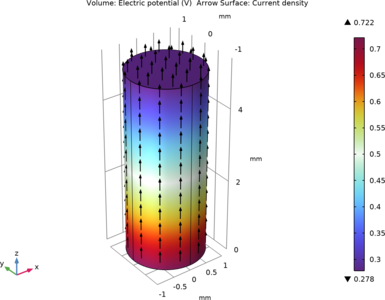
HowTo: Using the EC External I-Terminal The External Couplings in the CIR interface has two flavors that can be used. External I vs. U and External I-terminal. The former has two nodes (it represents a differential external voltage measurement) and when coupling to an EC Terminal ... Per saperne di più


