
Inverse Uncertainty Quantification of a Resistor
Application ID: 144681
This example demonstrates how to apply inverse uncertainty quantification (IUQ) using the Uncertainty Quantification (UQ) Module in COMSOL Multiphysics to calibrate uncertain material properties of a resistor based on measurement data. When experimental data such as resistance values are available, IUQ can be used to infer the underlying model parameters while accounting for uncertainty.
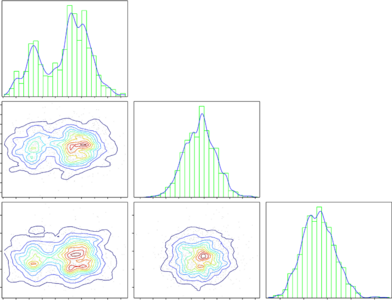
In this model, a resistor is built using the Electric Currents interface, and resistance is defined as the quantity of interest. The conductivities of two material regions are treated as calibration parameters with prior distributions. Pseudo experimental data are generated by sweeping the applied voltage and adding measurement noise, and an inverse UQ study is performed to obtain posterior distributions of the conductivities.
The posterior distributions can then be reused in forward uncertainty propagation and reliability analysis, enabling a data informed UQ workflow. More discussions on the model can be found in the blog post "Introduction to Inverse Uncertainty Quantification in COMSOL".
This model example illustrates applications of this type that would nominally be built using the following products:
however, additional products may be required to completely define and model it. Furthermore, this example may also be defined and modeled using components from the following product combinations:
The combination of COMSOL® products required to model your application depends on several factors and may include boundary conditions, material properties, physics interfaces, and part libraries. Particular functionality may be common to several products. To determine the right combination of products for your modeling needs, review the Tabella delle Funzionalità and make use of a free evaluation license. The COMSOL Sales and Support teams are available for answering any questions you may have regarding this.


