

In previous blog posts, I have written about my fascination with association football (“soccer”), in particular, the challenge of striking the ball with the outside of the foot, a technique known as a trivela, and the creation of its characteristic curved trajectory due to the Magnus effect. Players such as Nelinho, Éder, and Roberto Carlos turned this technique into an art form, sometimes referred to as “the power trivela”. I have also explored how the design of the official match balls for the FIFA World Cup® and UEFA® European Championship (“the Euro”) influences their aerodynamic behavior.
Ahead of this year’s World Cup, I found myself thinking more broadly about the role of modeling and simulation in the game. It’s not just the physics of the ball that can be analyzed; among other things, the interaction between the foot and the ball can be modeled and simulated, as well as the motion sensors that are now embedded in the ball and the vests players wear under their jerseys.
In this blog post, I’ll take a closer look at the 2026 match ball, the Adidas Trionda®, its aerodynamics, and the dynamics of the impact between the foot and the ball and share some simulations that have me excited to watch for power trivelas in this year’s matches.
Official Match Ball Aerodynamics
Controversy surrounding the World Cup match ball has largely disappeared since the Adidas Jabulani® was used at the 2010 World Cup in South Africa. In comparison to the Jabulani, the Brazuca® (2014), Telstar® 18 (2018), and Al Rihla® (2022) all have more similar aerodynamic properties (Ref. 1). If you look at the drag coefficients for the five most recent World Cup balls, including this year’s Trionda, you can see why the Jabulani was controversial.
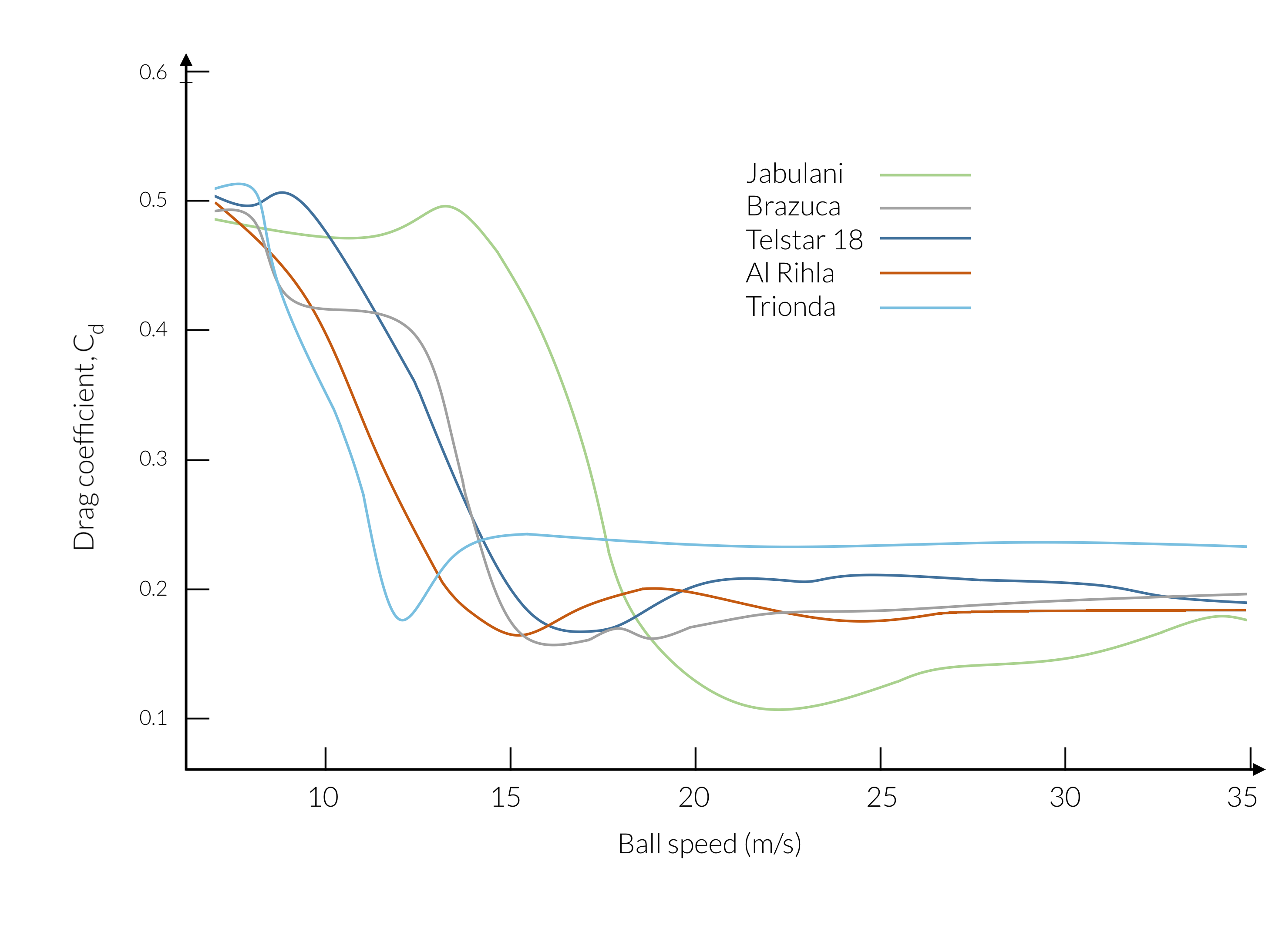 Figure 1. A schematic of the drag coefficient curves of the five latest World Cup balls as measured experimentally in a wind tunnel in one of two non-spinning orientations (orientation A from Ref. 1).
As I’ve mentioned in previous blog posts, if you hit the Jabulani really hard with the outside (i.e., the pinky-toe side) of the boot (or “cleat” if you’re American) in a high-power trivela, the ball accelerates quickly and the boundary layer transitions to turbulent flow. In this regime, the separation points on the two sides of the spinning ball become more symmetric. Since the Magnus effect relies on an asymmetry in the flow and in the separation of the boundary layer, the influence of the spin is reduced at high speeds. The ball therefore travels almost in a straight line, despite the spin.
As the ball slows down and the Reynolds number decreases, the boundary layer gradually transitions from turbulent to laminar flow and the separation points shift. At this point, the asymmetry caused by the spin becomes much more pronounced, and the ball’s trajectory starts to curve sharply. In the case of the Jabulani, this transition, known as the drag crisis, occurs at relatively high speeds, as indicated by the green curve in Figure 1. This means that the curve can appear both late in the trajectory and at high speed, which makes it difficult for goalkeepers to predict.
Even more challenging to anticipate is a shot with little or no spin: at high speeds, the ball can wobble like a beach ball, as seen in Diego Forlán’s unforgettable free-kick goal against Ghana in the 2010 World Cup with the Jabulani.
The latest World Cup balls are more stable, retaining a turbulent boundary layer even at lower speeds. This behavior shifts the low drag region further into the low speed regime. As a result, these balls do not decelerate as quickly as the Jabulani, exhibiting a more predictable trajectory. In Figure 1, you can see that the Trionda retains a turbulent boundary layer down to very low speeds.
Ahead of the Euro 2024, I wrote a blog post about the tournament’s official match ball, the Fussballliebe®. The Fussballliebe is generally considered a refinement of the Al Rihla, with a focus on improved surface grip and consistency rather than maximum top speed. Simulation results I shared in that post comparing the Fussballliebe with the Telstar 18 suggest that the Fussballliebe, like the Al Rihla and the Trionda, also remains in the low-drag turbulent regime down to relatively low speeds.
It will therefore be interesting to investigate how the aerodynamics of the Trionda compare to the experimental results in Figure 1 and with our previous simulations of the Telstar 18 and Fussballliebe.
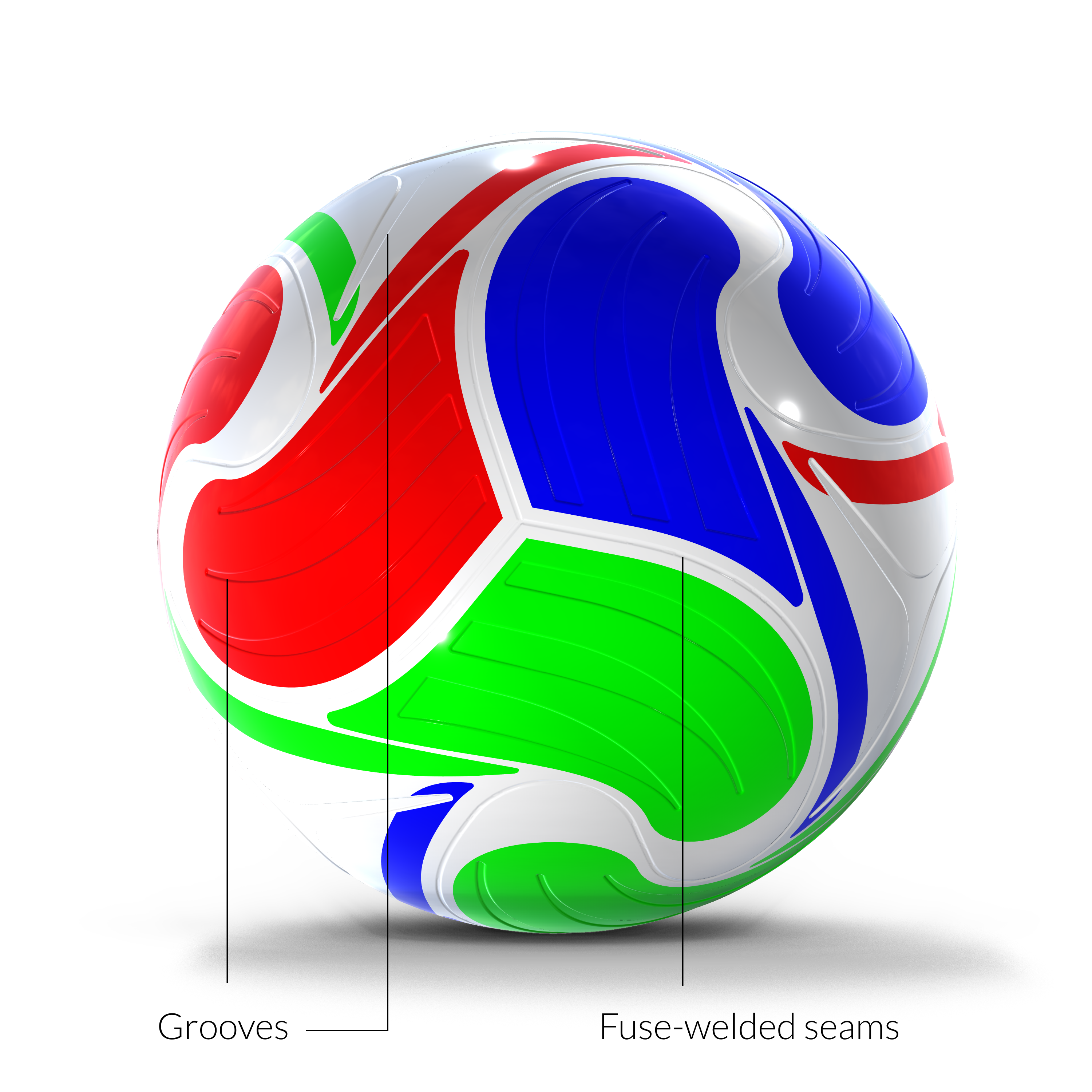 Figure 2. The Adidas Trionda as modeled in COMSOL Multiphysics®.
The New Adidas Trionda Ball
The Trionda consists of only four fuse-welded panels (compared to 20 for the Al Rihla and six for the Jabulani). The total seam length is about 2.6 m, which is relatively small compared to 3.5 m for the Al Rihla and 4.3 m for the Fussballliebe. The controversial Jabulani, meanwhile, had a seam length of about 2.0 m, which might suggest that the Trionda would behave similarly. However, the Trionda features deeper grooves and ridges that effectively increase the aerodynamic roughness. In addition, the surfaces between the grooves contain small protrusions in shapes representing the three host nations of the 2026 FIFA World Cup: five-pointed stars for the U.S., maple leaves for Canada, and golden eagles for Mexico. The surface texture and grip are similar to those of the Fussballliebe, which likely reflects similar aerodynamic behavior between the two.
This interpretation is consistent with the experimental data in Figure 1. The Trionda has a higher drag coefficient at high speeds than the earlier World Cup balls.
What’s in a name? “Trionda” refers to the three host nations, where tri– denotes “three” and –onda means “wave”, suggesting waves of energy. The number three is reflected throughout the design, as you can see in Figure 3. Each panel consists of a roughly triangular central shape — where a wavy three-pointed star is debossed — from which three arms extend, each with three debossed Adidas stripes. As if this were not enough, the trivela is also known as tres dedos in Spanish and Portuguese, referring to the three outer toes of the foot.
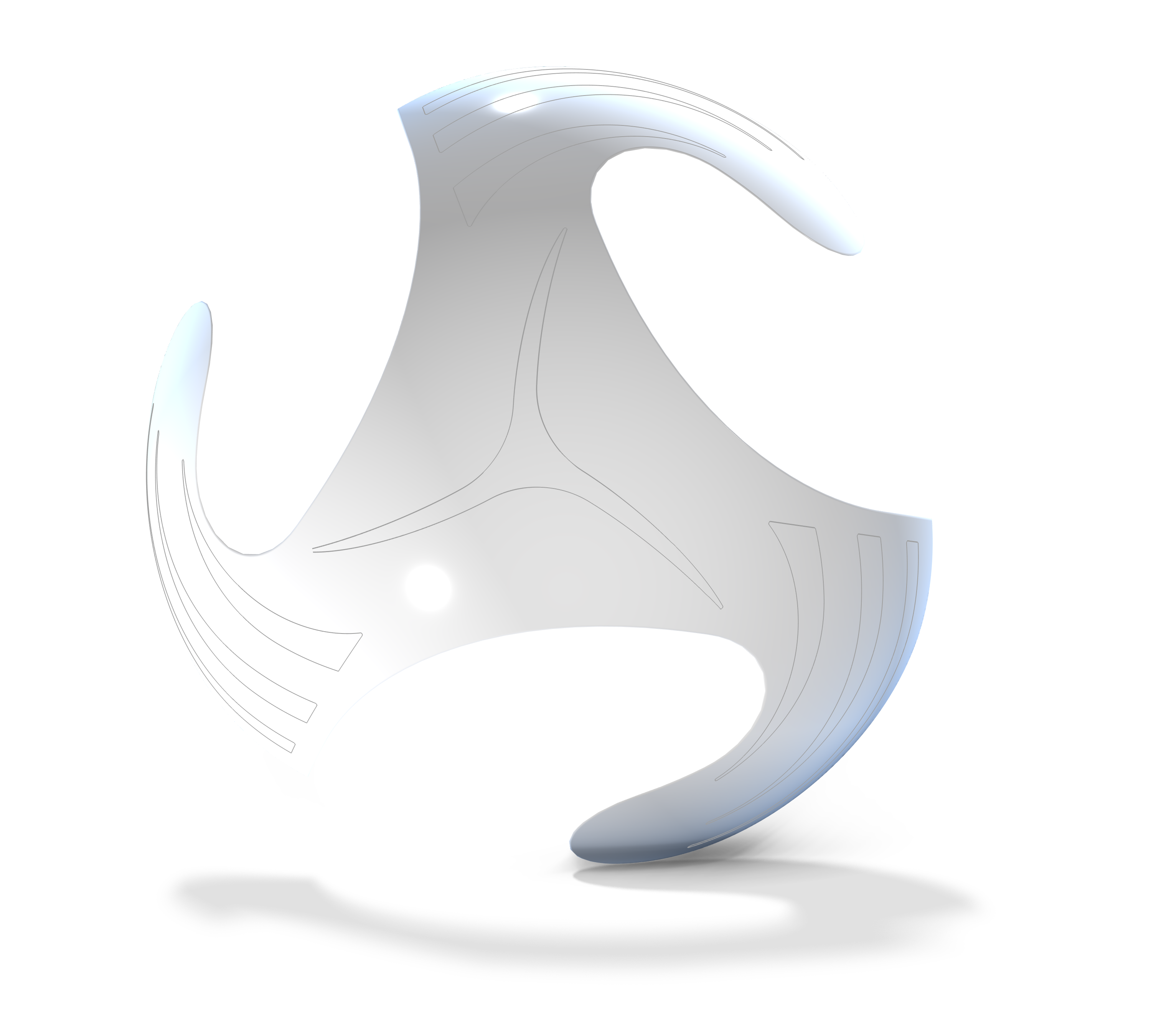 Figure 3. The geometry of one of the four panels that, when fuse-welded together, form the ball.
In the model of the Trionda that my colleagues and I built, the seams and grooves are explicitly represented using the built-in geometry tools in COMSOL Multiphysics®. The star-, maple-leaf-, and eagle-shaped protrusions, in contrast, are modeled as surface roughness and are not explicitly included in the geometry in the Reynolds-averaged Navier–Stokes (RANS) models. They are not accounted for at all in the large eddy simulation (LES) models.
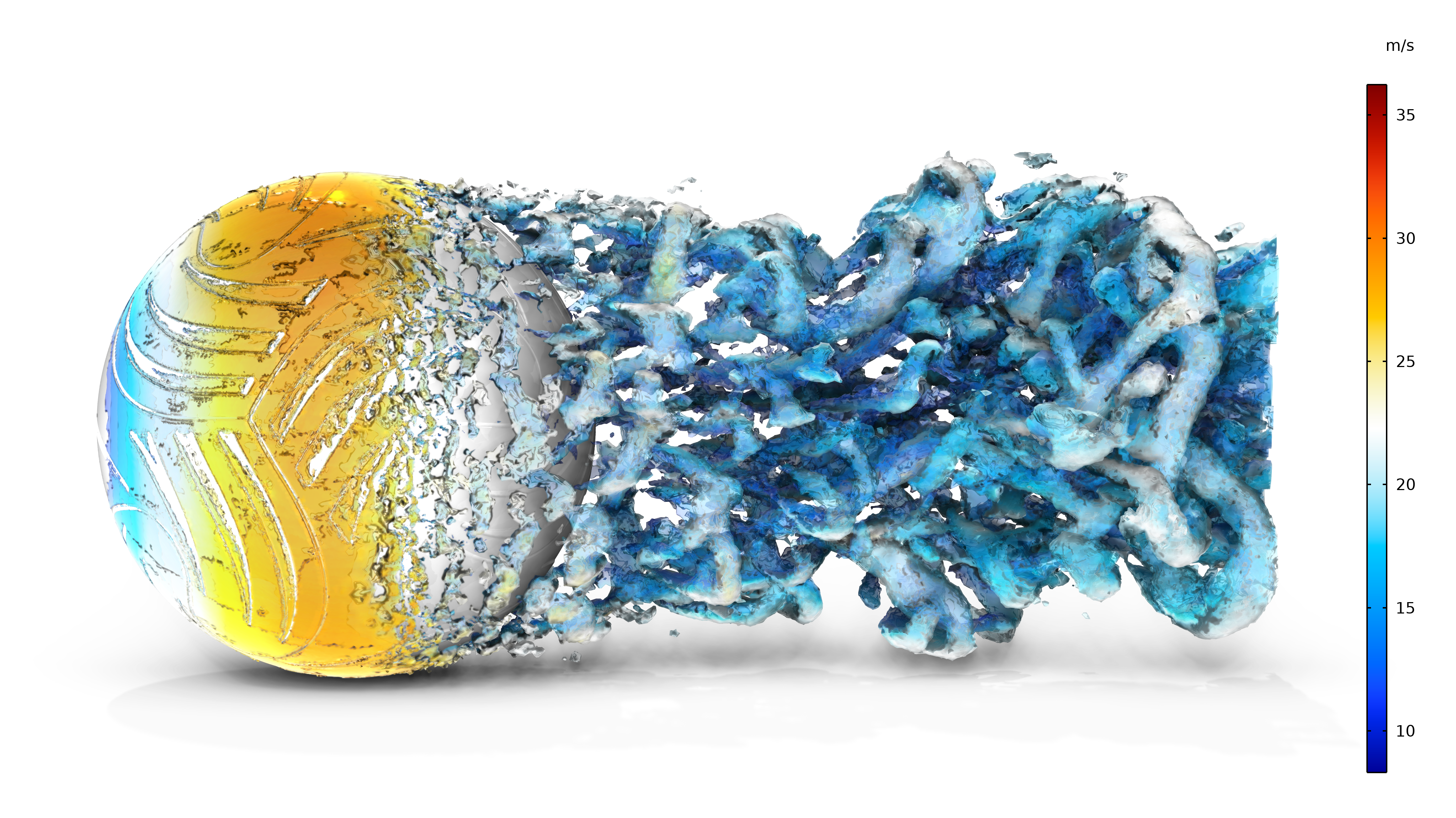 Figure 4. Flow velocity relative to the ball plotted as isosurfaces.
The measured drag coefficient for the Trionda is higher than the Al Rihla at high velocities, but the drag crisis occurs at substantially lower velocities. This means that the drag coefficient for the Trionda is substantially lower than that of the Al Rihla at low velocities. This is similar to the Fussballliebe, which, as I shared in my previous blog post, shows a substantially lower drag coefficient than the Telstar 18 at low velocities. (We never modeled the Al Rihla.)
Figure 4 shows the velocity isosurfaces for the Trionda obtained using LES. We can see that the separation line around the ball occurs relatively early downstream of the vertical equator, just as in the Fussballliebe simulations from 2024. In comparison, the simulations for the Telstar 18 show a later detachment. Figures 5a and 5b show animations of the wakes behind the Trionda and the Fussballliebe, showing similar behavior. The drag coefficient of the Trionda at 20 m/s, computed using LES, is 0.17, which is in good agreement with the experimental values for the second simulated ball orientation (orientation B), which are slightly below 0.2 (Ref. 1).
This drag coefficient is slightly lower than the value for the Fussballliebe, which is 0.19 (LES). However, the Trionda features larger surface protrusions than the Fussballliebe, which likely increases the drag coefficient. When the surface roughness is accounted for, we estimate a drag coefficient closer to 0.22, which is similar to the Fussballliebe (0.21) when surface roughness is included using RANS-based models.
Figures 5a and 5b. Animations of the wake for the Trionda (left) and the Fussballliebe (right).
The Euro 2024 saw a total of 19 goals scored from outside the penalty area. This was a record, with 16.2% of all goals from these long-range shots. This may have been influenced in part by the stability of the Fussballliebe as well as its low drag coefficient as the ball decelerates to low speeds. (The ball “stays hit”, according to Harry Kane.) Based on our simulations, I’d say we can safely hope for some outside-the-penalty-area screamers at the World Cup 2026, preferably from high-power trivelas!
Hitting the Ball Right
One of the biggest differences between modern match balls and the balls of the 1980s, 1990s, and early 2000s is the surface texture. The later versions of the traditional 32-panel balls typically have a relatively glossy surface, while balls like the Fussballliebe and Trionda feel noticeably rougher — but also more elastic.
The use of thermal bonding and advanced materials in modern balls results in a “bouncier” ball with higher energy retention after impact. The coefficient of restitution (CoR, a measure of “bounciness”) of modern Adidas balls is not publicly available, but estimates based on recent measurements (Ref. 2) suggest values just below 0.9 at an internal pressure of 1 bar. This relatively high CoR may also help explain Harry Kane’s remark that the Fussballliebe “stays hit”.
The rough surface of a modern ball also makes it feel easier to strike cleanly. But is this only a psychological effect? According to a modeling and experimental investigation by Ishii et al. (Ref. 3) on curved shots taken with the inside of the foot, the friction between the shoe upper and the ball has only a limited effect on the ball velocity and spin.
To investigate the bounciness of the Trionda and the dynamics of the foot–ball impact, we set up our own model using the new explicit dynamics functionality in COMSOL Multiphysics®. We modeled the Adidas® F50 Elite Laceless shoe that’s used by many top players, including Lamine Yamal. This shoe provides excellent contact between the ball and the foot, not only for a pure instep shot but also for a power trivela, where the ankle is also fully locked (by tensing both the calf and shin muscles).
Figure 6. Animation of a high-power trivela performed with an Adidas F50 Elite Laceless shoe and the Adidas Trionda. In this simulation, the friction coefficient is 0.5.
Figure 6 shows an animation of the simulation results for a high-power trivela performed with a fully locked ankle on the Adidas Trionda. We can see substantial deformation of the ball during impact. This agrees qualitatively with the results reported by Ishii et al. (Ref. 3), as well as with high-speed recordings by QuinticConsultancy of an instep kick perfomed on a ball from the Adidas Finale series, the official match balls for the UEFA Champions League. The animation also shows the angular velocity generated by the asymmetric impact, a clear signature of the famous curl.
The computed CoR at 1 bar is 0.85, which is close to the values reported for the Telstar 18 family (Ref. 2). Another recent match ball, the Uniforia® Pro used at the Euro 2020, is based on the same general construction.
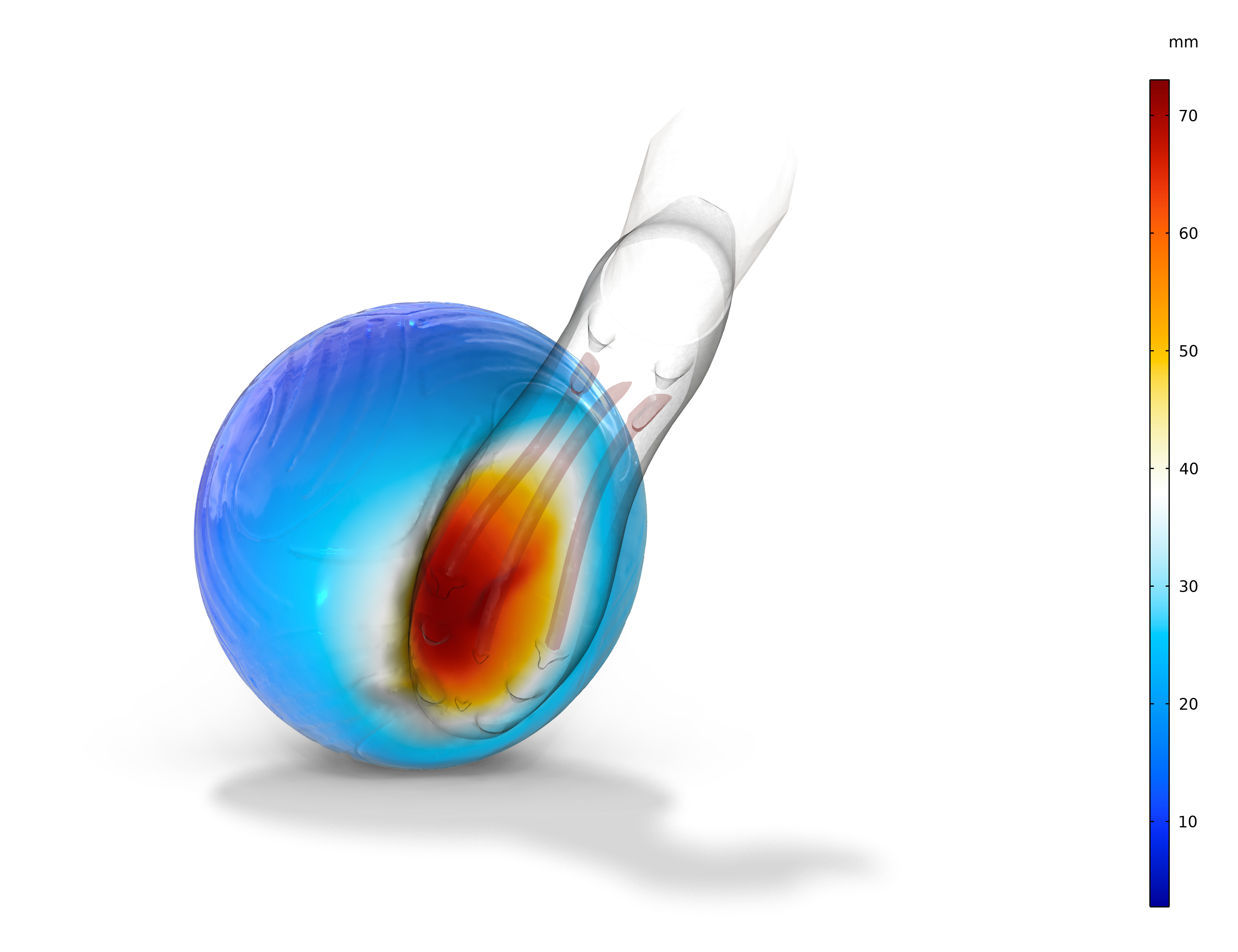 Figure 7. Deformation of the Trionda during a high-power trivela, 5.5 ms after contact for a friction coefficient of 0.5.
Figure 7 shows the deformation of the Trionda 5.5 ms after being hit with a real thunderbolt of a shot, in the range of Roberto Carlos, or Federico Valverde, to mention one current player with a whip for a shooting leg.
Figure 8. Trivela with the same scenario as in Figure 6, but here with a friction coefficient of zero.
What about the friction coefficient between the ball and the foot? It turns out that it does have an effect for a trivela. The animation in Figure 8 shows the same shot scenario as in Figure 6, but now without friction. You can see that the ball slips away from the foot with very little curl.
Unlike the curved shots with the inside of the boot studied by Ishii et al. (Ref. 3), the trivela involves a strongly asymmetric and sliced impact, where the foot strikes the ball in a direction that does not pass through the center of the ball. In this case, the friction between the foot and the ball becomes much more important.
Figure 9 shows the ball velocity just before, during, and after impact for three different values of the friction coefficient. The exit velocity decreases as the friction coefficient is reduced, from about 34 m/s in the baseline case to approximately 24 m/s in the frictionless case.
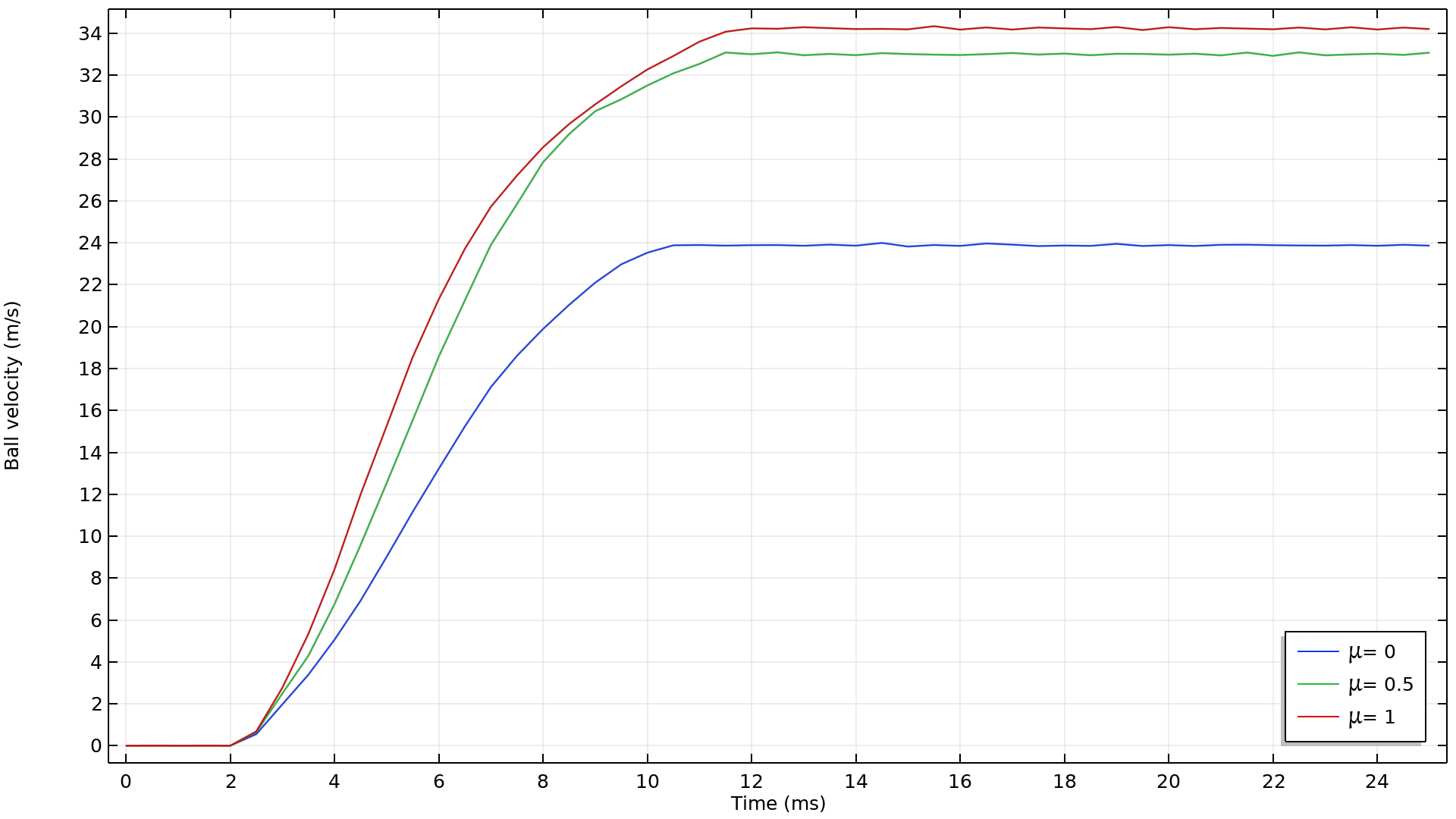 Figure 9. Ball velocity for three different values of the friction coefficients.
In our simulations, we assumed a perfect strike on a stationary ball. In a real game situation, where the ball is often already moving, the friction coefficient becomes even more important. This is one reason why modern football boots often feature carefully engineered contact zones designed to improve the interaction between the foot and the ball.
Looking Forward to the World Cup
In this post, we’ve taken a deep dive into the aerodynamics of official match balls and the interaction between the foot and the ball during high-power shots. This is a nice, although perhaps slightly nerdy, preparation for the 2026 World Cup. But we have not nerded out enough.
In my next blog post (coming soon!), I will discuss the sensors embedded in the ball and in the players’ vests. I will also look at the acoustics of football stadiums, which are crucial for the atmosphere during the matches.
For the Love of the Game (Only!)
Although the models and simulations presented here are state-of-the-art, they were created just for fun. A serious scientific study would investigate the involved parameters in much greater detail, and the simulation results would need to be validated using experimental measurements.
These investigations were performed independently of Adidas, and we do not claim any cooperation with Adidas.
References
- J. E. Goff et al., “Trionda: Enhanced Surface Roughness Relative to Previous FIFA World Cup Match Balls,” Applied Sciences, vol.16, no. 6, start p. 2808, 2026; https://doi.org/10.3390/app1606280808.
- A. Tunçel, N. Özgören, and S. Aritan, “Comparison of Collision Dynamics of Soccer Balls with Energy Dissipation Method,” Proceedings of the Institution of Mechanical Engineers, Part P: Journal of Sports Engineering and Technology, vol. 240, advance online publication 2024; https://doi.org/10.1177/17543371241237589.
- H. Ishii, Y. Sakurai, and T. Maruyama, “Effect of Soccer Shoe Upper on Ball Behaviour in Curve Kicks,” Scientific Reports, vol. 4, no. 1, start p. 6067, 2014; https://doi.org/10.1038/srep06067.
Adidas, Al Rihla, Brazuca, Fussballliebe, and Trionda are registered trademarks of adidas AG. Jabulani, and Telstar are registered trademarks of adidas International Marketing B.V.
FIFA World Cup is a registered trademark of the Fédération Internationale de Football Association.
UEFA is a registered trademark of the Union of European Football Associations.
COMSOL AB and its subsidiaries and products are not affiliated with, endorsed, by, sponsored by, or supported by any of the foregoing trademark owners.




Comments (0)