
In conformità con la nostra Quality Policy, COMSOL ha pubblicato una libreria con centinaia di esempi di modelli documentati che vengono regolarmente testati rispetto all'ultima versione del software COMSOL Multiphysics®, compresi i problemi di benchmark di ASME e NAFEMS, così come TEAM problems.
I nostri test di verifica e validazione (V&V) forniscono soluzioni sempre accurate che vengono confrontate con i risultati analitici e i dati di riferimento stabiliti. I modelli documentati qui sotto fanno parte delle Application Library integrate nel software COMSOL Multiphysics®. Includono inoltre valori di riferimento e fonti per un'ampia gamma di benchmark, così come istruzioni passo-passo per riprodurre i risultati sul proprio computer. Questi modelli possono essere usati non solo per documentare l'impegno nella garanzia di qualità del software (SQA) e nella verifica del codice numerico (NCV), ma anche come parte di un programma di formazione interno.

This example shows how to set up a model of furrow irrigation in a nonuniform soil column. It employs the Unsaturated Dual Permeability feature, which links two Richards' Equations through a fluid transfer function. This scenario can be regarded as a benchmark problem for dual ... Per saperne di più
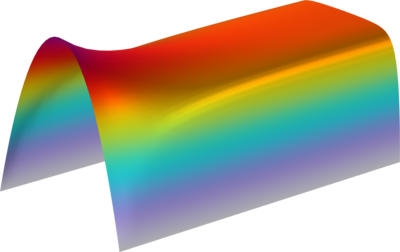
Classical MHD benchmark problem was solved analytically by J. Hartmann. He considered laminar incompressible flow between two planes (in planar duct) in transversal imposed magnetic field under next assumptions: * fully developed flow (far from inlet) * fluid properties are constant * ... Per saperne di più

This benchmark model computes the valence band structure of an unstrained and a strained bulk GaN wurtzite crystal, as a tutorial for users who wish to set up multiple wave function components with the Schrödinger Equation interface. The model follows the formulation given in the ... Per saperne di più
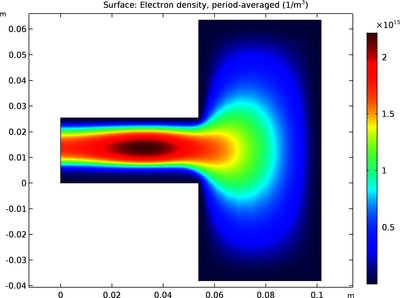
This model investigates the National Institute of Standards and Technology (NIST) Gaseous Electronics Conference (GEC) reference cell in two dimensions using the Plasma, Time Periodic interface. A 2D example helps in understanding the physics without excessive CPU time. The cell is ... Per saperne di più
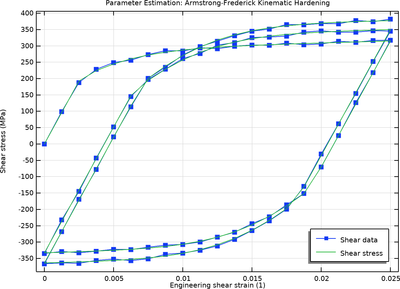
This tutorial model demonstrates how to estimate the material parameters of a combined hardening elastoplastic material model given cyclic shear data. Per saperne di più
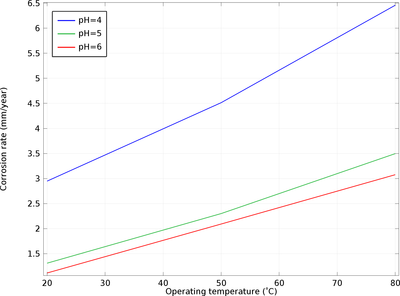
Carbon dioxide in aqueous solution is highly corrosive and can cause significant damage to steel designs. Such conditions arise in pipes used in a variety of applications, especially within the petrochemical industry. In this tutorial example, turbulent flows consisting of carbon ... Per saperne di più
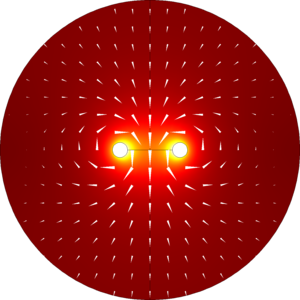
A parallel wire transmission line is composed of two conducting wires in a dielectric such as air. The fields around such a transmission line are not directly confined by the conductors, and extend to infinity, although they drop off in rapidly away from the wires. This model ... Per saperne di più
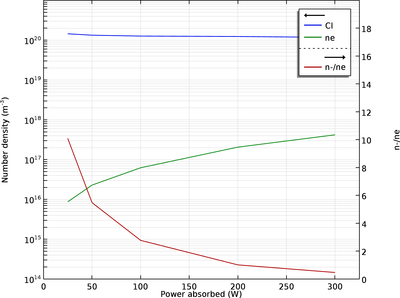
Plasma discharges containing chlorine are commonly used to etch semiconductors and metals in microelectronics fabrication. This tutorial model studies chlorine plasma discharges using a global (volume-averaged) diffusion model. Global diffusion models can run simulations in a fraction ... Per saperne di più
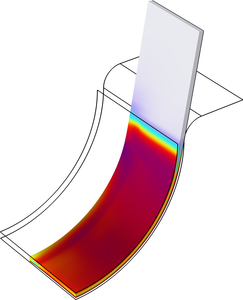
This example benchmarks a NAFEMS validation model of a friction contact problem with an elastoplastic material model. A thin metal sheet is forced into a die by a punch. Both the compressing displacement and the release of the punch are modeled in order to compute the forming angle (at ... Per saperne di più
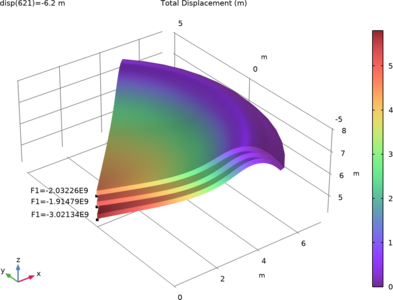
This benchmark studies the nonlinear deformation of a spherical cap subjected to point load at center using 2D axisymmetric Solid Mechanics and Shell interfaces. The results from the Shell interface are compared with Solid Mechanics interface as well as with analytical results given in ... Per saperne di più


