
Clemson Simulates Electrode Setup for Dielectrophoresis
G. Zhang
Clemson U, SC, USA
J. Brcka, J. Faguet, E. Lee
Tokyo Electron, TX, USA
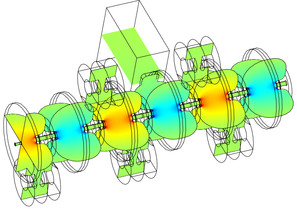
Dielectrophoresis (DEP) is a method of patterning cells and particles used in medical, electronics, and energy applications. When an electric field is applied to an array of cells or dielectric particles suspended in a medium, they become polarized, causing movement that reorganizes the particles. This is an efficient way to assemble materials layer by layer at the nanoscale, and is sometimes used in mass production of materials. Through a partnership between Clemson University and Tokyo Electron U.S. Holdings, Inc., researchers are analyzing unexpected particle rotation and alignments they have observed during cell patterning. They have used COMSOL Multiphysics models to understand cell patterns and material assembly; their simulations account for nonhomogeneous cell properties and electric field distortions, which they are analyzing to predict the influence of DEP force on this behavior.
Suggested Stories
Optimizing Wireless Test Systems and Antennas for High-Speed Communication
To design reverberation systems for measuring the performance of wireless devices and wideband antennas, engineers at ...
Keynote: Multiphysics Modeling in AR & VR Innovation
Meta is working to advance the optical and display technologies for its augmented reality (AR) and virtual reality ...
Multiphysics Simulation Drives Smart City Technology
Traditional power boxes are bulky and too large. To design a power box that is more space-conscious, modular, and ...
MRI Tumor-Tracked Cancer Treatment
Radiation therapy targeting in cancer treatment involves many uncertainties, including the movement of targeted sites ...


