
Multiphysics Analysis of CO2 Foil Thrust Bearing Characteristics
Treevor Munroe
Knolls Atomic Power Laboratory, Niskayuna, NY
Knolls Atomic Power Laboratory (KAPL) is a research and development facility supporting the United States Naval Nuclear Propulsion Program. KAPL recently collaborated with Bettis Atomic Power Laboratory to test a supercritical carbon dioxide (S-CO2) Brayton power cycle system.
The system was designed to operate at high speed and high gas pressure, which means the turbine shaft bearings must withstand a wide range of radial and axial loads. The thrust bearings used to constrain the axial forces, however, showed extensive wear at certain speeds.
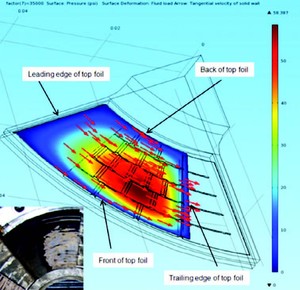
Using COMSOL Multiphysics, KAPL was able to analyze the structural mechanics, fluid mechanics, and heat transfer of the Brayton power cycle system to better understand the operation and deterioration of the thrust bearings. This allowed them to optimize geometry and to improve bearing performance.
Suggested Stories
Sonar Dome Vibration Analysis
There has been a recent move towards utilizing bulbous bows on ships to house different types of sonar systems, but it ...
Sea Floor Energy Harvesting
Veryst Engineering has provided design solutions for a variety of industries in the field of energy harvesting. One of ...
Multiphysics Analysis of CO2 Foil Thrust Bearing Characteristics
Knolls Atomic Power Laboratory (KAPL) is a research and development facility supporting the United States Naval ...
Keeping Cool: SRON Develops Thermal Calibration System for Deep-Space Telescope
Deep-space telescopes require ultrasensitive detectors and calibration to pick up weak far-infrared signals. The SpicA ...


