
KAPL Analyzes CO2 Foil Thrust Bearing Characteristics with Simulation
Treevor Munroe
Knolls Atomic Power Laboratory, Niskayuna, NY
Knolls Atomic Power Laboratory (KAPL) is a research and development facility supporting the United States Naval Nuclear Propulsion Program. KAPL recently collaborated with Bettis Atomic Power Laboratory to test a supercritical carbon dioxide (S-CO2) Brayton power cycle system.
The system was designed to operate at high speed and high gas pressure, which means the turbine shaft bearings must withstand a wide range of radial and axial loads. The thrust bearings used to constrain the axial forces, however, showed extensive wear at certain speeds.
Using COMSOL Multiphysics, KAPL was able to analyze the structural mechanics, fluid mechanics, and heat transfer of the Brayton power cycle system to better understand the operation and deterioration of the thrust bearings. This allowed them to optimize geometry and to improve bearing performance.
Suggested Stories
Democratizing Simulation with Applications
Veryst Engineering, AltaSim Technologies, and GLL Bio-Med Analytics build applications in COMSOL Multiphysics ...
Get an Inside Look at How Veryst Engineering Looks Inside Designs
Step into the material test lab at Veryst Engineering to see how they develop accurate material models for use in ...
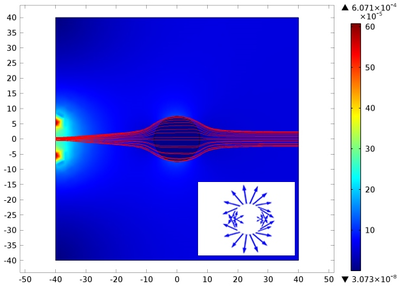
Patterning Cells with the Flip of a Switch for Bioengineering Applications
Dielectrophoresis (DEP) is a method of patterning cells and particles used in medical, electronics, and energy ...
Adding Quantitative Systems Pharmacology to Pharmaceutical Science Curriculum
The FDA is encouraging pharmaceutical companies to include simulation in their product development cycles, so ...


