
Fraunhofer ISE Optimizes Climate Control Systems with Simulation
Eric Laurenz, Hannes Fugmann, Fraunhofer ISE, Germany
Adsorptive climate control systems can reduce the power required to heat and cool buildings by running primarily on waste heat, natural gas, and solar thermal energy instead of electricity. While adsorption-based chillers, heat pumps, and thermal storage units are available commercially, they need to be more efficient, compact, and cheaper to produce in order to be available on a larger scale.
Researchers at the Fraunhofer Institute for Solar Energy Systems (ISE) use numerical simulation and experimentation to better understand and design heat exchangers for adsorption systems, including wire-based structures with high surface areas. Using COMSOL Multiphysics® software, the research team captured the dynamics of the adsorption and desorption processes that release heat into buildings. Their work entails modeling water vapor and heat transfer through porous structures, such as sorbent, as well as isothermal fluid flow and heat transfer through solids, to achieve an optimized exchanger geometry.
Suggested Stories
Illuminating Complex Material Behavior with Multiphysics Simulation
At Canadian Nuclear Laboratories, multiphysics simulation is used to gain insight into the behavior of nuclear fuel ...
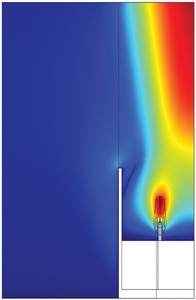
Multiphysics Analysis of a Burning Candle
Using COMSOL Multiphysics, AltaSim Technologies were able to predict the temperature distribution and flow pattern of ...
Prototyping Antennas for Mobile Recording of TV Sports Events with Simulation
Researchers at Radiotelevisione Italiana (RAI) are optimizing circularly polarized antenna designs for recording live ...
Keynote: Electromagnetic-Based Hyperthermia Therapy for Treatment of Brain Cancer
This keynote talk from the COMSOL Conference 2024 Boston explores how Dr. Dario Rodrigues from the University of ...


