
Better Ways to Heat and Cool Buildings
Eric Laurenz, Hannes Fugmann, Fraunhofer ISE, Germany
Adsorptive climate control systems can reduce the power required to heat and cool buildings by running primarily on waste heat, natural gas, and solar thermal energy instead of electricity. While adsorption-based chillers, heat pumps, and thermal storage units are available commercially, they need to be more efficient, compact, and cheaper to produce in order to be available on a larger scale.
Researchers at the Fraunhofer Institute for Solar Energy Systems (ISE) use numerical simulation and experimentation to better understand and design heat exchangers for adsorption systems, including wire-based structures with high surface areas. Using COMSOL Multiphysics® software, the research team captured the dynamics of the adsorption and desorption processes that release heat into buildings. Their work entails modeling water vapor and heat transfer through porous structures, such as sorbent, as well as isothermal fluid flow and heat transfer through solids, to achieve an optimized exchanger geometry.
Suggested Stories
Multiphysics Analysis Helps Preserve the Past
Jos van Schijndel is the founder of Netherlands-based consulting firm CompuToolAble and assistant professor at ...
Compressing the Timeline to a Fusion Future
General Fusion has successfully designed and optimized a fusion demonstration machine with the help of multiphysics ...
Making Biofuel a Cost-Effective, Renewable Source of Energy
Pyrolysis is a pre-commercial thermochemical process that converts renewable, plant-based materials such as wood into ...
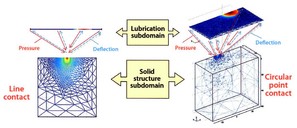
Shape Changing Lubricants
Shell Global Solutions UK is conducting research to optimize lubricants for the fuel economy. A problem exists in ...


