
DEMCON multiphysics

Address & Contact Information
DEMCON | multiphysics
Institutenweg 25
7521PH Enschede
Tel: +31 (0)88 – 115 20 00
Email: multiphysics@demcon.com
Web: https://multiphysics.demcon.com
DEMCON multiphysics is an engineering consultancy provider that specializes in the research and development of products and systems, finding solutions with the help of simulation. Whether you are developing a new concept or improving an existing technology, the first step is to understand the physical phenomena involved.
Simulations (or virtual prototyping) are essential for fast and efficient engineering. Having a good overview of all significant physical effects and their approximations in a simulation, and to be aware of their numerical implications, is key. Experience and specialization are thus important for progress in projects involving (advanced) simulation techniques.
This is exactly DEMCON multiphysics' business: It has many years of experience in complex multiphysics modeling, helping clients solve technical problems and achieve their engineering goals in a reliable and efficient manner. Additionally, being a part of the DEMCON group grants the team access to extensive engineering resources and the expertise of more than 1000 specialists and scientists in a wide variety of technical disciplines, further expanding the team's ability to find solutions.
Areas of Expertise
DEMCON multiphysics' in-house expertise covers many physics domains (and their interactions), such as:
- Electromagnetics
- Thermal engineering
- Structural mechanics
- Fluid dynamics
- Acoustics & vibrations
- Nuclear physics
- Plasma modeling
Examples of Complex Multiphysics Problems
DEMCON multiphysics uses the COMSOL Multiphysics® software to model complex multiphysics problems. One example is the modeling of superconductors. This type of modeling is complex due to the nonlinear relation between the electric field and current. Hence, alternative strategies to solve Maxwell’s equations are required.
DEMCON multiphysics modified and implemented various common modeling strategies, such as the H and A–V formulation. These strategies enable simulations of, for example, quench scenarios in a superconducting coil for nuclear fusion and evaluating AC losses in superconducting coils.
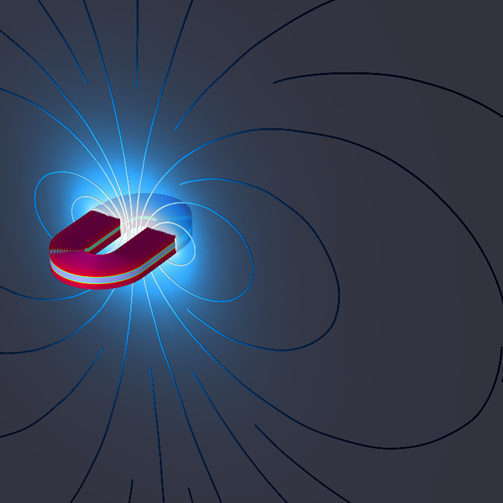
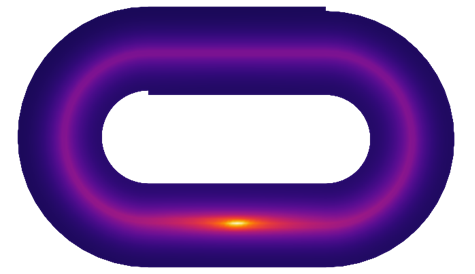
The images below show an application example: a model of a racetrack coil that is suitable for evaluating hysteresis losses and coupling losses in 3D, showing the B-field (left) and a quench model of the same noninsulated coil exhibiting a complex interaction between electrical (L/R) and thermal time scales (right).
 |
 |
 |


