
La Galleria delle Applicazioni raccoglie un'ampia varietà di tutorial e di app dimostrative realizzati con COMSOL Multiphysics in diversi ambiti applicativi, inclusi quelli elettrico, meccanico, fluidico e chimico. E' possibile scaricare i file dei modelli e delle app demo pronti all'uso e le istruzioni step-by-step per costruirli, e utilizzarli come punto di partenza per le proprie simulazioni.
Lo strumento di Ricerca Rapida permette di trovare i modelli che si riferiscono alla propria area di interesse.
Si noti che molti degli esempi qui presentati sono accessibili anche tramite le Librerie delle Applicazioni incorporate nel software COMSOL Multiphysics® e disponibili dal menu File.
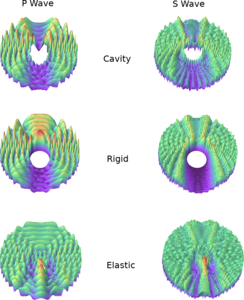
This model showcases how to solve for the scattered field when knowing the incident field for three different types of scatterer, that is, an infinitely rigid one, a cavity and an elastic inclusion. This formulation can be useful when the scatterer is in the far field of the source, so ... Per saperne di più

In this benchmark example, a semi-elliptical crack at the inner surface of a cylinder is studied. The inside of the cylinder and the crack faces are subjected to a pressure load. The J-integral is calculated along the crack front, and the stress intensity factor is then compared with the ... Per saperne di più
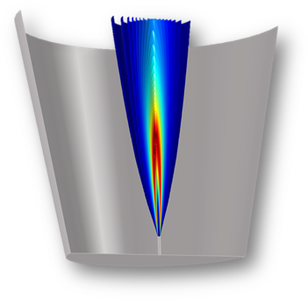
The model simulates non-premixed turbulent combustion of syngas (synthesis gas) in a simple round-jet burner. Syngas is a gas mixture, primarily composed of hydrogen, carbon monoxide and carbon dioxide. The name syngas relates to its use in creating synthetic natural gas. In the model, ... Per saperne di più
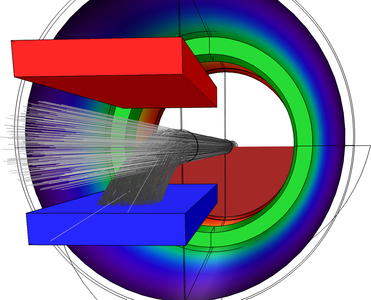
Gas cells have several applications in the design of scientific instruments. A gas cell is used to define a high-pressure region within the instrument's main vacuum system. For example, in this application, note we are designing a high-pressure region 100 mm long, with an operating ... Per saperne di più
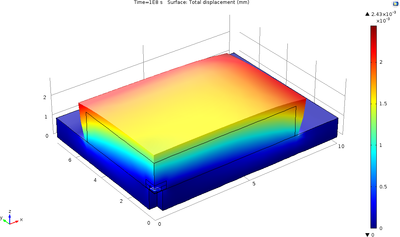
Modern integrated circuits are available as plastic encapsulated microcircuits (PEM). These devices are molded out of polymeric materials and epoxy resins in order to protect the internal semiconductors. Unfortunately, polymeric mold compounds absorb moisture when exposed to a humid ... Per saperne di più
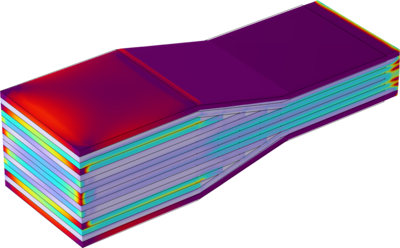
This example illustrates the modeling of ply drop-off in a composite panel. The panel considered for the analysis has three sections–thick, taper, and thin. The thick section plies are divided into the core, top-bottom belts, and dropped plies. The thick section of the panel has sixteen ... Per saperne di più

Hydrogen embrittlement refers to the degradation of metal ductility due to the absorption of hydrogen. The metal becomes more brittle and thus cracks might initiate at lower stress levels. It is important to estimate hydrogen concentration and the speed at which it diffuses into the ... Per saperne di più
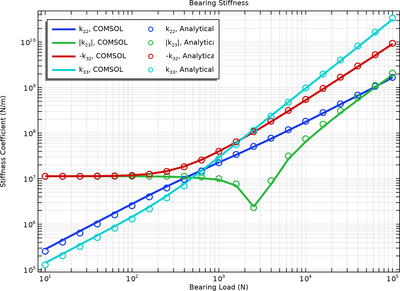
When analyzing rotors, it is common that bearings are modeled through their effective dynamic coefficients about a static equilibrium position. This model illustrates how to compute such coefficients for a cylindrical journal bearing. The bearing length is kept much smaller than its ... Per saperne di più


