
La Galleria delle Applicazioni raccoglie un'ampia varietà di tutorial e di app dimostrative realizzati con COMSOL Multiphysics in diversi ambiti applicativi, inclusi quelli elettrico, meccanico, fluidico e chimico. E' possibile scaricare i file dei modelli e delle app demo pronti all'uso e le istruzioni step-by-step per costruirli, e utilizzarli come punto di partenza per le proprie simulazioni.
Lo strumento di Ricerca Rapida permette di trovare i modelli che si riferiscono alla propria area di interesse.
Si noti che molti degli esempi qui presentati sono accessibili anche tramite le Librerie delle Applicazioni incorporate nel software COMSOL Multiphysics® e disponibili dal menu File.
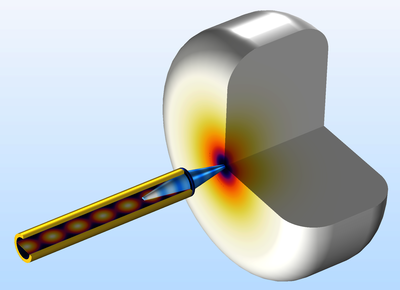
The response of a millimeter wave with frequencies of 35 GHz and 95 GHz is known to be very sensitive to water content. This model utilizes a low-power 35 GHz Ka-band millimeter wave and its reflectivity to moisture for noninvasive cancer diagnosis. Since skin tumors contain more ... Per saperne di più
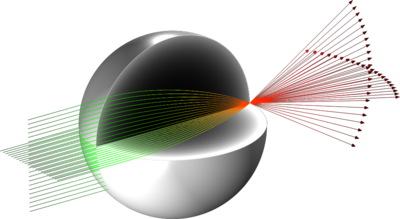
A Luneburg lens is a type of graded index, or GRIN lens, in which the gradient of the refractive index leads to special focusing properties. This example model uses the Geometrical Optics interface to compute the curved ray trajectories in the graded-index medium. Per saperne di più
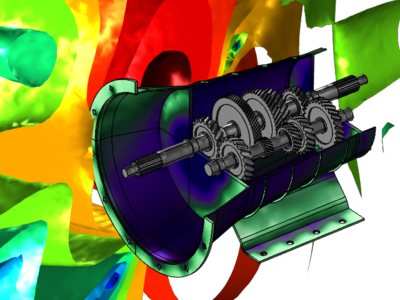
A gearbox is used to transfer power from an engine to its associated wheels or cogs, which can result in radiating noise to the surroundings. This is due to the transmission of undesired lateral and axial forces on the bearings and housing, while transmitting power from one shaft to the ... Per saperne di più

This tutorial demonstrates how to use the temperature and relative humidity computed from a heat and moisture transport simulation of an insulated roof as inputs for a mold prediction model. The VTT model for mold growth and decline prediction calculates a mold index M by solving an ... Per saperne di più
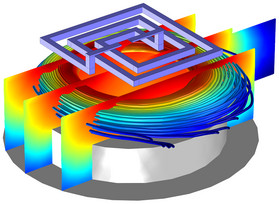
The COMSOL® software includes capabilities for 3D plasma modeling. In this example, a square coil is placed on top of a dielectric window and is electrically excited at 13.56 MHz. A plasma is formed in the chamber beneath the dielectric window, which contains argon gas at low ... Per saperne di più
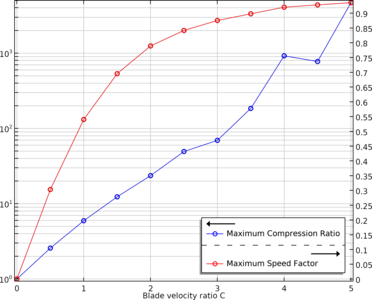
The Free Molecular Flow interface, available in the Molecular Flow Module, is an efficient tool for modeling extremely rarefied gases when the gas molecules move much faster than any geometric entities in the domain. For turbomolecular pumps, in which the blades move at speeds comparable ... Per saperne di più
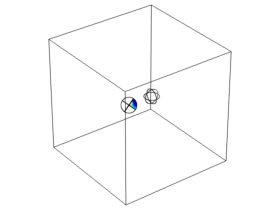
This model verifies that the onset of streamer formation between two spheres separated by atmospheric pressure dry air at a distance of 2cm occurs at 51.8kV. The electrical breakdown is detected by integrating Townsend coefficients along the electric field lines between the two spheres. ... Per saperne di più
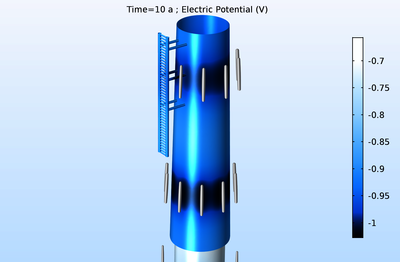
A monopile foundation is a large-diameter structural element that can be used to support structures like offshore wind turbines. This application exemplifies how the cathodic protection of a monopile decreases over time as the sacrificial anodes dissolve. The model can be used to ... Per saperne di più
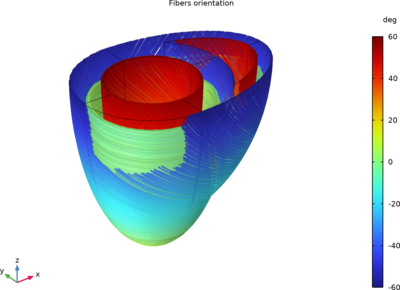
The standard biventricular cardiac model is used to show how to set up fiber directions in a complex geometry. The fibers are then used to model the large deformation of the myocardium with the Holzapfel-Gasser-Ogden anisotropic material model. The Aliev-Panfilov equations are included ... Per saperne di più

Piezoelectric microblowers are compact, lightweight air pumps with varying applications including electronics cooling and airflow related medical devices. The device consists of a PZT-brass diaphragm and a specially designed housing including a pumping chamber, air inlet and outlet ... Per saperne di più


