
La Galleria delle Applicazioni raccoglie un'ampia varietà di tutorial e di app dimostrative realizzati con COMSOL Multiphysics in diversi ambiti applicativi, inclusi quelli elettrico, meccanico, fluidico e chimico. E' possibile scaricare i file dei modelli e delle app demo pronti all'uso e le istruzioni step-by-step per costruirli, e utilizzarli come punto di partenza per le proprie simulazioni.
Lo strumento di Ricerca Rapida permette di trovare i modelli che si riferiscono alla propria area di interesse.
Si noti che molti degli esempi qui presentati sono accessibili anche tramite le Librerie delle Applicazioni incorporate nel software COMSOL Multiphysics® e disponibili dal menu File.
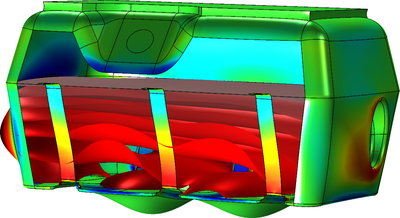
This model analyzes the frequency response of a fuel tank partially filled with fluid. The tank is submitted to a vertical acceleration. Two modeling methods are considered to represent the fluid: a traditional method of smearing the mass of the fluid through the wetted surface of the ... Per saperne di più
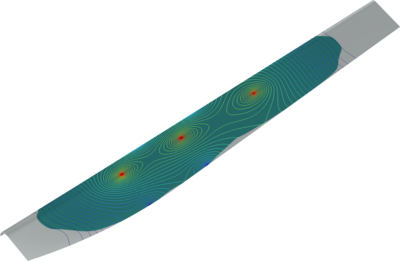
This example shows the modeling of a resin transfer molding (RTM) process for a wind turbine blade using the Two-Phase Flow, Level Set, Brinkman Equations interface. Resin is injected into a preform consisting of different composites with different anisotropic permeabilities. Per saperne di più
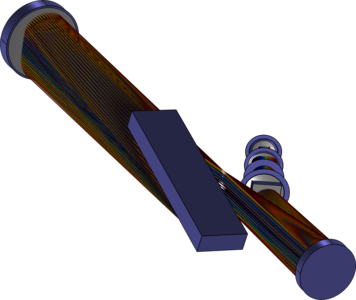
Échelle spectrographs are commonly used in astronomy for high-resolution analyses of stellar atmospheres and for precision Doppler velocimetry. This tutorial simulates a "white pupil" form of this instrument. It makes use of several parts from the COMSOL Part Library and demonstrates the ... Per saperne di più
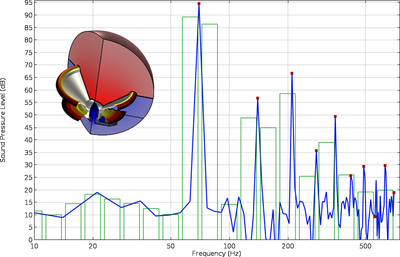
In this model, a full transient analysis of a loudspeaker driver is performed, which allow the modeling of nonlinear effects. It extends the linear frequency domain analysis done in the Loudspeaker Driver tutorial model. The analysis accounts for nonlinear behavior of the soft iron in ... Per saperne di più
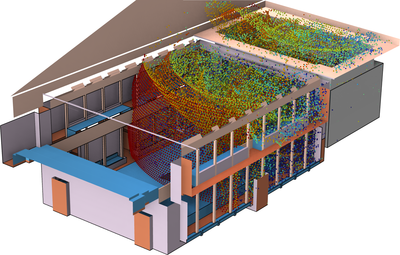
In this model, the acoustics of the Small Hall in the Konzerthaus Berlin is simulated with ray tracing. A full study of the room is performed in 1/3-octave bands with 10 pairs of source-receiver positions. The room acoustic parameters are derived from the calculated impulse responses, ... Per saperne di più
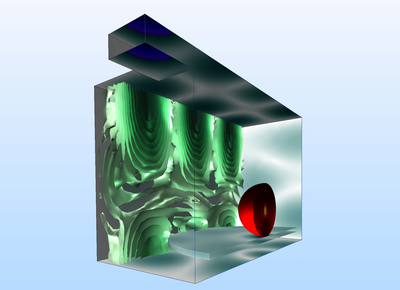
This is a model of the heating process in a microwave oven. The distributed heat source is computed in a stationary, frequency-domain electromagnetic analysis. This is followed by a transient heat transfer simulation showing how the heat redistributes in the food. Per saperne di più

This model demonstrates the simulation of the scattering of a plane wave of light by a gold nanosphere. The scattering is computed for the optical frequency range over which gold can be modeled as a material with negative complex-valued permittivity. The far-field pattern and losses are ... Per saperne di più
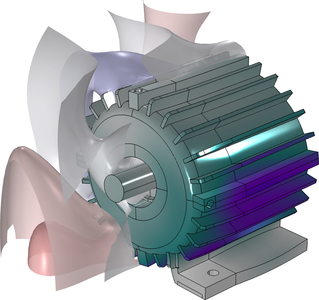
This model analyses the noise generated by an electric motor during its operation at different speeds of rotation. The type of electric motor analyzed, a permanent magnet synchronous motor (PMSM) uses permanent magnets in the rotor and a variable frequency current traveling through the ... Per saperne di più


