
La Galleria delle Applicazioni raccoglie un'ampia varietà di tutorial e di app dimostrative realizzati con COMSOL Multiphysics in diversi ambiti applicativi, inclusi quelli elettrico, meccanico, fluidico e chimico. E' possibile scaricare i file dei modelli e delle app demo pronti all'uso e le istruzioni step-by-step per costruirli, e utilizzarli come punto di partenza per le proprie simulazioni.
Lo strumento di Ricerca Rapida permette di trovare i modelli che si riferiscono alla propria area di interesse.
Si noti che molti degli esempi qui presentati sono accessibili anche tramite le Librerie delle Applicazioni incorporate nel software COMSOL Multiphysics® e disponibili dal menu File.
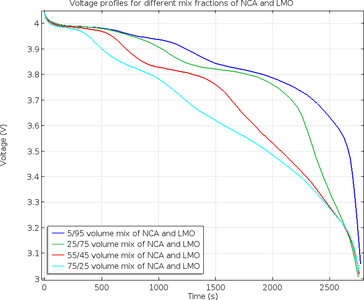
Lithium-ion batteries can have multiple active materials in both the positive and negative electrodes. For example, the positive electrode can have a mix of active materials. These materials can have different design properties (volume fraction, particle size), thermodynamic properties ... Per saperne di più

The electrodes of a lithium-ion battery are porous, consisting of an active solid material, a binder, and pores filled with liquid electrolyte. If a force is applied on the porous layers of a battery, this will affect the volume fraction of the electrolyte-filled pores in the electrodes, ... Per saperne di più
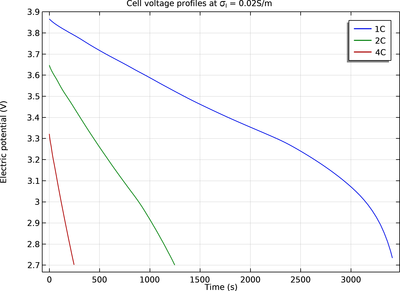
This example demonstrates the Lithium-Ion Battery, Single-Ion Conductor interface for studying the discharge of a lithium-ion battery with solid electrolyte. The geometry is in one dimension and the model is isothermal. The behavior at various discharge currents and solid electrolyte ... Per saperne di più

Side reactions and degradation processes may lead to a number of undesirable effects, causing capacity loss in lithium-ion batteries. Typically, aging occurs due to multiple complex phenomena and reactions that occur simultaneously at different places in the battery, and the degradation ... Per saperne di più
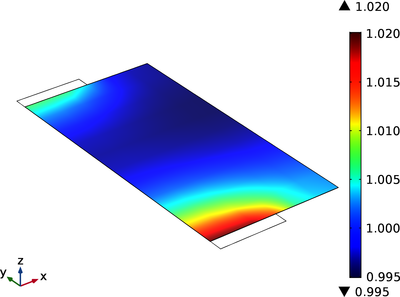
Large lithium-ion batteries are widely deployed in electric vehicles and for stationary energy storage applications. In the (stacked) pouch battery cell design, all current exits the cell on the cell "tabs", and as the cell size and power increase, the voltage gradients in the highly ... Per saperne di più

How the open-circuit voltage (OCV) of a lithium-ion battery varies with the state of charge is governed by various physical properties such as the thermodynamics of the electrode reactions, the relative capacities of the electrode materials, and the amount of cyclable lithium, but also ... Per saperne di più
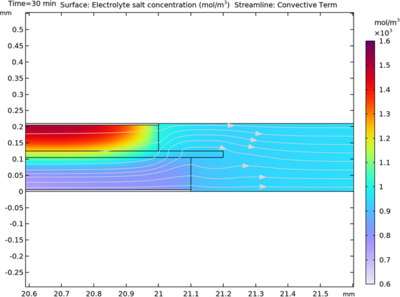
The electrodes of a lithium-ion battery are porous and consist of an active solid electrode material, a binder, and pores filled with a liquid electrolyte. Expansion of the active material due to lithium intercalation changes the volume fraction of electrolyte-filled pores in the ... Per saperne di più

This model illustrates the charge/discharge control of a Lithium-Ion battery in a Simulink® simulation. Per saperne di più


