
La Galleria delle Applicazioni raccoglie un'ampia varietà di tutorial e di app dimostrative realizzati con COMSOL Multiphysics in diversi ambiti applicativi, inclusi quelli elettrico, meccanico, fluidico e chimico. E' possibile scaricare i file dei modelli e delle app demo pronti all'uso e le istruzioni step-by-step per costruirli, e utilizzarli come punto di partenza per le proprie simulazioni.
Lo strumento di Ricerca Rapida permette di trovare i modelli che si riferiscono alla propria area di interesse.
Si noti che molti degli esempi qui presentati sono accessibili anche tramite le Librerie delle Applicazioni incorporate nel software COMSOL Multiphysics® e disponibili dal menu File.

This model simulates a simple three-dimensional axisymmetric Helmholtz resonator, a classic acoustics model of a resonating circuit with a known theoretical solution. The idealized version considered here consists of a tube and a closed volume in series which are exposed to a pulsatile ... Per saperne di più
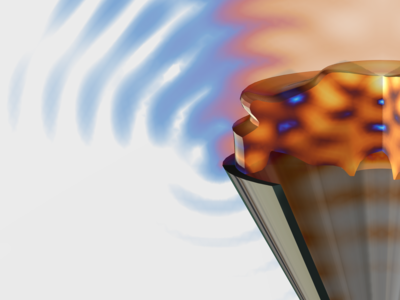
Manual design optimization typically requires numerous sweeps over a parameterized geometry, but it does not guarantee optimal performance under given conditions. Shape optimization removes the need for explicit parameterization and can achieve comparable or even better performance in a ... Per saperne di più
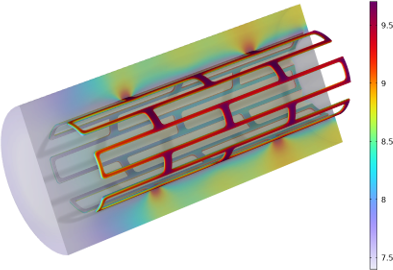
Biodegradable metallic biomaterials such as Magnesium (Mg) are gathering attention for biomedical applications due to their favorable properties. The present model simulates dissolution of a Mg stent in a blood vessel. Due to the circumferential symmetry, only one-twelfth of the actual ... Per saperne di più
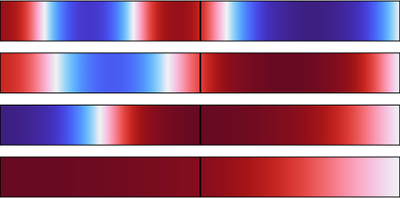
This tutorial demonstrates how to model the interaction between an acoustic field and the heat release from a flame, using the Flame Model domain feature. Modeling this interaction is important in order to understand and predict unstable acoustic modes in gas turbines and jet engines. ... Per saperne di più
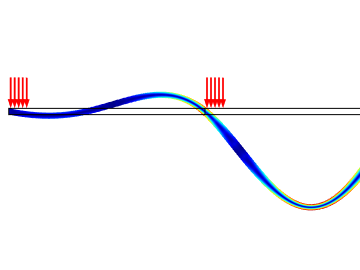
This example shows how to model a load which varies in space and time. A series of load pulses travel along a beam which is supported at equal distances. For some combinations of the traveling speed of the load pulses and the spacing between them, it is possible to excite resonances in ... Per saperne di più
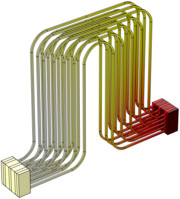
This model simulates a temperature profile in a number of cells and cooling fins in a liquid-cooled battery pack. The model solves in 3D and for an operational point during a load cycle. A full 1D electrochemical model for the lithium battery calculates the average heat source. Per saperne di più
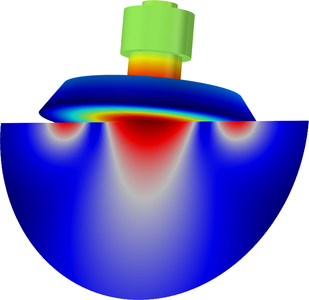
A tonpilz transducer is used for relatively low frequency, high power sound emission. It is one of the popular transducer configurations for SONAR applications. The transducer consists of piezoceramic rings stacked between a head mass and a tail mass which are connected by a central ... Per saperne di più
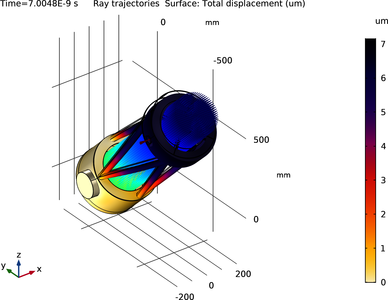
This tutorial demonstrates a structural analysis of a simple telescope. The deformation of the telescope structure under gravity is examined and the effect on image quality is demonstrated. Per saperne di più
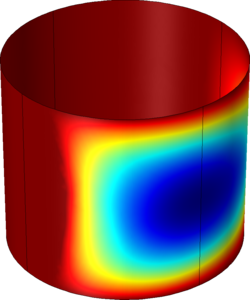
A journal bearing is composed of an outer cylinder (bearing) wrapped around an inner rotating journal (shaft), with a lubricant separating the two. Under certain operating conditions, cavitation can occur between the bearing and the journal, leading to component damage and failure. ... Per saperne di più

Journal bearings are used to carry radial loads, for example, to support a rotating shaft. A simple journal bearing consists of two rigid cylinders. The outer cylinder (bearing) wraps the inner rotating journal (shaft). The new thin-film flow user interfaces of the CFD Module enables ... Per saperne di più


