
La Galleria delle Applicazioni raccoglie un'ampia varietà di tutorial e di app dimostrative realizzati con COMSOL Multiphysics in diversi ambiti applicativi, inclusi quelli elettrico, meccanico, fluidico e chimico. E' possibile scaricare i file dei modelli e delle app demo pronti all'uso e le istruzioni step-by-step per costruirli, e utilizzarli come punto di partenza per le proprie simulazioni.
Lo strumento di Ricerca Rapida permette di trovare i modelli che si riferiscono alla propria area di interesse.
Si noti che molti degli esempi qui presentati sono accessibili anche tramite le Librerie delle Applicazioni incorporate nel software COMSOL Multiphysics® e disponibili dal menu File.

This example shows how to image the interior permittivity of a box by applying a potential difference on the boundaries of the box. The result is a surface charge density that depends on the permittivity of the medium inside the box. Read about this tutorial model in our blog post "The ... Per saperne di più
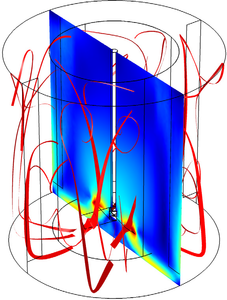
This tutorial example simulates the flow in a flat bottom mixer containing, agitated by a pitched four blade impeller, where the fluid is water, and flow is assumed to be turbulent. The flow in the mixer is modeled using the k-ε turbulence model, and a time-dependent simulation ... Per saperne di più

In his example, the lowest natural frequency of a 3D bracket are maximized using shape optimization. Per saperne di più
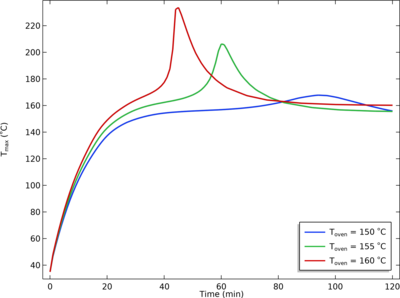
This example simulates the temperature dynamics in cylindrical battery, initially at room temperature, after being placed in an oven. As the temperature increases, various exothermal decomposition reactions are activated, which in turn result in further heating of the battery. Per saperne di più
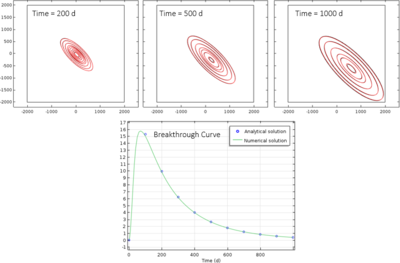
Predicting the transport of solutes that move with subsurface fluids is of general interest in environmental engineering and geosciences. Solutes may not only be pollutants but also artifical tracers added to the groundwater for investigation purposes. This model tracks a solute over ... Per saperne di più

A benchmark model where a thick plate exposed to pressure on the top surface is analyzed. The solution is compared with a NAFEMS benchmark solution. Per saperne di più
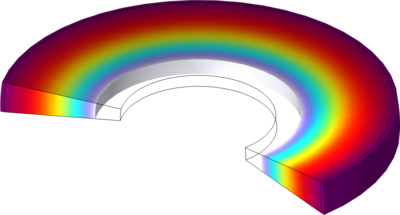
Creep is an inelastic time-dependent deformation which occurs when a material is subjected to stress at sufficiently high temperature, say 40% of the melting point or more. Experimental creep data (using constant stress and temperature) often display three different types of behavior ... Per saperne di più

Striking a drum excites a spectrum of vibration modes that together make up the instrument’s characteristic sound or acoustic signal. These vibration modes correspond to the eigenmodes, or eigenfunctions, of the drum’s membrane. Thus you can study this problem by solving eigenvalue ... Per saperne di più

Follow this tutorial series to learn about how to work with imported surface meshes. The instructions detail how to import STL files of three vertebrae and two intervertebral discs as well as how to repair holes, misaligned mesh vertices, and intersecting elements. It further ... Per saperne di più
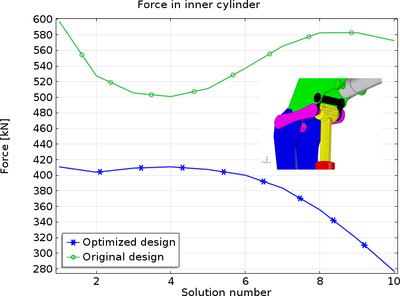
In complex mechanical systems, it can be challenging to find an optimal (or even good enough) solution only through engineering insight or trial-and-error procedures. Using mathematical optimization methods can then be an efficient path to a better design. In this example, a link ... Per saperne di più


