
La Galleria delle Applicazioni raccoglie un'ampia varietà di tutorial e di app dimostrative realizzati con COMSOL Multiphysics in diversi ambiti applicativi, inclusi quelli elettrico, meccanico, fluidico e chimico. E' possibile scaricare i file dei modelli e delle app demo pronti all'uso e le istruzioni step-by-step per costruirli, e utilizzarli come punto di partenza per le proprie simulazioni.
Lo strumento di Ricerca Rapida permette di trovare i modelli che si riferiscono alla propria area di interesse.
Si noti che molti degli esempi qui presentati sono accessibili anche tramite le Librerie delle Applicazioni incorporate nel software COMSOL Multiphysics® e disponibili dal menu File.
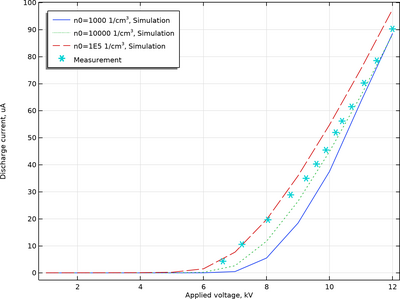
This model analyzes negative corona formation in a point-to-plane configuration driven by high applied voltages. The resulting I–V characteristics align well with experimental observations documented in the literature. The goal here is to capture the steady electrical characteristics ... Per saperne di più
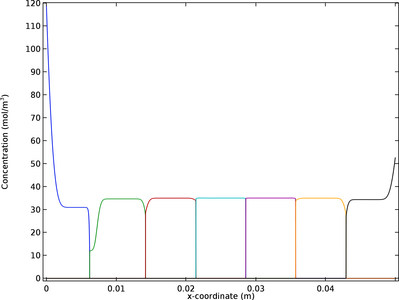
This model demonstrates isoelectric focusing (IEF) of seven ampholytes in a column. The model is in 1D and is solved in a time-dependent simulation. Per saperne di più
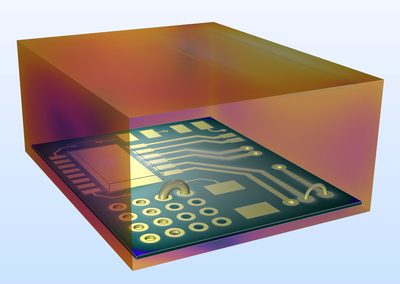
This model example shows how to simulate basic electromagnetic interference (EMI) and electromagnetic compatibility (EMC) behavior in a printed circuit board (PCB). The model contains two analyses to evaluate radiated emissions from PCB traces, crosstalk between adjacent microstrip ... Per saperne di più

This model analyzes an RF MEMS switch consisting of a thin micromechanical bridge suspended over a dielectric layer. A DC voltage greater than the pull-in voltage is applied across the switch, causing the bridge to collapse onto the dielectric layer with a resulting increase in the ... Per saperne di più
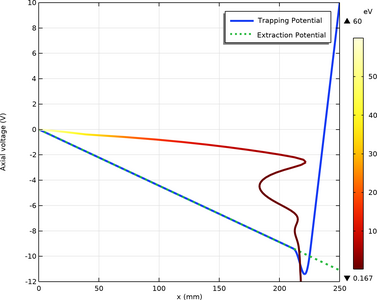
A radio frequency quadrupole ion trap utilizes a radio frequency quadrupole (RFQ) in order to trap an ion beam. A continuous high energy ion beam is first cooled and converted into a spatially confined bunch, which can then be released with minimal heating of the beam. The device is also ... Per saperne di più
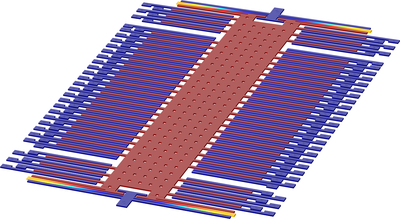
This model shows how to simulate a capacitively actuated surface micromachined accelerometer using the Electromechanics, Solid interface. It is based on a case study from the book Microsystem Design by Stephen D. Senturia (Kluwer Academic Publishers, 5th Edition, 2003, pages 513–525). Per saperne di più
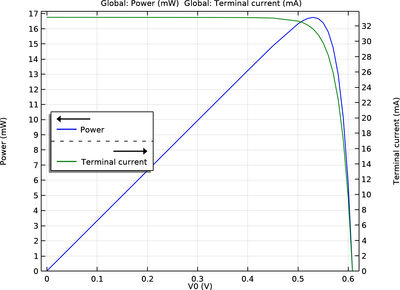
This tutorial uses a simple 1D model of a silicon solar cell to illustrate the basic steps to set up and perform a device physics simulation with the Semiconductor Module. A user-defined expression is used for the photo-generation rate and the result shows typical I–V and P–V curves of ... Per saperne di più
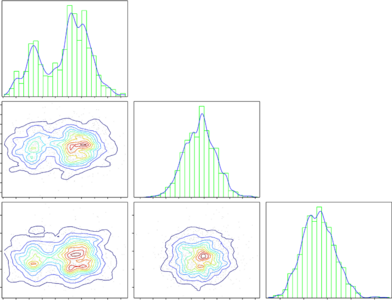
This example demonstrates how to apply inverse uncertainty quantification (IUQ) using the Uncertainty Quantification (UQ) Module in COMSOL Multiphysics to calibrate uncertain material properties of a resistor based on measurement data. When experimental data such as resistance values are ... Per saperne di più
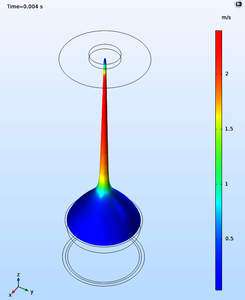
This model deals with electrohydrodynamics (EHD), where a charge separation on the phase boundary between a liquid and air involves the formation of a charged layer. This charged layer allows for a net force to be induced at the interphase when a large electric field is applied. The ... Per saperne di più
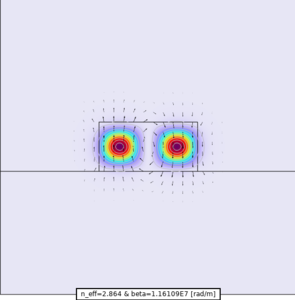
Mode analysis is a basic tool for a wide range of radio frequency and wave optics calculations because it allows for the investigation of mode characteristics in complex waveguide structures. In this tutorial model, you can find two examples that demonstrate typical settings and best ... Per saperne di più


